

Scientist? Artist? Engineer? Theo Jansen, TU Delft alumnus and creator of generations of extraordinary beach beasts rejects any kind of label: “The line between art and engineering exists only in our minds.”
Share
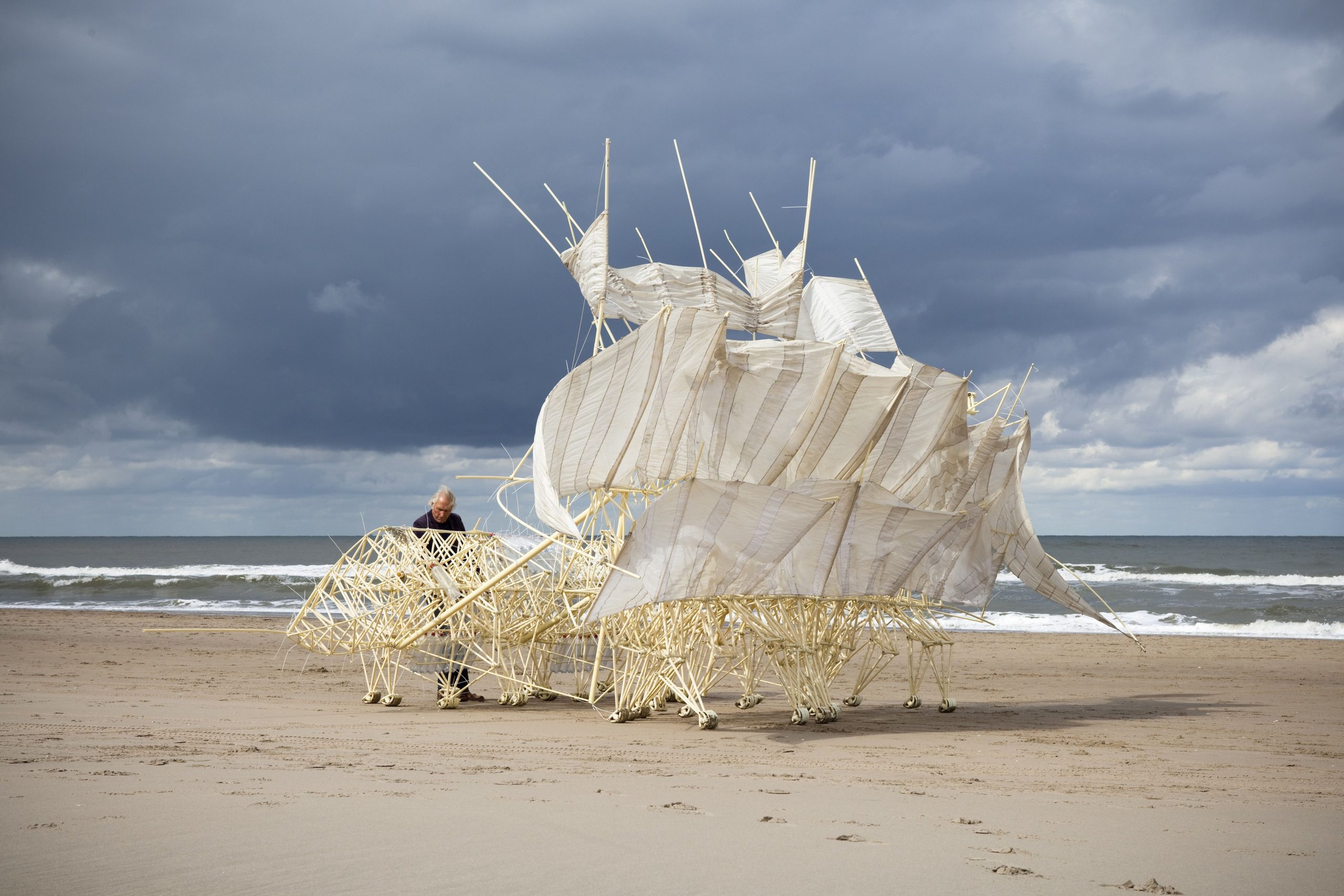
Jansen has spent the past 25 years making new forms of life – enormous, animated constructions that stride over the beaches of the Netherlands powered only by the wind. Called strandbeesten in Dutch, these ‘beach beasts’ are made almost entirely from the pale yellow plastic tubes used in buildings in the Netherlands to house electrical cables. And the beasts are impressively large, up to 12 metres long and four metres tall. “They need to be big otherwise they blow away on the beach”, explained Jansen.
Shoring up the sand dunes
Originally driven by the idea of creating a life-form that would reinforce low-lying Dutch coastlines against tidal erosion, Jansen has since become more focussed on the evolution of his animals, as he calls them. “But I’m not trying to copy existing creatures”, he said, “I want to make a new kind of nature.” Since 1990, Jansen, a former writer for TU Delta, has created some 40 species of these huge mechanical creatures, which have evolved over the generations; some have sported propellers, others had sails, and one even a hammer for anchoring itself to the beach on windy days. “Every generation has something new”, said Jansen, “an experimentation or a mutation.”
Secret ratios
Perhaps the most extraordinary characteristic of these beach beasts is their remarkably organic mode of locomotion, which in some ways resembles the scuttling of a gigantic many-legged spider. But this complex walking mechanism was devised entirely by Jansen back in the early 1990s. Using an ancient Atari computer, he designed a genetic algorithm that would come up with the optimal ratio of lengths of different parts of the leg, giving the most efficient and, as it turns out, the most beautifully natural movement. “This is the core of my work”, said Jansen. “The secret to these animals is the relative proportions of 13 lengths of tube.”
Reproduction
Having perfected the ratios that drive the leg system, Jansen later published these numbers on the internet so that now, hundreds of students all over the world are creating their own beach beasts. “In a sense,” said Jansen, “you could say that the beasts are using students for their own reproduction.”
Meanwhile, as some of Jansen’s beautiful creations make their way to their next exhibition in Boston, visitors to the Netherlands can watch Jansen and his other strandbeesten in action on the beaches of Scheveningen in July and August 2015.



Comments are closed.