

Een graafmachine schampte maandagochtend tegen half twaalf een stroomkabel op het kruispunt van Michiel de Ruyterweg en Zuidplantsoen.
Kortsluiting
Spontaan vlamde een steekvlam op uit de geul, die echter snel doofde nadat de spanning van de kabel was.
In veel TU-gebouwen viel hierdoor gedurende enkele minuten de stroom uit.
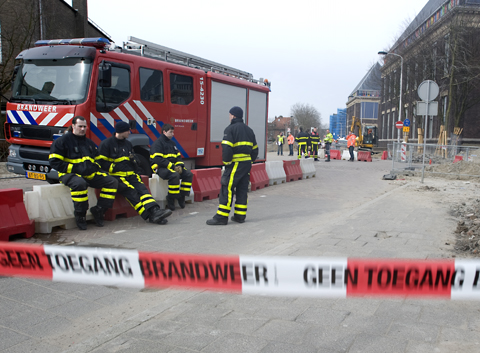
Brandweer en politie waren snel ter plekke. Te blussen was er niet veel omdat de vlam uit zichzelf was gedoofd.
Toch bleven de hulpdiensten ter plaatse in afwachting van een reparatieploeg. De brandweerlieden dachten dat de reparatie van de beendikke kabel wel een dag zou kunnen duren.
In some coastal areas and islands with shortages of fresh drinking water, but enough seawater and wind power, the combination of wind energy and reverse osmosis may provide a sustainable way to produce drinking water.
On 15 November 2007, the universities of Delft and the Netherlands Antilles agreed to cooperate in a project whose common goal was to set up a high-quality knowledge infrastructure in water-system management for the Dutch Antilles, Aruba and Suriname. ‘Drinking with the wind’ is the first project executed in the framework of this agreement.
In February 2008, the first prototype of a ‘water windmill, designed at TU Delft’s Faculty of Civil Engineering’s water management department, was constructed in Delft as part of the MSc degree thesis project of Evgenia Rabinovitch. After pre-testing, the windmill was dismantled and shipped to Curacao to continue the hydraulic and mechanical testing and to research the reverse osmosis process, as well as the water quality and quantity produced, on location.
Reverse Osmosis
Reverse Osmosis is a pressure difference separation technique that is by far the most energy efficient technology for desalinating seawater. It uses the natural osmosis process that occurs when two solutions of different salt concentration are placed at either side of a semi-permeable membrane. At equal pressure and temperature, the water will flow through the membrane from the less concentrated solution to the one with a larger concentration, and will dilute it until the concentrations are equal. When a high-pressure pump is used to apply a pressure greater than the osmotic pressure, the flow goes in the opposite direction, flowing from the more concentrated side to the more diluted solution. This process is called Reverse Osmosis.
After Rabinovitch conducted one year of hydraulic and mechanical testing at the civil engineering faculty lab and on location in Curacao, the windmill was adapted and optimized for use under local conditions. This is how the most recent version of the windmill works (see image):
- To start the process salt water is pumped to a buffer tank at the top of the windmill, to maintain a constant head for the high-pressure pump.
- The pump consists of the high-pressure pump and the energy recovery unit. The pump produces the 60 bar pressure, which is needed for the reversed osmosis process. There is no electricity involved because of the connection between the axis of the windmill and the axis of the pump.
- The reverse osmosis takes place in pressure barrels, which contain the RO membranes through which the salty water is pushed. The fresh water goes to the second buffer tank at the top of the windmill.
- Fresh flush: when there is no wind, the pump stops and the pressure drops. This causes a natural osmosis process from the fresh water to the feed side of the membrane. The fresh flush is needed to prevent this.
- After the reverse osmosis process, a concentrate flows out of the system, still under high pressure. The high pressure is used in the energy recovery part of the pump.
- When the second buffer tank is filled, safe drinking water can be tapped off. The installation can produce between 5 and 10 m3 of fresh water per day.
- The energy recovery part of the pump functions like a reverse pump. The high pressure of the concentrate is used to drive the high-pressure pump. This significantly raises the efficiency of the pump.
Wanted: Team for Somaliland
In 2008, a team of students worked on a prototype ‘water windmill’ that directly drives a reversed osmosis process in Somaliland. The design of this windmill needs to be revised and adapted to local conditions. A new student team is therefore being assembled to build the new windmill in Somaliland.
Are you enthusiastic about this project. Would you be interested in joining the team or receiving more information? Please send an email to
Sjoerd Dijkstra at dijkstrahs@gmail.com or Miranda Pieron at miranda@students4sustainability.nl.
 Kortsluiting
Kortsluiting
Kortsluiting
Spontaan vlamde een steekvlam op uit de geul, die echter snel doofde nadat de spanning van de kabel was.
In veel TU-gebouwen viel hierdoor gedurende enkele minuten de stroom uit.
Brandweer en politie waren snel ter plekke. Te blussen was er niet veel omdat de vlam uit zichzelf was gedoofd.
Toch bleven de hulpdiensten ter plaatse in afwachting van een reparatieploeg. De brandweerlieden dachten dat de reparatie van de beendikke kabel wel een dag zou kunnen duren.
Het cvb heeft laten weten dat om zes uur ’s avonds de stroom wederom onderbroken zal worden voor de reparatie van de hoogspanningskabel. Medewerkers wordt aangeraden voor die tijd hun werkplek te verlaten. De Michiel de Ruyterweg blijft in verband met de werkzaamheden gesloten.

Heb je een vraag of opmerking over dit artikel?
delta@tudelft.nl


Comments are closed.