

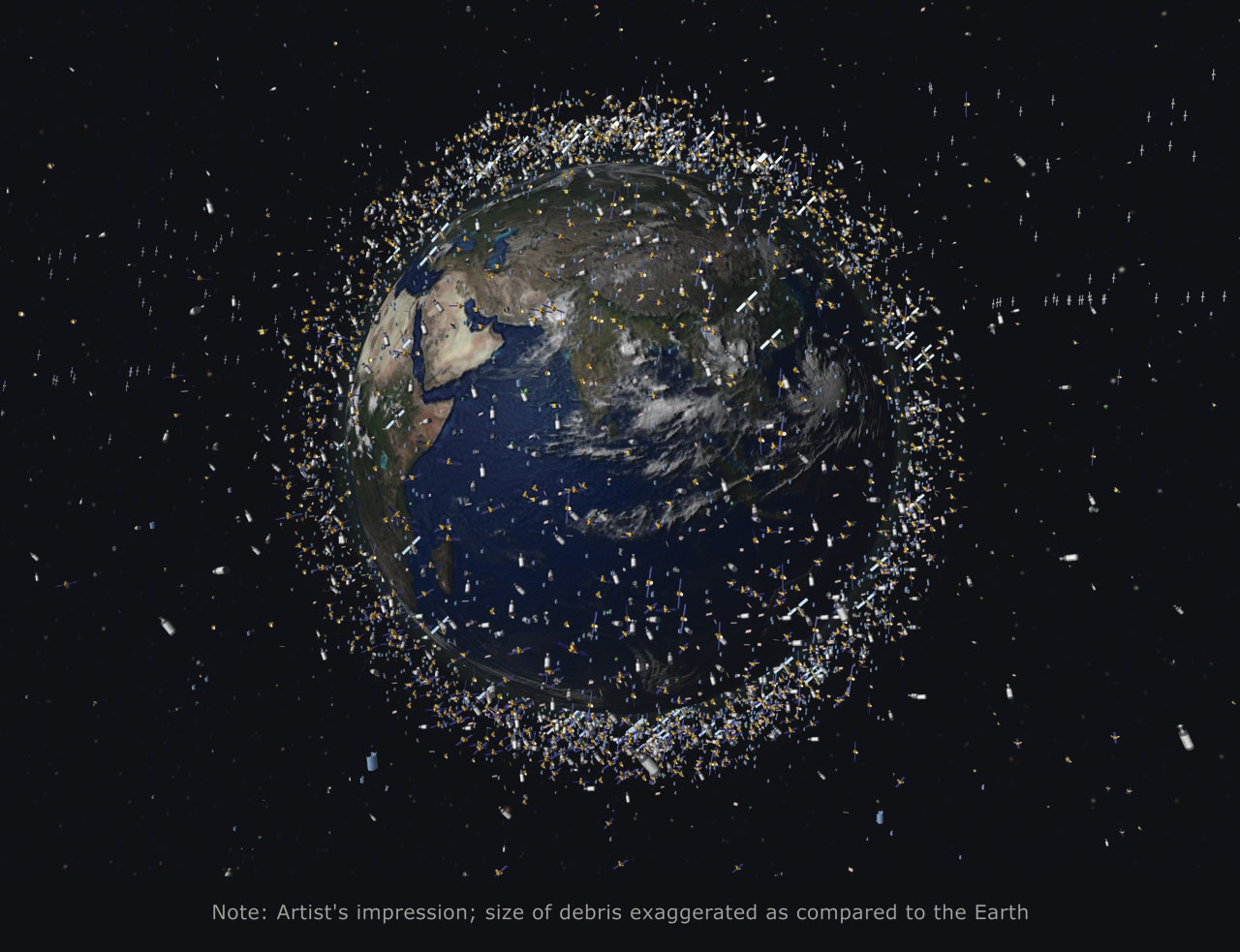
Space travel is highly jeopardized by debris orbiting the world, space debris expert Ron Noomen believes. China launched its first space lab module last week, underscoring its aspiration to become a major space power in the decades to come. But will space travel remain possible in the years to come?
Share
There are approximately 19,000 objects larger than 10 centimetres orbiting the earth. Rather, ironically, thousands of these threatening pieces of scrap are the result of China’s destruction of a weather satellite in 2007, which was also a display of power.
Most the debris however is the result of old, exploding upper launch vehicle stages with stored energy sources left in orbit, or collisions in space, such as the collision in 2009 of an operational American and a defunct Russian communication satellite.
Ron Noomen (AE faculty) foresees a grim future: “If no measures are taken, space travel could be over before the end of the century.” Noomen adds that, according to some researchers, we now have breached a critical threshold, meaning that the natural decay of trash that falls back to Earth due to atmospheric drag can no longer keep pace with the new build up.
Not launching satellites for a while will not change the situation. Debris will keep accumulating due to collisions and exploding launch vehicles that are already in orbit. Eventually, a chain reaction can occur in which colliding rubble leads to an exponentially growing amount of debris.
There are many ideas on how to clean the mess. Last year, researchers who participated in the Master’s program, SpaceTech (AE faculty), suggested sending out satellites that can attach little ion thrusters to the potentially dangerous upper launch vehicle stages, so that they can be redirected into the atmosphere.
And at Noomen’s request a group of BSc students investigated the possibility of decelerating debris with lasers. By vaporizing a part of the surface of a piece of litter, little plasma plumes are created causing it to decelerate and subsequently burn in the atmosphere.
“This idea was first proposed by the US Air Force, and so a lot of information was classified,” Noomen says. “According to the students, the technology is problematic because, if not aimed precisely enough, the laser would accelerate other debris at the same time.”
Although people around the world have been hatching ideas like these for decades, Noomen says no serious attempts have been made to solve the problem. “Cleaning up the mess is costly,” he says. “And nobody wants to pay for someone else’s mess.”



Comments are closed.