
On the eve of the new academic year, the FNV, AOb and CNV trade unions recommend 10 steps to improve social safety at TU Delft. Following up on the Inspectorate of Education’s assessment last year, they conclude that the system is still ‘structurally failing’. “TU Delft must take action now.”
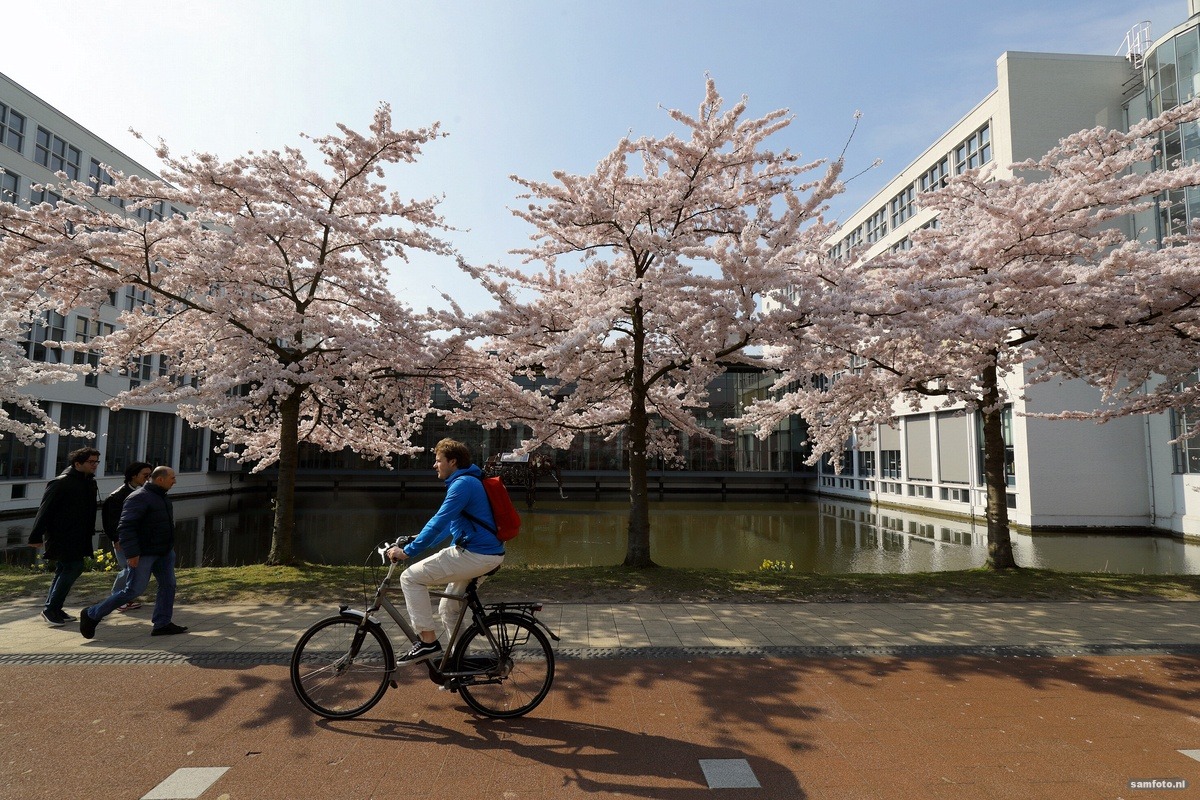
(Photo: Sam Rentmeester)
Strengthen the role of the ombudsperson, make the training of all supervisors on social safety mandatory, and make the organisation more democratic are just three of the 10 recommendations made to TU Delft by the FNV, AOb and CNV trade unions.
They are included in a research report entitled Social Safety and Leadership at TU Delft that the unions issued on Thursday. The report is based on a questionnaire among staff members. FNV, AOb and CNV presented their initial findings to the Executive Board in May. The report is now finalised and includes the 10 recommendations and a breakdown according to specific parts of the organisation.
Codes of Conduct
The recommendations are wide-ranging and are explained in the report (in Dutch). In short, the other seven are the following.
- Include social safety in the Risk Assessment & Evaluation (RI&E).
- Make social safety a permanent part of staff performance and performance evaluation, especially for supervisors.
- Make the Confidential Advisors, points of contact, and Ombudspersons better known.
- Make sure that HR is also there for the interests of staff members, and not only to support the hierarchy.
- Make training for people who observe incidents available for all staff members.
- Design codes of conduct for the shop floor that gain support.
- Train HR, supervisor and confidential advisors on suicide prevention.
The last recommendation is drawn directly from the questionnaire answers. Of the staff members who experienced transgressive behaviour, at least 8% said that they had thought about suicide.
Are you thinking about suicide? Then phone 113 Suicide Prevention.
The other findings of the questionnaire are telling too: 43% of the respondents experienced one or more types of transgressive behaviour last year, 83% of whom did not feel that the organisation supported them.
It also appeared that trust in the management was low: 55% trust the leadership of their own supervisors, 33% in the management of their own faculty or service, and 9% in that of the Executive Board. The respondents are also critical of the social safety policy.
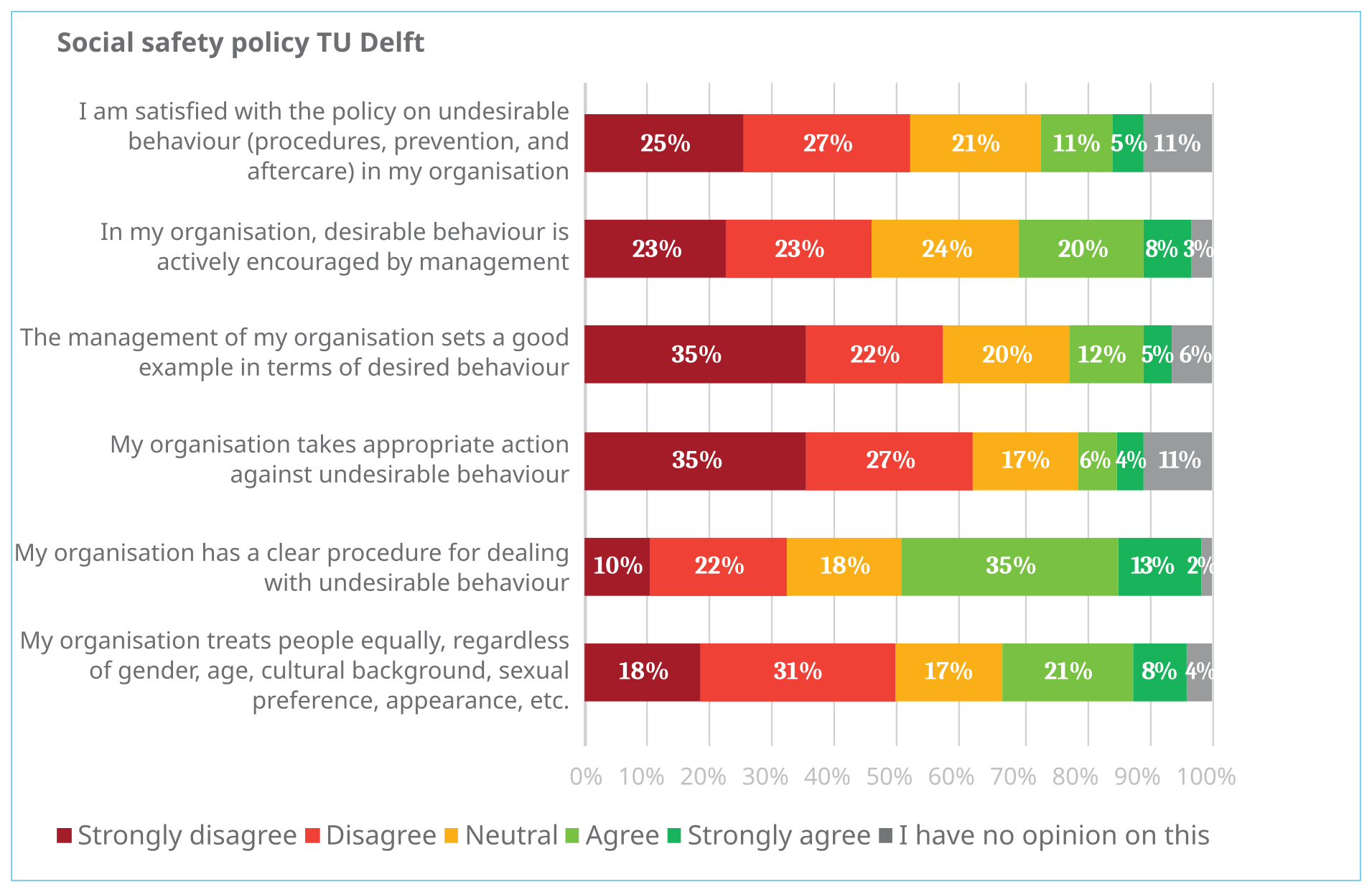
Source: Social Safety and Leadership at TU Delft investigative report
Executive Board response
TU Delft is already working on some of the recommendations. Training is now given to supervisors, although this is not mandatory. TU Delft is also working on a new Code of Conduct and staff members are able to contribute to it.
In a response, the Executive Board also points to other initiatives such as the Mindlab theatre performance, the Executive Board drop-in sessions, the point of contact, and the updating of the Regulations for Complaints about Undesirable Behaviour.
The Executive Board states that it takes the findings of the report seriously.’Every single feeling of the lack the safety is serious. This is certainly the case for the answers of the respondents of the unions’ questionnaire who say that they are struggling with suicidal thoughts. This is extremely serious.’
Faculties and the University Services
The unions have now also broken down the figures for the different sections of the organisation. In doing so, they set a minimum of 25 respondents per section of the 530 in total. These are the University Services (US, 156 respondents), and the EEMCS (93), TPM (81), CEG (50), Architecture and the Built Environment (34), ME (33) and AE (25) faculties.
‘Trust can only be restored through strong measures and a change in culture from high to low’
While the numbers are relatively small, the unions present each of these seven parts individually. These are in the annexes of the report. They also compared the seven parts to the TU Delft average in points.
In the table at the beginning of this article, this shows that 52% are dissatisfied with the social safety policy to varying degrees. The University Services stands out positively at 44%, and AE the most negatively at 73%.
Taking action
In a press release, the unions write that things have to change at TU Delft. They believe that, after one-and-a-half years after the publication of the Inspectorate report, things are still not going well. ‘TU Delft must take action now’, writes Gijs Kooistra, administrator of the FNV’s Education and Research unit. ‘Our report shows that the system is structurally failing. Trust can only be restored through strong measures and a change in culture from high to low.’
The other findings of the questionnaire are telling too: 43% of the respondents experienced one or more types of transgressive behaviour last year, 83% of whom did not feel that the organisation supported them.
It also appeared that trust in the management was low: 55% trust the leadership of their own supervisors, 33% in the management of their own faculty or service, and 9% in that of the Executive Board. The respondents are also critical of the social safety policy.

(Source: Social Safety and Leadership at TU Delft investigative report)
Executive Board response
TU Delft is already working on some of the recommendations. Training is now given to supervisors, although this is not mandatory. TU Delft is also working on a new Code of Conduct and staff members are able to contribute to it.
In a response, the Executive Board also points to other initiatives such as the Mindlab theatre performance, the Executive Board drop-in sessions, the point of contact, and the updating of the Regulations for Complaints about Undesirable Behaviour.
The Executive Board states that it takes the findings of the report seriously.’Every single feeling of the lack the safety is serious. This is certainly the case for the answers of the respondents of the unions’ questionnaire who say that they are struggling with suicidal thoughts. This is extremely serious.’
Faculties and the University Services
The unions have now also broken down the figures for the different sections of the organisation. In doing so, they set a minimum of 25 respondents per section of the 530 in total. These are the University Services (US, 156 respondents), and the EEMCS (93), TPM (81), CEG (50), Architecture and the Built Environment (34), ME (33) and AE (25) faculties.
‘Trust can only be restored through strong measures and a change in culture from high to low’
While the numbers are relatively small, the unions present each of these seven parts individually. These are in the annexes of the report. They also compared the seven parts to the TU Delft average in points.
In the table at the beginning of this article, this shows that 52% are dissatisfied with the social safety policy to varying degrees. The University Services stands out positively at 44%, and AE the most negatively at 73%.
Taking action
In a press release, the unions write that things have to change at TU Delft. They believe that, after one-and-a-half years after the publication of the Inspectorate report, things are still not going well. ‘TU Delft must take action now’, writes Gijs Kooistra, administrator of the FNV’s Education and Research unit. ‘Our report shows that the system is structurally failing. Trust can only be restored through strong measures and a change in culture from high to low.’
What did the Inspectorate of Education say about TU Delft again?
The Inspectorate of Education investigated transgressive behaviour at TU Delft from December 2022 to November 2023. In the resulting report, the investigators speak of intimidation, racism, sexism, bullying, exclusion, gossiping, social insecurity due to lack of leadership and a culture of fear, among other things. For instance, employees are said to be afraid to voice their opinions and hold each other accountable for behaviour.
The effects among TU Delft employees who have reported to the inspection are often long-lasting and hampering. The inspectorate speaks of psychological and physical health complaints, absence from work and a general feeling of insecurity. Stress, burnout, depression and PTSD, crying and tense home situations also occur, as do illness, vomiting at work, panic attacks and heart palpitations.
The inspectorate reports that TU Delft’s university administration has a lot of information regarding what is happening in terms of social safety, but that they ‘omit to add everything up so as to create a complete picture’. ‘The management’ also ‘does not adequately manage in terms of appropriate measures’. The Inspectorate believes that this is mismanagement.
Read the news and background articles on the Inspectorate’s report in our dossier.
Do you have a question or comment about this article?
[email protected]


Comments are closed.