
Make the amount of time used for teaching measurable; monitor PhD candidates better during their doctoral programme; and, reserve enough time for supervision. These are the recommendations of PhD candidates and their representatives in the face of faculties’ austerity plans.
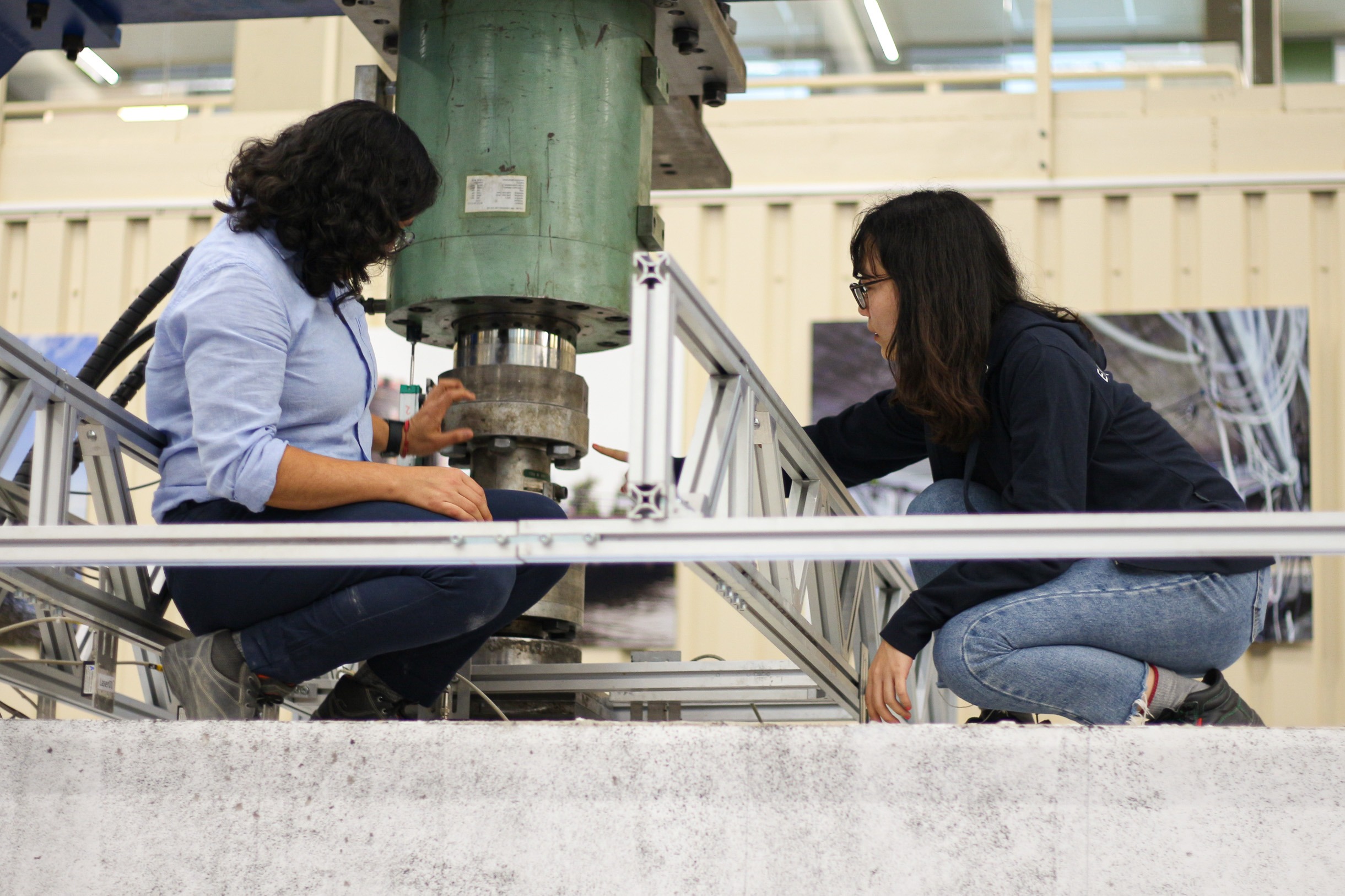
Researchers in the Macrolab at CEG. (Photo: Justyna Botor)
This article in 1 minute
- Each faculty is taking different austerity measures regarding PhD candidates. These are explained in detail in the previous article that we wrote on this subject.
- Delta asked the University PhD Council (UPC), PhD Network Netherlands (PNN) and PhD candidates for their opinions about the plans.
- UPC and one member of the PhD Council are critical, including about the fact that the Faculty of Mechanical Engineering will not have first funding stream places for PhD candidates anymore. “It limits the freedom of universities to choose the direction of their research themselves.”
- The advocates also believe that the plans clash with each other. Some faculties want PhD candidates to obtain their doctorates faster, while at the same time they are cutting back on things like supervision and research facilities. PNN says that this actually makes it harder to do experiments on time.
- The advocates also give recommendations. A doctoral candidate at the ME Faculty for example suggests monitoring PhD candidates better during their entire doctoral programme.
TU Delft is to spend 10% less than now, without forced dismissals, by 2028. The measures that will be taken will have consequences for the nearly 3,500 PhD candidates at TU Delft. Delta discussed the austerity plans with PhD Network Netherlands (PNN), University PhD Council (UPC), the Mechanical Engineering (ME) PhD Council, and a doctoral candidate that had just completed his Doctoral Programme.
The measures concerning doctoral candidates vary per faculty and can be divided into three main categories:
- They will give more lessons as the number of Student Assistants will drop;
- they have to complete their doctoral programme more quickly; and,
- doctoral dissertation places will disappear over time through natural turnover.
The Mechanical Engineering (127 doctoral dissertation places), Architecture and the Built Environment (12 doctoral dissertation places), Aerospace Engineering (nine doctoral dissertation places) and Electrical Engineering, Mathematics and Computer Science (unknown number of places) Faculties chose to eliminate PhD positions funded by the first funding stream through natural turnover. PhD candidates may finish their research, but there will be no new PhD candidates.
‘The best way to not throw the baby out with the bath water’
Fred van Keulen, ME Dean, had previously said that the 127 doctoral dissertation places that will disappear is ‘the best way to not throw the baby out with the bath water’. His view is that nobody will be fired while money will remain available for labs and technicians.
At some point there will be no more doctoral dissertation places from the first income stream at ME and Architecture and the Built Environment. The share of doctoral dissertation places in the second and third income streams, such as KNAW (Royal Netherlands Academy of Arts and Sciences) subsidies or corporate sector financing, will increase at this faculties.
The University PhD Council, the consultation body by and for PhD candidates at TU Delft, is concerned about this development. UPC Board Member Nic Orchard says that “Instead of completely academic driven research based on intellectual curiosity, we foresee a lot more industry funded research. This will inevitably affect the subjects that we work on – and I consider this problematic. It limits the freedom of universities to choose the direction of their research themselves.”
Scrapping things must create ‘peace and space’
Van Keulen, the ME Dean, thinks that cutting 127 FTEs (full-time equivalents) will create peace and space. The number of PhD candidates at the Faculty increased strongly in a short space of time from 424 in 2020 to 549 in 2025. “It rose so fast that we were worried about accommodation,” says Van Keulen. “Through this step we can revert the number of FTEs back to the previous situation.” Alice Dautézac of the PhD Council at ME says that she hopes that her Faculty grabs that peace and space to organise the facilities. “Because the rapid growth has put too much pressure on the available research facilities and office space.”
Fewer doctoral dissertation places, more teaching tasks
PhD candidates will be given more teaching tasks at Aerospace Engineering and ME. The faculties will save on hiring others, including student assistants. Tasks such as supervising working groups and checking exams will be moved to other personnel. Martijn Van der Meer, Chair of the PhD Network Netherlands, stresses that PhD candidates on a contract may spend up to 20% of their contracted work time on teaching, as stated in the collective labour agreement. “Keep an eye on this when rolling out this measure,” he says.
What is striking is that at the same time, both faculties are scrapping doctoral dissertation places. So this will mean more work for fewer people. But the faculties do not see this as a problem. They say that the teaching hours are now not divided equally among the PhD candidates. Some are at the maximum time allowed, while others do not have any teaching tasks at all. “This is a luxury that we can no longer allow for ourselves,” says Van Keulen, the ME Dean. The departments at ME are currently noting who does how much teaching.
‘For teaching tasks, this inevitably leads to a higher workload per person’
According to Alice Dautézac of the ME PhD Council, PhD students have been well involved in this process so far. However, she is concerned about the extra workload. “Unlike the number of PhD students, the number of students is not decreasing. For teaching tasks, this inevitably leads to a higher workload per person.”
Dautézac and Orchard say that it is difficult to estimate how much time teaching tasks actually take. They therefore propose that faculties develop an estimation model for teaching time, such as a formula or flowchart. Orchard: “When redistributing teaching tasks, you can be more precise if you can calculate how much time it takes to prepare different types of lessons.” For example, faculties can take into account the type of lesson and whether the material is new or has been used before, they believe.
Obtaining one’s doctorate more quickly
Obtaining one’s doctorate is supposed to take four years, but PhD candidates take more time to do so at all the faculties. The Faculties of Civil Engineering and Geosciences (CEG) and Electrical Engineering, Mathematics and Computer Science (EEMCS) want their PhD candidates to obtain their doctorates more quickly. The time taken at CEG and EEMCS is 5.3 and five years respectively. But the PNN and UPC advocacy organisations have their reservations. “This may be a good measure in theory, but in practice, in cases of delays caused by unforeseen circumstances such as long-term sick leave or pregnancy, the contract should still be extended,” says PNN Chair Van der Meer.
The advocates see that these extensions are hard to obtain. “We hear from PhD candidates that they can hardly get any extension anymore,” says Dautézac. In the case of doctoral candidate Jesper Zwaginga, for example, while he did get an extension, it was not easy to get. He explains that “Because of the stop of the first income stream, my supervisor had to take various courses of action one step at a time to arrange an extension. The uncertainty gave me a lot of extra stress and this affected my work.”
Cutbacks cause delays
PNN Chair Van der Meer and Dautézac see that working towards obtaining a doctorate more quickly clashes with other measures. Several faculties are economising on research facilities and the positions of technicians and professors who retire are not always filled. This makes it harder to carry out experiments. And if the supervision time for each doctoral candidate will also be reduced, this may lead to more delays, they both believe.
Board Member Nic Orchard would like to see more attention being paid to the progress of doctoral programmes so that PhD candidates do not have to rush in their last year to finish on time. “Ensure more feedback rounds and more support from the supervisor and Graduate School. This will avoid any unpleasant surprises at the end.”
‘Ensure that the workload is distributed more evenly throughout the promotion process’
Zwaginga, the doctoral candidate, agrees. He submitted his dissertation on making ships more sustainable last month. “We often concentrate on reaching the end of the process and everything gets pushed together in a couple of months so as to finish on time. We should make sure that a doctoral programme is well organised right from the start and that the workload is spread over the years more evenly. The progress would then be easier to track.”
Zwaginga believes that the pressure on the last year negatively affects both the doctoral candidate and the research. He adds that extending the process should be an option. “Delay is sometimes unavoidable. Faculties should continue to offer the option of extension and completion in your own time. They could do this by continuing to allow access to research data through a guest account for example. A guest account at the moment is expensive so faculties are less inclined to do this. Hopefully there will be a cheaper guest account.”
Fewer points through summer schools
Faculties are taking a wide range of minor austerity measures. EEMCS and Technology, Policy and Management (TPM) are more frequently not approving international travel for staff members. Nic Orchard, the UPC Board Member, says that this affects PhD candidates and especially those in the first income stream. “Some of them had already booked a trip when they heard that they could not proceed with it,” she says. “This negatively affects their doctoral programme as they get points for conferences and summer schools and these are critical for building a network. Faculties need to offer alternatives so they can still get those points.”
Whatever happens, the austerity measures on PhD candidates will negatively affect academia, believe both UPC and PNN. “Without PhD candidates, little will remain of the research that a university does,” says Orchard. Van der Meer says that “If PhD candidates are trained to be researchers but there is no place for them at the university itself, this will be a sort of destruction of capital.”
News editor
Annebelle de Bruijn
Do you have a question or comment about this article?
[email protected]


Comments are closed.