

On Tuesday morning, TU employees gathered at Delft station on their way to a new higher education demonstration. They try to forget for a moment that their work will pile up on this strike day. “If we continue like this, the TU will become a diploma factory.”
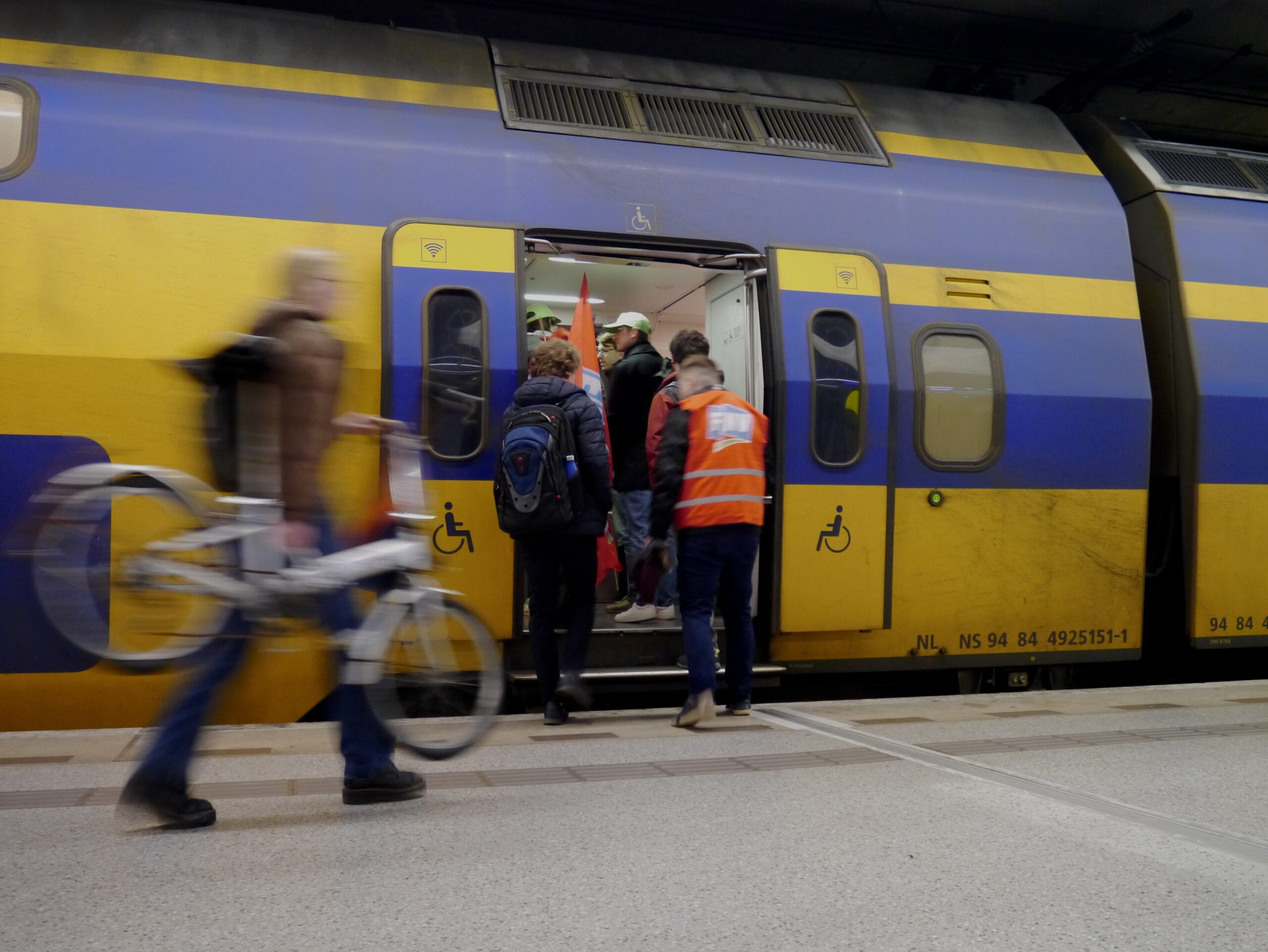
TU Delft strikers on their way to Amsterdam. (Photo: Susanna Holwerda)
Especially for this strike day, maths teacher Zoë Gromotka has placed red little sequins next to her eyes – the colour that recurs in all the campaign material. She was one of the driving forces behind the previous strikes and, despite the piles of work that will remain undone until tomorrow, she is not letting this one pass her by either. “I have to fight against the cuts.”
The parties at the coalition talks need to be reminded that this is serious, says Jesper Cockx, wearing an AOb cap and an FNV vest. “During the campaign, D66 said they wanted to invest in higher education, but now they don’t mention it at all. A big strike is a good way to remind them.”
He expects about 150 people from TU Delft to gather on the Amsterdam Dam Square, he says. In addition to the group of eleven gathering at Delft station, that means another 140 people or so will be travelling to Amsterdam by other means. A programme featuring speakers from various universities and political parties began there at noon. The day is a follow-up to the strike on the Malieveld a year ago and the relay strike at the TU this spring.
‘The lucky one’
Ironically, it is the workload that is preventing their colleagues from joining them in greater numbers today, they say. Jackson Campolattaro (PhD student in computer engineering) considers himself the lucky one simply because he is able to be here today. “Many of my colleagues are simply too busy. I am fortunate to have a supervisor who ensures that I am not given too many teaching assignments”’

The absence of Gromotka’s colleagues is also due to impossibility rather than unwillingness. “You see that many people want to, but cannot. They think: if I strike for one day, what will my workload look like the next day?’”
Marleen Keijzer and Niek de Kleijn (both interfaculty mathematics lecturers) also joined the group of train passengers. In the thirty years that Keijzer has been at TU Delft, she has seen many changes. The teacher sees an increasing emphasis on efficiency. “Sure, you can just give everyone a video and some old exams, but that’s not academic education. That requires interaction. And that takes time and money.”
De Kleijn, with his protest sign reading ‘Ho, stop the demolition!’, agrees. “If we continue like this, TU Delft will become a diploma factory where no one learns anything anymore.” While classes are getting bigger, there are fewer and fewer staff members, says computer science lecturer Cockx. He fears for the accessibility of higher education. “In computer science, we are forced to work with a numerus clausus. There are many students who want to study with us, but we cannot offer them a place.”
‘If the government cuts funding, that’s a reason for TU Delft to budget even more strictly’
Another way in which faculties are cutting costs is by hiring fewer teaching assistants, a sought-after student job. They support lecturers in their teaching tasks. But now that there are fewer of them, their tasks are being taken on by permanent staff, says Gromotka. “This creates extreme work pressure, especially during the exam period.”
Local cutbacks
Cutting back on teaching assistants is one of the ways in which faculties are tackling local cutbacks. So why protest against national cutbacks? They are difficult to separate, says Gromotka. “What we are already seeing at TU Delft is the direct result of local budget cuts. But if less money comes from the government, that is a reason for TU Delft to budget even more strictly. The result is even more stress.”
12-12-2025: At the interviewee’s request, the quote ‘In the past, a teacher taught one subject per term, now it’s three’ was removed from the sixth paragraph.
Do you have a question or comment about this article?
[email protected]


Comments are closed.