

Single glazing, centimetre-wide gaps and poorly insulated walls: many student houses are facing a cold winter. With a free insulation service, the students at Holy Folie step in where landlords fail. “The landlord doesn’t feel the cold.”
(Photo: Thijs van Reeuwijk)
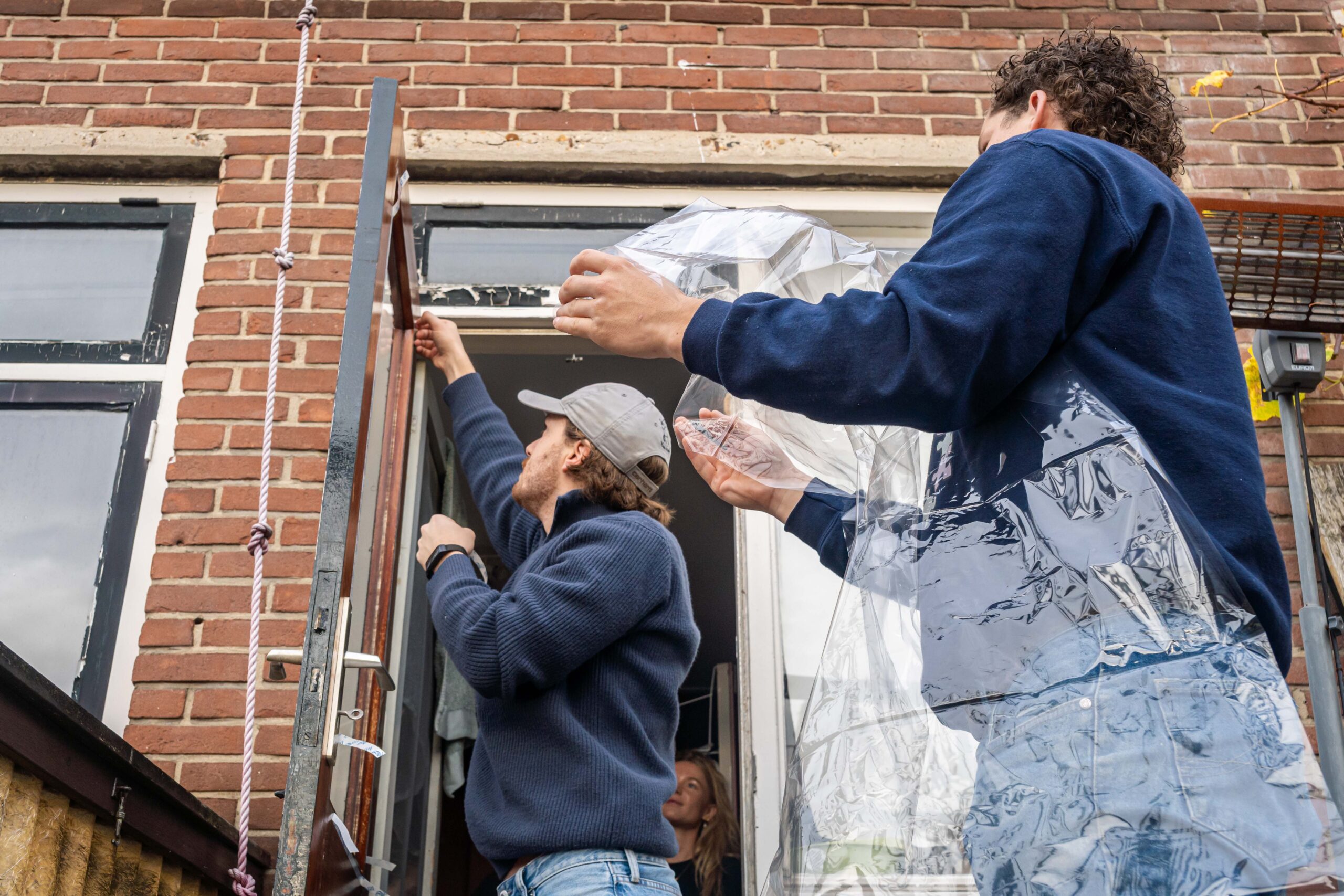
Armed with a well-stocked shopping bag, Talli and Cees enter the living room of a student house in the centre of Delft. They are not quite awake yet. Two friendly students in their early twenties, also with sleepy eyes, offer them a cup of coffee.
A shiny roll of radiator foil sticking out of the bag reveals what the boys are here to do: prepare the house for winter. The residents are happy to see them, halfway through November. “It gets very cold in the downstairs bedroom in winter,” says Maud, a 23-year-old veteran of the house.
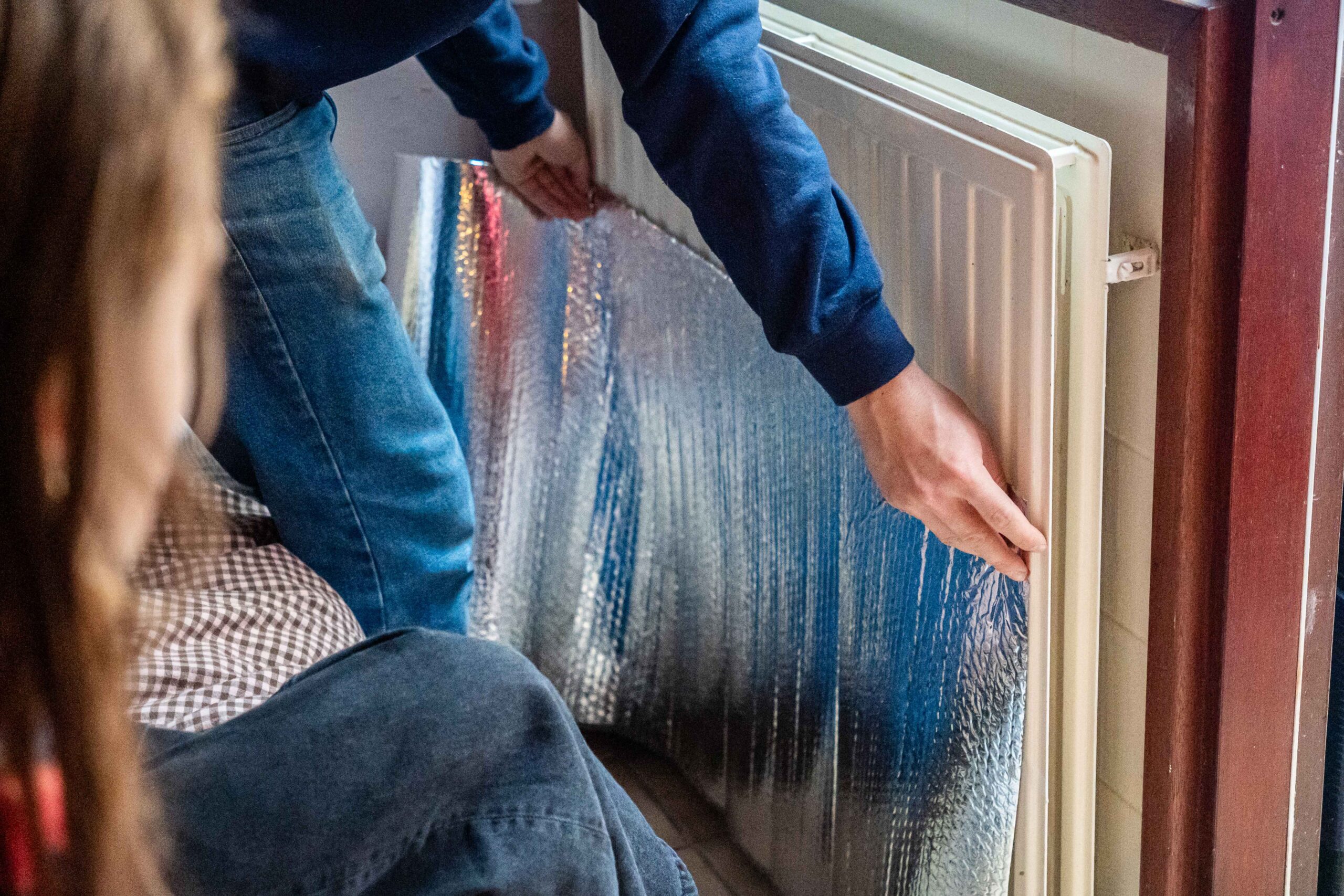
Talli and Cees are representatives of Holy Folie, a Delft initiative that has been helping student houses reduce their energy consumption since 2023. Under the umbrella of the Social Impact Hub, a social organisation run entirely by students, the project equipped fifty poorly insulated buildings with radiator foil, window foil and draught strips last year.
Landlords are failing to deliver
Demand was so high that Maud and her housemates were turned down when they first applied to Holy Folie last year. This is not surprising, as residents do not pay a penny and landlords do not bear the costs either. The municipality finances most of the insulation service. In addition, Rabobank is contributing from a special innovation fund for ‘projects that contribute to the Energy Transition, Food Transition or Financially Healthy Living’.
The help comes at just the right time. Landlords are not particularly keen when it comes to making student accommodation cold-proof, according to a report published in January by STIP, Oras and SHS Delft, among others. Only 18 per cent of the 571 respondents said they lived in a recently renovated house.
This residence has also yet to undergo sustainability improvements, as Talli and Cees discover when they walk through the house with residents Maud and Julie. The good news: some radiators have radiator foil behind them (“from 2009”, Maud notes) and most of the windows are double-glazed (some with cracks).
The less good news: the doors downstairs and to the roof terrace urgently need draught strips, most radiators have no foil, and a number of windows have missed the double glazing boat.
The secret weapon: window film
For the latter, the Holy Folie working students have an ingenious weapon in their arsenal: window film. When applied correctly, the film ensures that single glazing transmits 40% less heat, says Cees. “We stick it to the window frame. This creates an extra insulating layer of air a few millimetres thick between the film and the glass. It doesn’t work with every window: ideally, the frame shouldn’t protrude much more than a thumb’s width.”
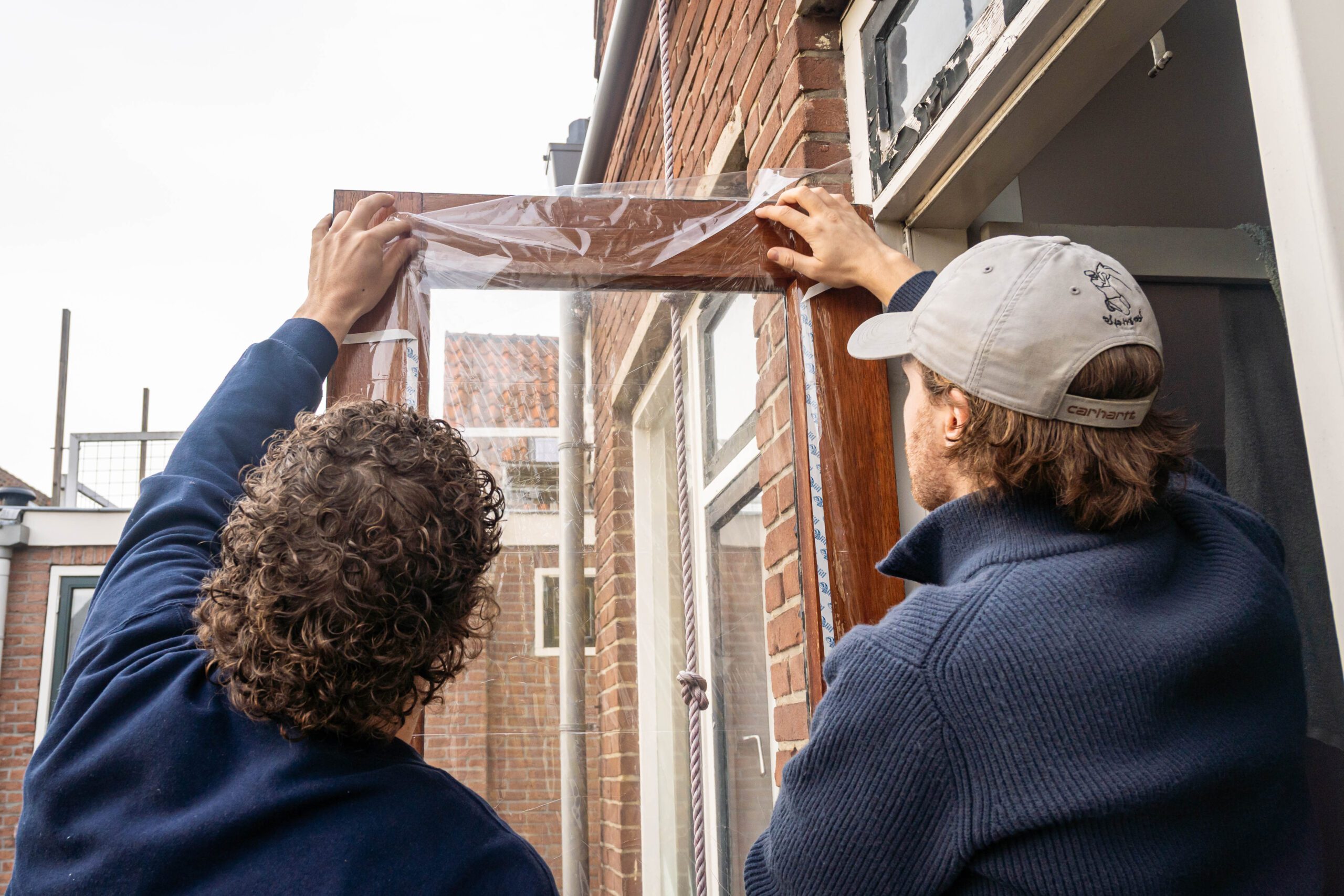
Hanging here and there, the group climbs the narrow spiral staircase, on their way to Julie’s room. She is the lucky one: next to her bed, in the door leading to the roof terrace, is the model window. Talli and Cees demonstrate once how to apply the film. For the other windows, the residents are on their own; they get the film as a gift.
While the women of the house chat about last night, Talli and Cees meticulously stick the film onto the window frame. “You really need two people for this,” Talli tells the housemates. From her bed, she watches the boys smooth out the film with a hairdryer. Julie is satisfied. “Well done. If you don’t look closely, you can’t even see it.”
Regulations desperately needed
The house in which Maud and Julie live is in many ways a typical Delft student house. A slightly crooked pre-war building with lots of draughts, not all of the windows double-glazed and a high gas bill in the winter months.
‘Homeowners don’t pay the energy bills, so most of them don’t really care about their tenants’
These types of houses are Holy Folie’s raison d’être, says project leader Liselotte de Boer by telephone. “Sometimes it’s because the buildings have monumental status, which means that double glazing, for example, is not allowed by law.” But usually it’s the homeowners who are the problem. “They don’t feel the cold and they don’t pay the energy bills, so most of them don’t really care about their tenants.”
She emphasises that substantial sustainability requires much more than foil and draught strips. Most of the houses Holy Folie visits do not have proper roof, floor or cavity insulation, and often do not even have an energy label – some landlords simply refuse to have one issued. Heat pumps or solar panels are even rarer in student houses.
According to De Boer, a legal sustainability obligation is therefore desperately needed. At present, there are no such mandatory regulations, but this will change in 2029. All rental properties must then be upgraded to at least energy label D, on pain of fines.
But for the time being, there is no progress. Housing associations have already presented joint plans, but private landlords are lagging behind. This is evident from, among other things, the Subsidy Scheme for Sustainability and Maintenance of Rental Properties: since it was created in 2022, only 18 per cent of the €152 million budget has been tapped.
Slightly dazed students
For the time being, students will still busy ‘Holy Folie-ing’ (dixit project leader De Boer). Expansion plans are in the works, starting in Rotterdam, where the first ten student houses will be tackled this year. “Ultimately, we want to put foil in all student cities.”
This also means more work for working students like Talli and Cees. They chat for a while on the pavement in front of the house; Maud and Julie have just assured the boys that the insulation materials they left behind are in good hands.
Talli likes the job, he says. Meeting the residents is the most entertaining part, especially when they are still a little groggy from their night-time activities. He is generally pleased with their commitment. Although: “Sometimes you come across houses with mould in places where you think: if you ventilated the place a little better, there would be no problem.”

Do you have a question or comment about this article?
nathan@hgsmk.nl


Comments are closed.