

Traffic signs are proudly displayed on the wall in some student houses. A stop sign in the corridor, street signs next to the fridge. How do they get there? And why?
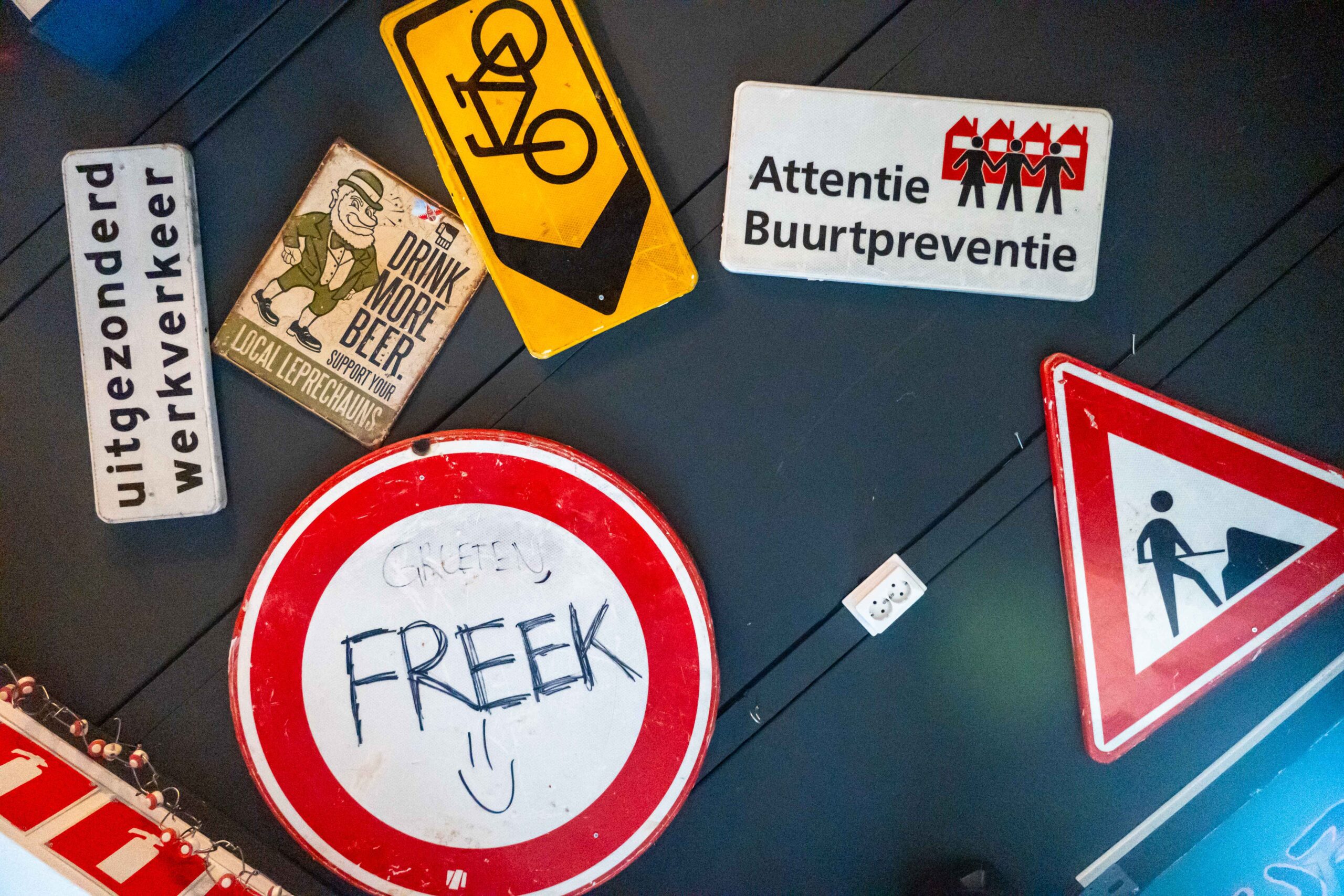
Traffic signs in student houses are no exception. Photo: Thijs van Reeuwijk
‘For hospice turn right’. ‘Do not turn here’. ‘Cyclists on the road’. ‘No entry’. ‘Only work vehicles permitted’. ‘Attention: neighbourhood watch’. Mick and Gijs’s student house is full of all kinds of traffic signs. There are about 20 on the walls, in the hallway and on the ceiling. How did they get there?
The answer to that question is a 13 mm wrench. A 13 mm wrench gets the job done fast, says Mick. “Just turn it a couple of times and the sign comes off. It is really easy. Anyone can do it.” But transporting a sign home sometimes need some preparation. The guys had to bring a blanket for the huge ‘Do not turn here’ sign. Gijs: “We wrapped the sign in the blanket and put it on my Swapfiets bike so that it was not recognisable. On the way back we purposely cycled through a quiet neighbourhood where there are rarely police.” And voilà, the loot is home.
Major costs
Students take traffic signs in other student towns too, not only in Delft. It happens all over the country. Earlier this year the traffic signs for a drug campaign in Rotterdam disappeared (in Dutch) a couple of hours after they were put up. The municipality of Amsterdam lost (in Dutch) 30 mileage signs after the Op de Ring festival.
The municipality of Delft does not have any figures on the number of signs that are stolen every year. There are nationwide figures though: of the six million traffic signs in the Netherlands every year, about 10,000 are stolen, says HR Groep, the traffic sign supplier. How many of these are taken by students is not known, although HR Groep believes that most are. These clowns cost municipalities and provinces EUR 3 million a year. This does not really bother Mick and Gijs. “It will all come right. We will pay for it through taxes later on.”
History
Traffic signs in student houses is not a recent phenomenon. In 1996 Delta wrote (in Dutch) that student houses and student cafés were full of them. The ‘Nickersteeg’ and ‘Leeghwaterstraat’ street name bords were the ones pinched most often. Gus Maussen, a former student who studied at TU Delft in 1987-1994, remembers traffic signs clearly. “They were not in my house, but were in other houses.”
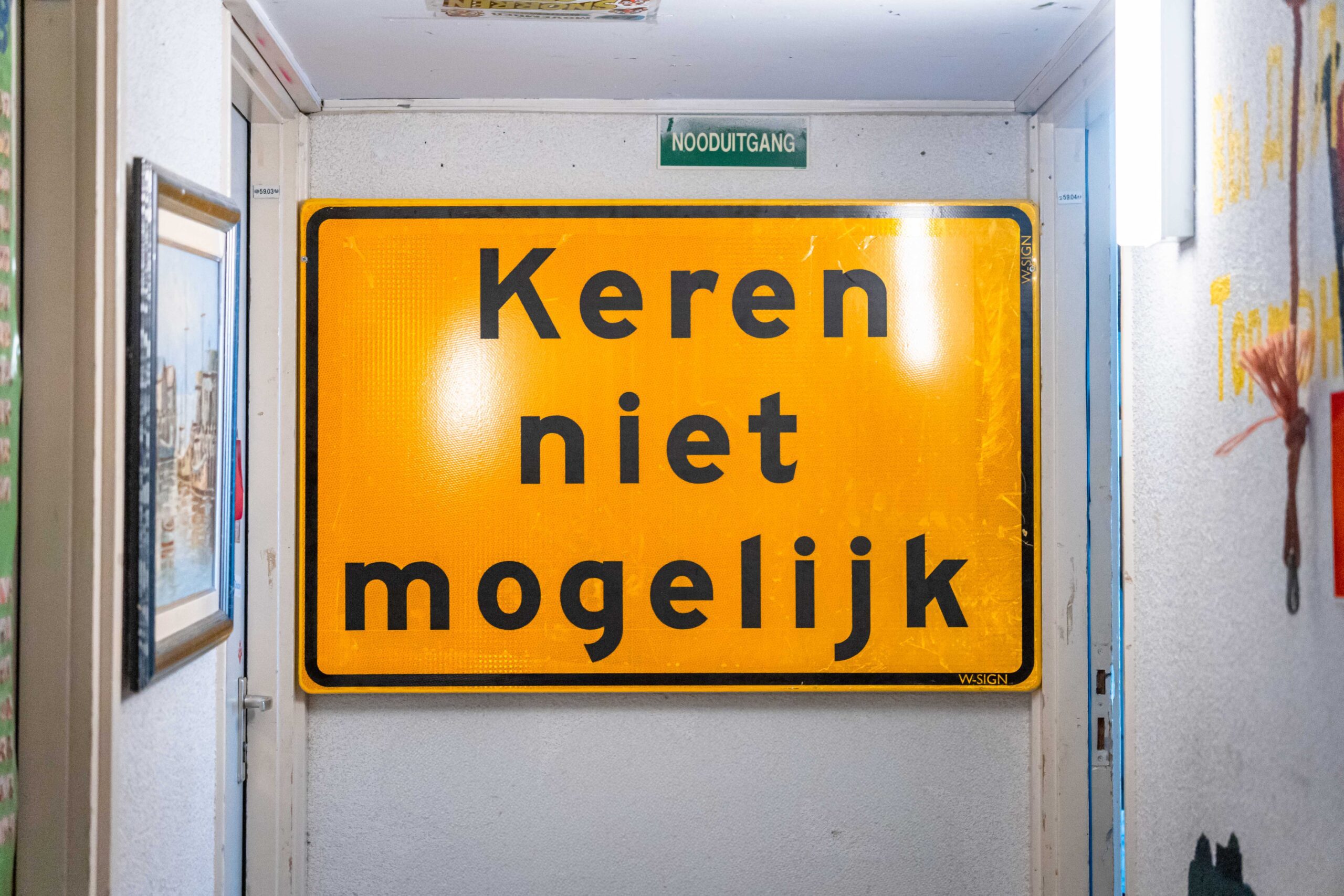
The main question is naturally why? Mick and Gijs say that they do not really know themselves. There were already a lot of traffic signs in their house when they moved in. They do think that it is primarily the text on the signs that is the deciding factor. For example the guys saw a street sign with ‘Knol’ during a huisweekend (a weekend away with your flatmates, Eds.). Mick: “This is the surname of our flatmate so we took it.”
A good story behind a successful steal is also a factor, says Gijs. “It’s about the adrenaline rush. It’s fun to be a little reckless. You’re also rarely sober when you take a road sign.” Maussen, the former student, thinks that it is also about resistance. “Traffic signs are equated with rules and authority. Students resist this.”
Kanonstraat
But there are risks involved in taking traffic signs. A group of TU Delft students (in Dutch) spent a night in prison after being caught. Officially, stealing traffic signs fall under Article 310 of the Penal Code and can entail a prison term of four years or a fourth category fine of up to EUR 25,750. In practice, it is often pushed under ‘baldadigheid op de openbare weg’, or hooliganism on public roads. The fine is then EUR 300.
This is a significant amount for a joke that got out of hand. But Mick and Gijs will not let that stop them. In answer to the question if they have a traffic sign on their wish list, they emphatically say “The Kanonstraat because of the Grolsch beer” (in Dutch). Mick: “But it’s in the city centre of The Hague where there are lots of security cameras, so that won’t happen.”

Do you have a question or comment about this article?
A.I.Elias@tudelft.nl


Comments are closed.