Limit the number of PhD candidates per supervisor, otherwise you create profkippen: academics with so many PhD candidates under their wings that they no longer have enough time for beginning researchers. This is the recommendation made on Tuesday by the Young Academy (De Jonge Akademie).
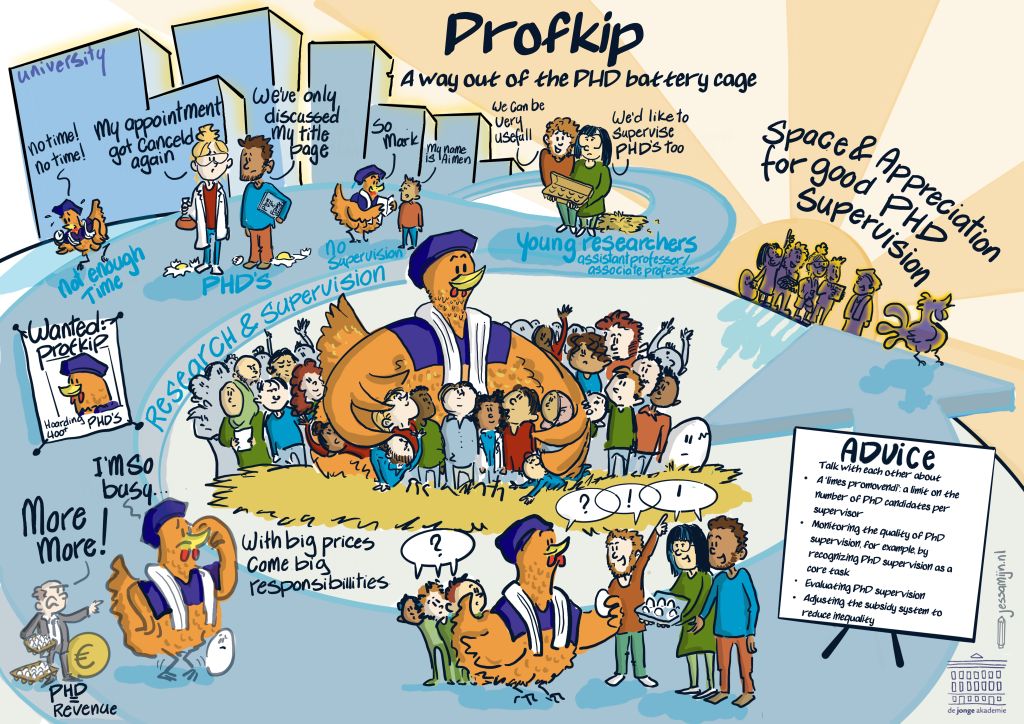
The Young Academy has created a discussion board to stimulate conversation about 'professional chickens' (Illustration: Jessamijn Alberts / KNAW)
This article in 1 minute
- Supervisors sometimes have too many PhD candidates under their care, meaning PhD candidates do not receive the supervision they are entitled to.
- To draw attention to this issue, the Young Academy has coined the term profkip.
- According to the early‑career top researchers, the way Dutch academia is funded is to blame for the rise of profkippen.
- Researchers secure large grants that allow them not only to hire PhD candidates, but also to win further grants. In this way, more and more funding and more and more PhD candidates end up concentrated around the same academics.
- With a visual explainer and a three‑page polemic, they hope to get the conversation started.
Sometimes a cultural shift needs a new word. In the campaign against industrial farming, for example, the term plofkip (“exploded chicken”) was introduced. On Tuesday, the Young Academy is launching its academic variant: the profkip (“exploded professor”).
With a polemic of three pages (plus a summarising cartoon), the early‑career top scientists want to open up the conversation about PhD supervision. They propose a limes promovendi: Latin for a limit on the number of PhD candidates.
Unequal distribution of pportunities and funding
They describe profkippen as “both the consequence and the driving force of an underlying problem”. According to the pamphlet, that underlying problem is the unequal distribution of opportunities and funding in academia. Researchers often build their careers on grants from the Dutch Research Council (NWO). That money is mostly used to appoint PhD candidates, the Young Academy writes.
Once someone has received a grant, they stand a better chance of winning the next one. This perpetuates inequality, the pamphlet argues, and the winners of these grants end up supervising ever more PhD candidates. That is how profkippen emerge.
Spread the workload
The consequences are problematic: PhD candidates receive insufficient supervision, while the grant‑winning academics experience increasing workload. In theory, this workload could be spread more evenly, as university lecturers and senior lecturers can also obtain ius promovendi, the right to act as a PhD supervisor. But this does not happen often enough.
Therefore, the Young Academy pleads for “a reasonable limit to the number of PhD candidates someone may supervise simultaneously”. And what should that number be? The Young Academy does not specify this.
Get the conversation started
The key point is to get the conversation started. On 18 May, a meeting on this topic will take place at the Trippenhuis in Amsterdam, the home of the Royal Netherlands Academy of Arts and Sciences (KNAW).
The Young Academy, part of the KNAW, is for some members a springboard to leadership positions. The new Minister of Education, Rianne Letschert, was once its chair.
HOP, Bas Belleman

HOP
Hoger Onderwijs Persbureau
Do you have a question or comment about this article?
[email protected]


Comments are closed.