

PhD candidates at TU Delft sometimes have to wait so long for their defense that their visas expire or job applications are jeopardized. A simplified PhD ceremony and the addition of an extra beadle — both negotiated by the Works Council — are expected to ease the pressure. And not a moment too soon, because the real wave of PhD defenses is still to come.
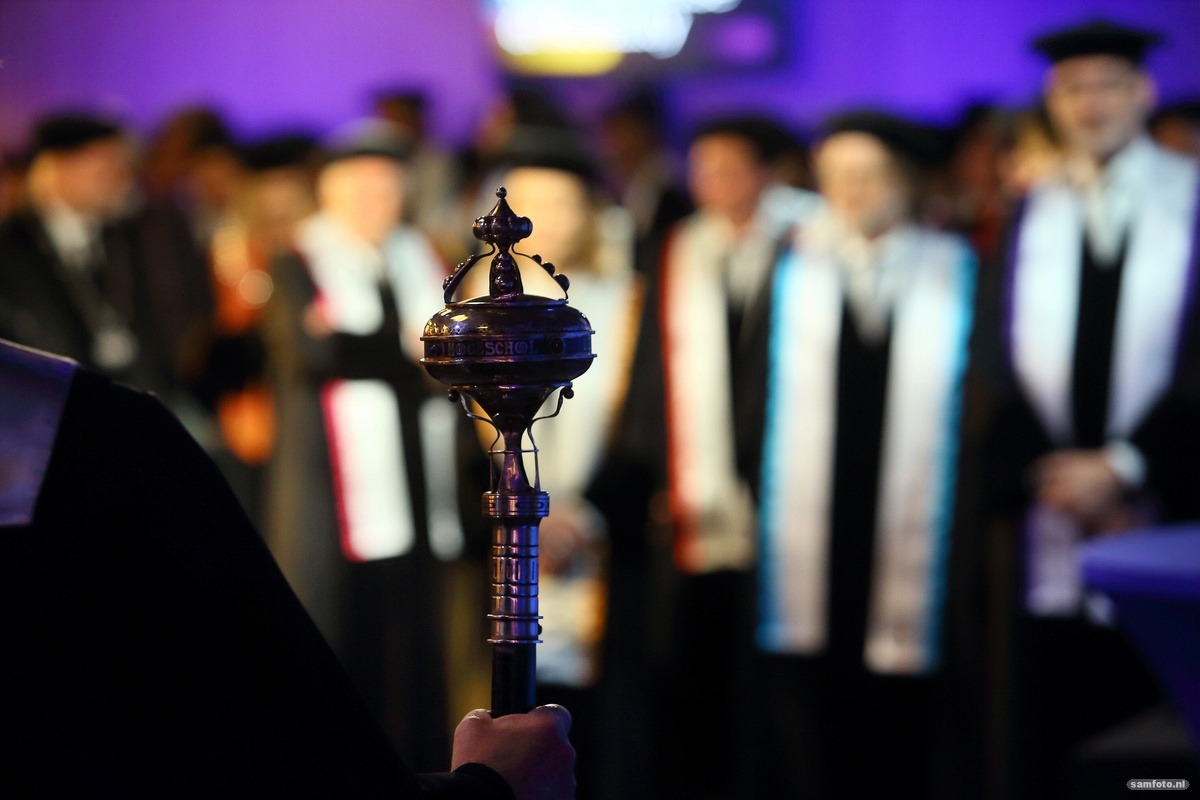
Staff of the beadle preparing for the 183rd Dies Natalis of Delft University of Technology. (Photo: Sam Rentmeester)
This article in 1 minute
When former PhD candidate Tim Boot (Mechanical Engineering) opened the university’s calendar for PhD ceremonies in July 2025 to book his defense, he had to scroll a long way. The first available slot was Wednesday 3 December, more than five months after his dissertation had been approved. Boot chose Friday 5 December, and yes, his defense went well. He is now officially Doctor — or, for those who prefer the English title, PhD.
The months-long wait did, however, complicate the job search. Boot was only allowed to use his doctoral title after the defense. During an application process at the European Joint Research Centre, he had to complete several extra assessments — assessments he wouldn’t have needed if his defense had already taken place. “I even sent them Form D as proof. It includes the final version of my thesis and the date of my defense, but it wasn’t enough. I understand it, though — a reputable scientific institution has to strictly follow its procedures.” He got the job but ended up taking a position elsewhere.
Hora est
A PhD trajectory is only completed once the candidate has defended their dissertation during a public ceremony. At TU Delft, this takes place in the Senate Hall of the Aula. Although it is an important ceremony with a serious academic debate, it is extremely rare for a doctoral candidate not to receive their degree afterwards.
At many universities, the waiting time for a PhD ceremony is around three months , but at TU Delft it is significantly longer. In early February the waiting time was five months, and last academic year eight‑month waits were not unusual. Stories like Boot’s are therefore not unique, says Works Council member and PhD candidate Annabel Broer. “It’s frustrating. They already know they will receive their doctorate, but they can’t yet prove it.” This causes problems not only for job applications but also for work visas. “Some international PhD candidates get into trouble because their visas expire.”
Fear of needing to go back
In addition, some international PhD candidates experience significant stress because they don’t know how long their waiting period will be. Broer says: “I know a progressive Iranian woman who is terrified she may have to temporarily return to Iran if her visa expires between the approval of her thesis and her defense. She is trying to escape the Iranian regime through her PhD.”
The long gap between official approval and the actual defense exists because the number of PhD candidates at TU Delft has increased significantly since 2020, explains Professor Bart van Arem. As pro vice rector magnificus for doctoral affairs, he is responsible for all protocol-related matters concerning PhD defenses. Sitting in his office at Civil Engineering and Geosciences, he opens his laptop to display forecasts for upcoming defenses. “In 2018 we were still below 400 PhDs per year. Now it’s 542.” The sharp rise in the number of PhDs is partly due to large government investments during the pandemic, which allowed the university to hire more PhD candidates, for example through the national Sector Plan for Science and Engineering.

From three to four daily time slots
Young Researchers Impact — the Works Council party to which Broer belongs — raised the issue with the Executive Board this and last academic year. It turned out to be harder to fix than expected. Although an extra daily time slot was added, increasing availability from three to four PhD ceremonies per day, a second defense location could not be found. “All defenses currently take place in the Senate Hall,” says Van Arem. “The alternative venues we investigated lacked adjacent rooms for committee deliberations, were too far from the robe room for timely gowning, and had other logistical limitations.”
At first glance, the Van Hasselt Hall appeared suitable, but a lack of technical infrastructure proved to be a dealbreaker. “The audio must be good, and we need to be able to switch between multiple screens in case committee members join online. It would have cost hundreds of thousands of euros to install the necessary cabling.”
By the end of 2025, progress was finally made. The Works Council proposed its own solution: a simplified PhD ceremony without gowns and without a beadle, designed for candidates who want to graduate quickly and who do not care much for the traditional ceremonial aspects.
The modest ceremony
Since January of this year, the simplified PhD ceremony has been available. It has no beadle, no technician, no livestream, no dress code, no TU Delft photographer, and no reception. The chair of the committee takes over the beadle’s role, and the supervisor manages MS Teams if a committee member participates online. The candidate or supervisor books a room themselves. The minimum waiting period for the light ceremony is thirteen weeks — needed for reviewing the dissertation and preparing all paperwork, such as issuing the diploma. On 8 December, the Graduate School sent out a newsletter announcing the new ceremony option.
Extra beadle will start soon
In late 2025, Tim van der Hagen also announced during a participation council meeting that an extra beadle would be hired , allowing more ceremonies to take place. The new beadle will begin working 28 hours per week starting in March. According to Broer, these solutions are urgently needed. “The real wave of PhD defenses is still ahead of us.”
Van Arem agrees. He checks the forecasts again: “We will likely hit 600 PhDs per year.” Still, he remains optimistic: “With the extra beadle and the simplified ceremony, we’ll really start making progress.”
Do you have a question or comment about this article?
[email protected]


Comments are closed.