


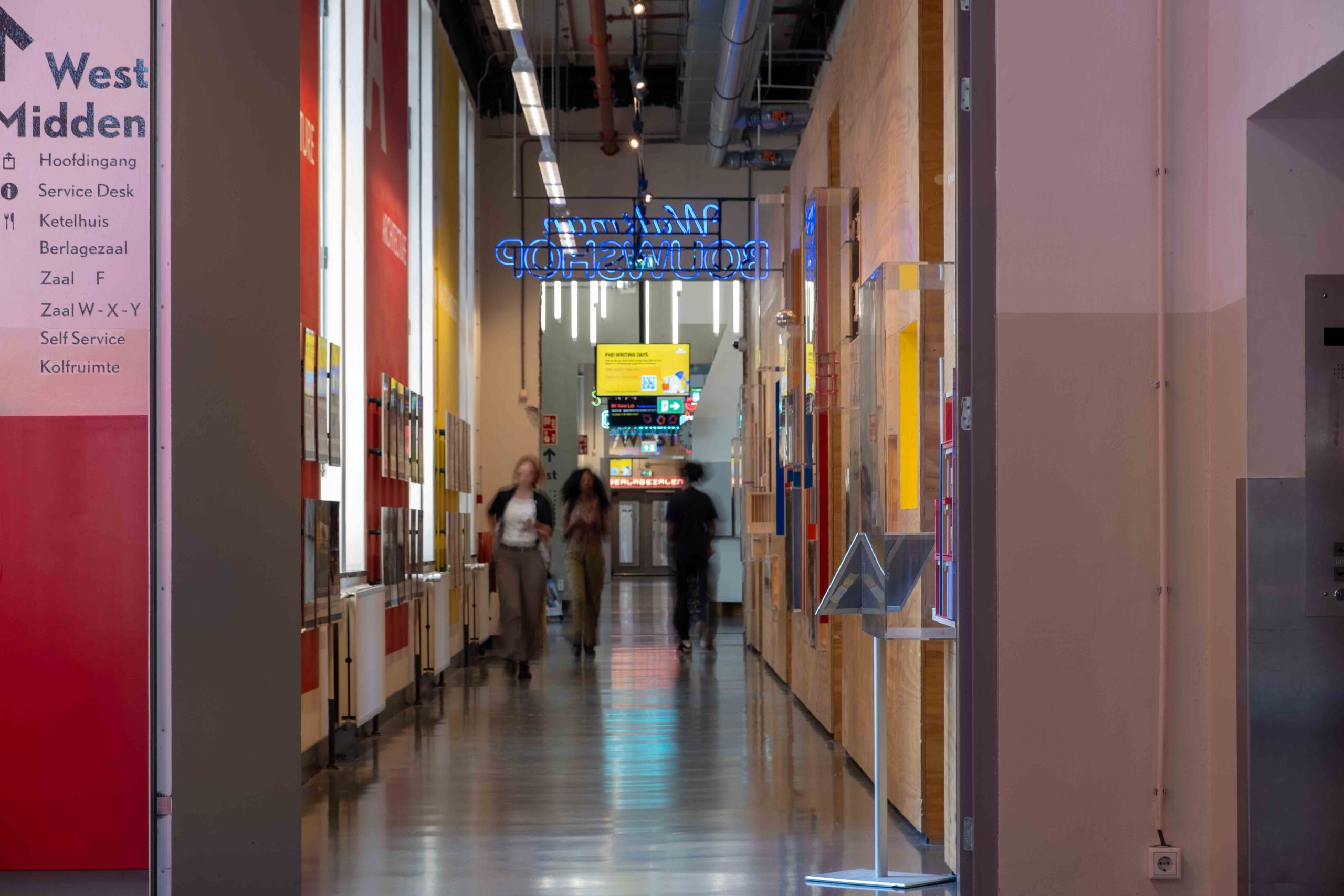
(Photo: Sam Rentmeester)
The working environment at Architecture suffers from systemic issues relating to social safety, leadership and career policy. These findings emerge from a risk analysis commissioned by the faculty, partly in response to reports received via TU Delft’s relatively new integrity and social safety reporting point.
This article in 1 minute
The report paints a picture of a faculty where employees sometimes do not know what they are being assessed on, where young researchers are heavily dependent on their line managers for their future, where decision-making is not always perceived as transparent, and where there is a perception that visibility and personal relationships can influence career opportunities.
The report also describes a strong results-oriented culture, a competitive working environment that some perceive as masculine, and a lack of trust in the way problems are addressed. According to the researchers, these are not isolated incidents, but a coherent set of factors that increase the risk of social unsafety.
Recurring patterns
The risk analysis was carried out by the external consultancy firm Governance & Integrity International and is based on 82 interviews with employees from all levels of the faculty. Respondents range from PhD candidates and support staff to full professors and managers.
The researchers explicitly did not look at individual incidents or questions of blame
The researchers explicitly did not look at individual incidents or questions of blame, but rather at recurring patterns, perceptions and risks within the organisation. The result is an analysis of the circumstances in which social unsafety can arise and persist, and of the factors which, according to employees, contribute to those risks.
Problems are not new
Many of the issues raised in the report are not new. In 2024, TU Delft came under increased scrutiny from the Education Inspectorate due to serious shortcomings relating to social safety. The finding of mismanagement was withdrawn this spring, after the Inspectorate concluded that the care for employees had been sufficiently restored.
That does not mean the problems have vanished. Recent annual reports from the confidential advisers, the ombuds officer and the integrity and social safety reporting point revealed patterns similar to those now evident at Architecture. Reports often do not concern a single incident, but situations that develop over a longer period of time. Power imbalances, failing leadership and unclear procedures are recurring themes in these reports.
Olivier Sueur, the interim manager of the Integrity Office who left this week, also said last week in an interview with Delta that many of the changes so far have mainly taken place at a systemic level. As a result, improvements are not yet noticeable everywhere in staff members’ day-to-day practice.
Dependency and unclear career paths
One of the key themes in the Architecture report is dependency. According to the researchers, PhD students, postdocs and other early-career staff in particular find themselves in a vulnerable position. They are often dependent on a small group of managers for their assessment, contract renewal or promotion prospects.
This dependence influences the way people behave. Some employees adopt a cautious approach for fear of the consequences for their careers. As a result, problems or criticism are not always raised.
This is linked to a second recurring theme: a lack of clarity regarding career paths. Some employees do not always find it clear what the requirements are for promotion or a permanent post. Nor is the way in which decisions are reached always perceived as transparent. The report even cites the perception of favouritism as one of the greatest risks to the working environment.
High-performance culture
The faculty is highly regarded internationally and attracts employees and students from all over the world. Many interviewees speak proudly of this standing. At the same time, the researchers highlight a downside to this culture.
According to employees, there are implicit expectations within the faculty. There is a prevailing view that one must work harder than is formally required, always be visible, and should not turn down extra tasks. Not everyone is able or willing to meet these expectations, which leads to differences between staff members.
The report also describes a culture that some perceive as highly competitive and masculine. According to those interviewed, women and international employees in particular face additional obstacles. The researchers do not comment on whether such experiences can actually be substantiated, but note that these perceptions have a significant influence on the working environment.
Leadership as a chore
Leadership is a recurring theme in almost all chapters. According to the researchers, leadership in the academic world is often part of an academic career, but not necessarily a conscious career choice. As a result, employees sometimes fulfil leadership roles without having been specifically selected or prepared for them. The interviews reveal that such a role is sometimes viewed more as a chore than as a profession in its own right.
Some managers are said to be insufficiently available, whilst others are perceived as highly directive
Employees describe significant differences between managers. Some are said to be insufficiently available, whilst others are perceived as being very directive. Furthermore, according to the report, it often remains unclear who is responsible for resolving conflicts or tensions.
Mistrust towards HR and reporting channels
The report also highlights criticism of the functioning of Human Resources (HR) and the accessibility of reporting channels. Some employees feel there are barriers to reporting problems and sometimes doubt whether reports actually lead to change.
At the same time, the researchers note that, in recent years, the university has in fact invested heavily in social safety measures, including the integrity and social safety reporting point. After all, the very fact that this study was carried out is partly due to the increased visibility of concerns raised via the reporting point and internal channels within the faculty. The faculty board, which was led by former dean Dick van Gameren at the time, initiated the study itself. According to a spokesperson, this was to better understand ‘the perceptions and underlying patterns’ of the existing working environment and to investigate ‘where risk-increasing factors lie’. “This will enable us to do more to prevent problems and strengthen our working environment.”
Court ruling
The publication of the report comes a few months after a notable court ruling concerning a labour dispute within the same faculty.
In April, the subdistrict court ruled that TU Delft had acted in a ‘grossly negligent’ manner towards an employee who had reported a lack of social safety. According to the court, the complaints were not taken seriously enough, and this was followed by an unjustified termination of employment with immediate effect. The university has been ordered to pay compensation and has faced criticism regarding the role of HR and the handling of the complaints.
Also read

Following the ruling, the Architecture stated that it would review the matter and take steps to prevent a recurrence.
What happens next?
On Thursday 2 July, the Governance & Integrity International report was presented at a closed-door staff meeting. This will be followed by discussions within the individual departments before the summer break. In the autumn, eight thematic dialogue sessions are to be held on topics such as leadership, career development, the role of HR and unequal opportunities.
Machiel van Dorst, Dean of Architecture since February, sees the report primarily as a tool to drive change, he says in an interview with Delta. Among other things, he wants to focus on further professionalising managers. In his view, leadership is ‘not a chore’, but a responsibility for which people need to be better equipped.
He believes this is not a short-term improvement programme. “This isn’t a matter of a few months. It will take us years.” In addition to social safety, psychological safety also deserves attention, he feels. “By the time someone has a complaint or makes a report, it’s actually already too late.”

- Read more about social (un)safety in our dossier.
Do you have a question or comment about this article?
[email protected]


Comments are closed.