
By early October, one in four TU Delft managers had completed the one-day course Leadership and Social Safety. Another quarter had signed up. The unions are calling for the training to be mandatory, but the Executive Board is sticking to persuasion rather than compulsion.
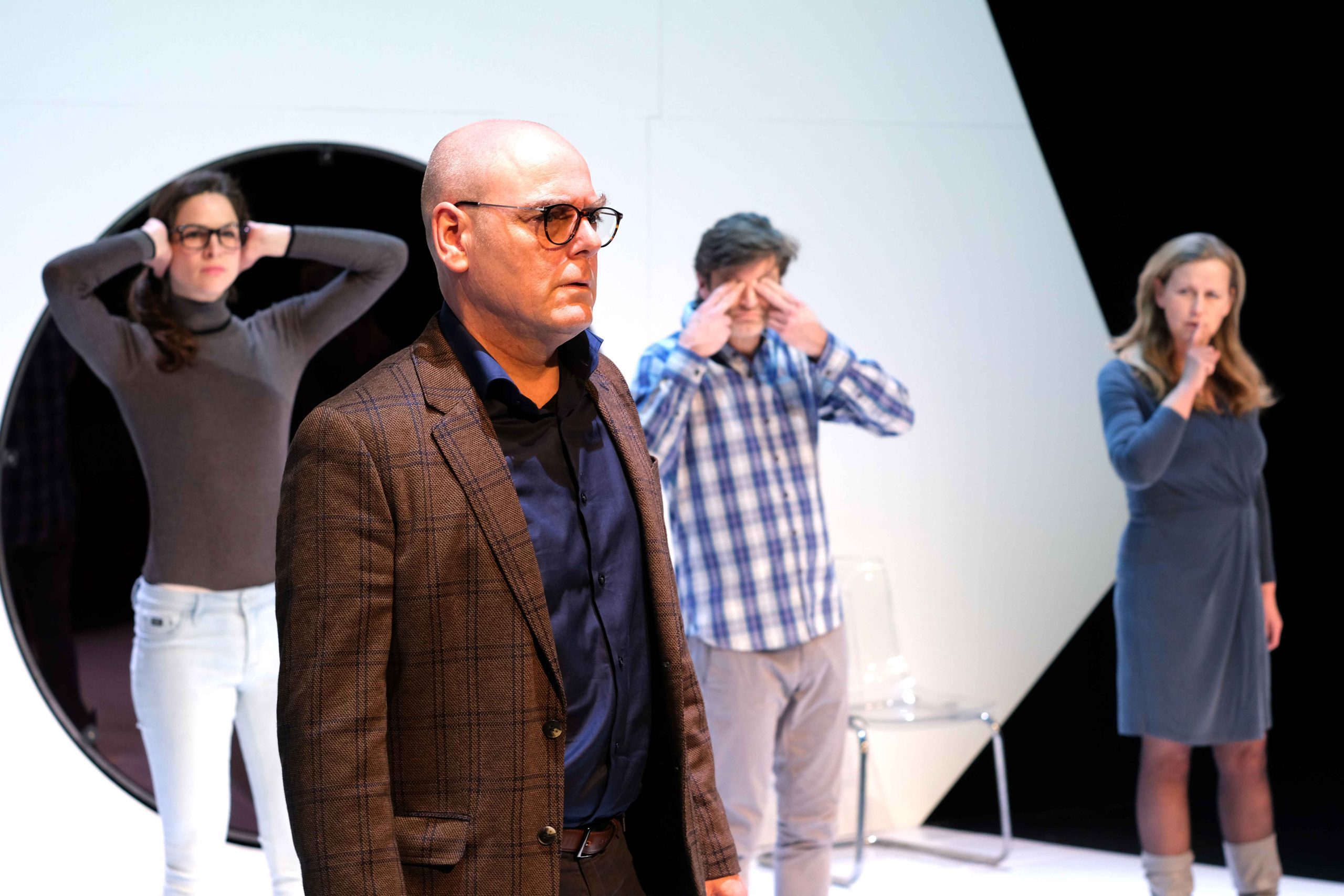
Scene in Mindlab. (Photo: Theatermakers Radio Kootwijk)
In October, 161 managers had taken the one-day course, and another 158 were registered. This is stated in the third-quarter social safety report for 2025. HR confirms that TU Delft had 625 managers at that time. The training has been running since late 2024 and is only compulsory for those starting in a leadership role.
Setting an example
In July, the unions argued that such a course should be mandatory for all managers. It was one of ten recommendations arising from a staff survey. They wrote that the training should make managers ‘aware of their role model function, the risks of unsafe behaviour, their responsibility to ensure a safe working environment, and provide them with the tools to achieve this’. They also called for’“regular updates and peer review sessions’.
Current managers are ‘expected’ to take part
The Executive Board, in a written response to the unions, does not directly address the demand to make the training compulsory for all managers. Current managers are ‘expected’ to take part. HR keeps the Executive Board informed about participation rates, which the Board then discusses with directors and deans. It remains unclear what happens after that, but several participants say they were strongly encouraged to attend.
Role of the ombudsperson
In its written response, sent in early November, the Executive Board also addresses the nine other union recommendations point by point. Often, the reply explains what is already being done on that topic. For example, a bystander training already exists and will be more widely available in 2026; HR’s role has been clarified as supporting staff as well as managers; and a new code of conduct is underway.
The unions also advised giving the ombudsperson the authority to request documents without intervention from the Executive Board or HR. That is already possible, the Board writes, and the organisation is obliged to share them. The Board also mentions two new studies that may affect the ombudsperson’s role: one by SoFoKles (Social Fund for the Knowledge Sector) on ombudspersons at all universities, and another upcoming review of the entire integrity structure at TU Delft.
Social safety in performance reviews
One striking point is the place of social safety in performance reviews, known as the Result and Development cycle (R&D). The unions want this to be a fixed and mandatory element. This aligns with the Education Inspectorate’s finding that social safety is rarely discussed in R&D meetings.
The Executive Board, however, does not see mandatory inclusion of social safety as logical, ‘because the conversation is intended as a one-off annual future dialogue about the employee’s development. Managers are instead equipped to recognise signs of social insecurity immediately and address them in daily practice’.
More democracy
The unions also called for more democracy in July. Faculty boards should consist of multiple people, and appointment advisory committees should include diverse representatives of students and staff to prevent favouritism.
The revised demonstration guidelines are generally less rigid
They asked the Executive Board to acknowledge that the university is not a company and to encourage discussion, debate and protest on campus. The Board agrees with the first point. Discussion, debate and protest are all possible, it writes, but the letter does not actively encourage these. It states: “As an academic institution, TU Delft values the right to demonstrate and wishes to convey that different views on a subject must be possible.”
The Board also points to the revised demonstration guidelines introduced in October 2025, which are generally less rigid than before because the previous version contained unlawful or potentially unlawful provisions. For example, after legal advice from the Legal Services department, shared with Delta, the ban on face coverings has been softened.
Occupying buildings is allowed
Within TU buildings, the ban still applies; outside, face coverings are only prohibited if they are ‘clearly used to commit (anonymous) criminal acts or offences’. The legal advice also notes uncertainty about this provision, as the (European) courts have not yet ruled on whether the right to (anonymous) protest outweighs the Partial Ban on Face-Covering Clothing Act.
The new guidelines also scrap the rule that buildings may not be occupied and that entrances and exits may not be blocked. That is now allowed. The only remaining prohibition is that escape routes and emergency exits must remain clear.
Protest on 3 December
Today, 3 December, will be the first test of the new guidelines in practice. From 12:30 PM, the activist group Delft Student Intifada will hold a demonstration.
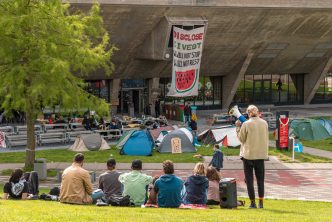
- In our dossier you’ll find more news, backgrounds and opinions about social (un)safety.

Do you have a question or comment about this article?
s.m.bonger@tudelft.nl


Comments are closed.