

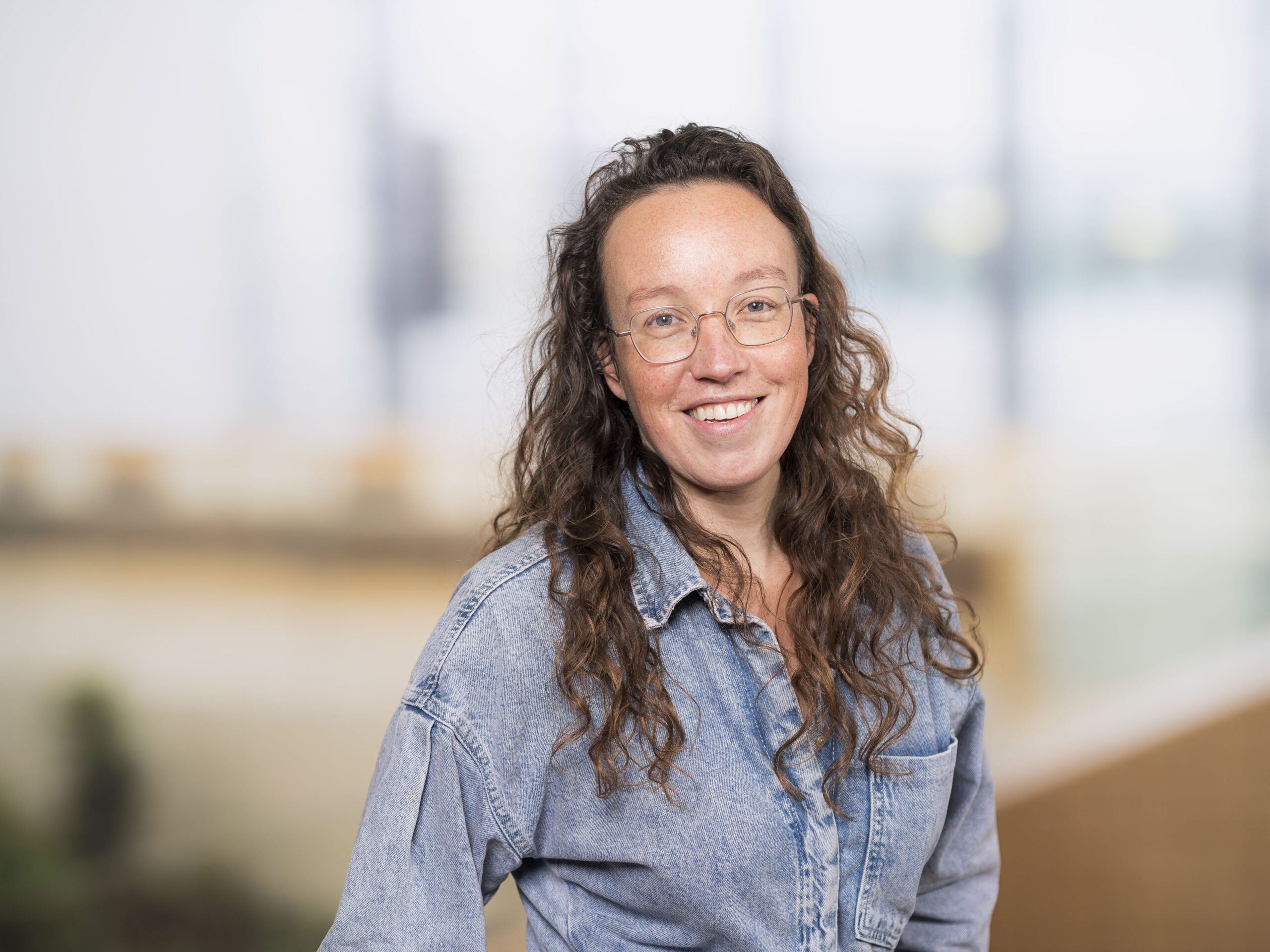
Swimming for 17 hours in an unpredictable sea. This august TU Delft alumnus Winnifred Noorlander will swim the huge distance of the English Channel. She is doing this to raise awareness about brain health. “There are a lot of misconceptions about the treatment and after effects of concussions.”

TU alumna Winnifred Noorlander has been training for months for the long-distance swim. (Photo: Wouter Hoogeveen)
While everyone was partying on Saturday evening 31 December 2022, former TU Delft student Winnifred Noorlander was on her own at the kitchen table at home. She had a headache which was too painful to go out. Noorlander had been dealing with the aftereffects of a double concussion, of which this headache was one, for more than one-and-a-half years.
Suddenly her phone rang loudly through the kitchen. It was Richard Broer, a Dutch swimming specialist who accompanies swimmers by boat while they do the long distant swim from England to France. “I am now booking the boats for 2025. If you phone me back tomorrow morning, you will have a good place on board,” his voice said on the other end of the line.
‘I thought it was intriguing that the human body is able to do something like this’
The crossing from Dover (England) to Calais (France) is known as one of the hardest long distance swims in the world. While it is about 33 kilometres long as the crow flies, the actual distance swum can go up to over 50 kilometres because of the weather, the tides and the currents. On that New Year’s Eve, her concussion meant that Noorlander couldn’t even swim 25 metres. But she still says yes. “It was an important point in my life. It entailed a change in mindset. I thought that I would really regret it in two-and-a-half years if I did not try. The worst that would happen is that I would not be able to do it, but I would in any case be fitter than now.”
She had known about the long distance swim for a while. “When I was 21 years old I heard about someone swimming from Calais in France to Dover in England for the first time. I found it intriguing that the human body is able to do something like that. It has stayed at the back of my mind since then.” This is the reason that she found Broer, the swimming specialist. Between the start of the Covid lockdowns and her double concussion, she started swimming lengths in outdoor water. Just out of curiosity she started phoning around asking how a swim across the English Channel worked.
WinniesWaves on Instagram
In 2019, around 89,000 people visited their general practitioner with a concussion, according to figures from the Brain Foundation. Some of them recover, but 10 to 30 percent of patients continue to experience symptoms months later, ranging from headaches, dizziness, nausea, and sensitivity to stimuli, to difficulty concentrating and remembering things. Noordlander wants to use her swimming challenge to raise money for increased awareness about brain health care. She is especially looking for more followers for her WinniesWaves Instagram page. She hopes that the more people that follow her, the more companies will be prepared to sponsor her.
Noorlander talks about all of this at a wooden picnic table at the back entrance to the TU Delft Aula. Around her, students are rushing to their faculties. Others stand around chatting in groups. “It really is lovely to be back on campus,” she says. She talks very energetically. Once in a while her laughter echoes on the concrete paths around campus.

Noorlander did both her bachelor’s and her master’s at TU Delft. She made the best use she could of her student period. She joined the Nuna Dream Team, joined an underwater hockey association, moved house several times in Delft, and, while studying for her Systems & Control Engineering master’s, she developed a patent by scientist Mark van Loosdrecht into the ExCulture start-up. Until 2021. On 14 February of that year she was concussed after a fall on ice. Less than six months later, on 17 June, she was hit by a car. The outcome was a double concussion.
Finding her way
A year without any real solutions followed the accident. She had to stop working at her start-up and her symptoms got worse. She was constantly over stimulated, could not look at screens, was exhausted from simple things like emptying the dishwasher, and she had headaches all day and night. Noorlander said that “In the medical world you hear that you won’t really get better after a year. I was then 28 years old, and I would not get better?”
She could not accept that. So she went looking for information. She found fellow sufferers on the internet and through acquaintances who she questioned in great detail. Her quest brought her to an American treatment that had been developed by the CognitiveFX clinic that specialises in concussion. Patients undergo intensive therapy lasting one to two weeks in the hope of getting over the symptoms caused by their concussion. The exercises are intended to push them to their limits.
‘I cried when my headache went away for the first time in one-and-a-half years’
There was just one problem. Noorlander had to pay thousands of euros for the treatment and go the United States while she was having to live on a student loan. She eventually found physiotherapists and other forms of treatment in the Netherlands that offered treatment based on CognitiveFX. She questioned them as well.
Using everything she learned ‘in a TU Delft way’, she eventually designed her own treatment week. “I took a one-time course at a practitioner’s to find out what training like that would feel like. I then broke this down into instructions for my friends.” During the treatment week, each friend gave her one or more training sessions. “On day three my headache went away for the first time in one-and-a-half years. It was such a special moment. I even had to cry.”
15 hours of training
After the treatment week, she continued training so that she could start looking at screens again, read texts and empty the dishwasher without feeling exhausted. She rounded off her master’s and cautiously started work. Step by step, she managed to do more and more. She now works full time, gives presentations to collect money for the Hersenstichting (brain foundation), and trains 15 hours a week.
That training is definitely necessary if she wants to swim across the English Channel. She designed her training schedule in the same way as she designed her training week: a lot of asking around and using these findings to design something that suits her.
‘As a student, I couldn’t chug at all. I had to learn it because of swimming’
She has already swim 22 kilometres in the IJsselmeer and crossed the Strait of Gibraltar in crawl at the end of last year to prepare for the swim. Everything that could go wrong did go wrong in the Strait of Gibraltar. She had to vomit, hit the wall (glycogen depletion in the liver and muscles), and the person in the accompanying kayak did not want to give her her own food. “I really enjoyed it though, even with everything that went wrong. I then knew that crossing the Channel would suit me.”
To be able to swim for about 17 hours, Noorlander will consume 250 millilitres of liquid food every half hour. “I will have to chug it while swimming on my back. It’s funny because when I was a student I could not chug at all. I had to learn it from swimming.”
The next goal
She wants to use her long distance swim to raise awareness among doctors and physiotherapists about brain healthcare. “They know a lot, but there are still misconceptions about the effects and treatment of concussion. Most doctors advise taking things easy and tell you that it will go away by itself. But that was not the case with me. It would be better if they send you to an occupational therapist (in Dutch) and physiotherapist so that you can do exercises there and function better. There should be better guidelines so that you can be referred to the right help at the right time.”
And when the swim is done? She will not do anything for a month. She already has her next challenge in sight. She does not want to say what that is. “I will phone you in August,” she says, her loud laughter once again rebounding over the campus.
Do you have a question or comment about this article?
a.m.debruijn@tudelft.nl


Comments are closed.