A team of lecturers from TU Delft has won the Dutch Education Award of 1.2 million euros for a new approach to robotics education. Their project, ‘Robotics: I can do it!’, guides students from simple tasks to more complex applications.
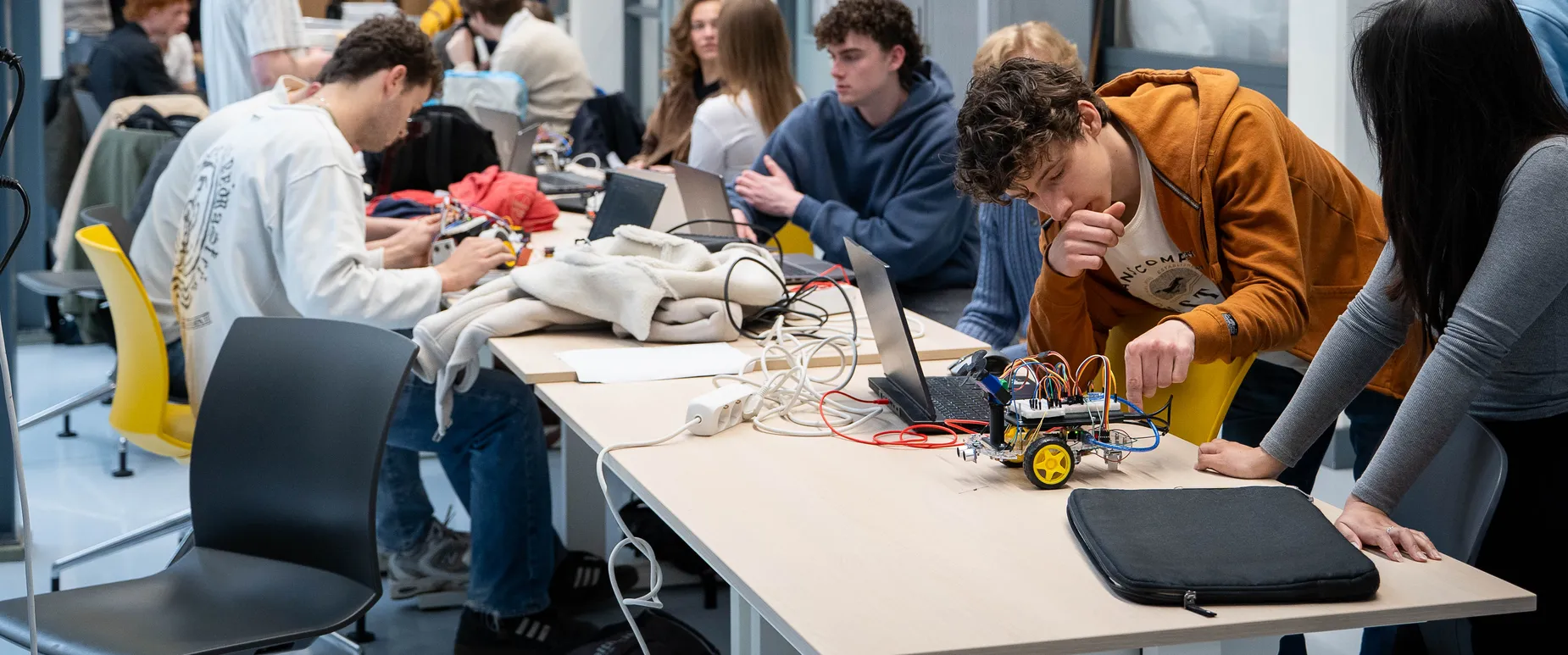
(Photo: TU Delft)
These are the MIRTE robots: a modular robot platform with accompanying learning pathways that enable students to build up their knowledge and skills step by step. They start with simple steps, such as making the robot move or controlling sensors. They then expand the system with additional components and software, enabling them to carry out increasingly complex tasks. According to the team, this step-by-step approach helps students maintain an overview in a subject area that normally demands a great deal all at once, ranging from mechanics to programming.
The idea is that students do not have to start from scratch every time, but can build on what they have already created. This makes it easier to tackle larger projects, such as robots that navigate autonomously or collect data. According to TU Delft, the platform can be used at various levels, from beginners to advanced students.
Faster learning
In a press release, the initiative’s founder, Martin Klomp, expressed his surprise at the win: “We already knew we were among the final three and that we would stand out with our tangible entry. But the fact that we would win really came as a surprise.”
Students learn more actively: ‘make mistakes, learn and carry on’
The lecturers say they have noticed that students learn more actively with their platform. “They make mistakes, learn from them and carry on. That’s exactly what you want in technical education,” says lecturer Gillian Saunders. According to the team, students are more willing to experiment and gain a better grasp of the subject matter.
A wide range of applications
The robots are used for various types of tasks. For example, students are building vehicles that avoid obstacles or systems that take measurements in a greenhouse. As the platform can be continually adapted, lecturers can use the same basic framework for a wide range of projects.
The award is intended to further develop educational innovation. The TU Delft team aims to expand the project and roll it out more widely, including beyond the university, for example in secondary education. In addition to Martin Klomp and Gillian Saunders, the team comprises Arend-Jan van Hilten, Demi van Kampen, Dante Williams, Martijn Wisse, Cilia Claij, Chris Pek, Carlos Hernandez Carbato and Jordan Boyle.
Other winners
The Education Awards have been in existence since 2021 and are regarded as the counterpart to major scientific prizes. Alongside TU Delft, The Hague University of Applied Sciences was also among the winners; in vocational education, the first prize went to Gilde Opleidingen.
Delta, Saskia Bonger/HOP, Bas Belleman
- Further information about the MIRTE project can be found here.
- More information about the Education Awards is available on the website of the National Knowledge Institute for Education (in Dutch).


Comments are closed.