

Tim van der Hagen was Chair of the Executive Board of TU Delft for 10 years. He was also Rector for the last eight years. He bid farewell in mid-January. Delta interviewed him about what he has and has not achieved, and what he will and will not miss. He once again apologised for the lack of social safety.

This year's Dies Natalis was also a moment of transition. Hester Bijl is the new rector magnificus. (Photo: Roy Borghouts)
This article in 1 minute
“Keeping an eye on the shop is too easy for me,” said Tim van der Hagen (in Dutch) when he became Chair of the Executive Board in 2016. His work did indeed become much bigger than that. The unrest in Europe caused by Brexit in 2016 was nothing compared to the geopolitical threat when Van der Hagen stepped down 10 years later. The war in Ukraine is still going on and TU Delft had to answer difficult questions about the genocide in Gaza. And in between there was the Covid outbreak and the Inspectorate of Education published a damning report about the lack of social safety at TU Delft.
These crises and concerns, and especially his accomplishments, were all mentioned at the farewell of the Rector Magnificus and Executive Board Chair on 15 January in Aula. He was described as ‘engaged, energetic, open and visible’, and he was said to have vision and courage. The warm connections with the Municipality of Delft and Erasmus MC, and the large number of companies that are now present on campus were all in part because of him, said the speakers.
What do think when you look back at your farewell week? You were highly praised and received three honours.
“It is wonderful, but at the same time makes me feel uncomfortable. After all, we did it together, with academics and non-academic personnel. It is often assumed that everything just goes on as usual, but to make this happen the non-academic staff work extremely hard. Students too have inspired me all these years. It is fabulous to talk to the new generation, with people who are really passionate and who will do things better.”
As a gift, you asked for donations to the Delft Global Scholarship Fund. Why that fund?
“It is good that young people get the chance to come here and financial inputs are sometimes needed for this. Investing in the Fund is so much more valuable that giving me a bottle of wine or a book. You then serve society and do something good that lasts.”
‘The government made a decision regarding academic ties with Russia. In the case of Israel, we had to make our own decision’
In your farewell speech you said that the events in the world are making TU Delft look more carefully at future scenarios and potential partners to continue safeguarding values such as academic freedom. How does this work?
“Previously, every few years we set a strategic course and it gave us direction in our work. But societal and international developments are now moving so fast that we have developed a method called strategic foresight. This is a system that allows us to be more aware of what is happening in the world and what potential impact there may be. We can then act and take steps quickly. One example is our Israeli partners.”
Why did it take so long to come up with the ‘no, unless’ policy for Israeli partnerships?
“What is long? These are highly sensitive and complex issues. For Russia we always said that academic contact is highly important so, as academics, let us stay connected. Then the Dutch government decided to cut ties with Russia. In the case of Israel, we had to take a decision ourselves. You do not do this overnight. It is complex as being a university, you want to stay connected with knowledge institutions. Unless they are explicitly connected to the army. We said no through the moral deliberation. You could say that it could have been done more quickly.”
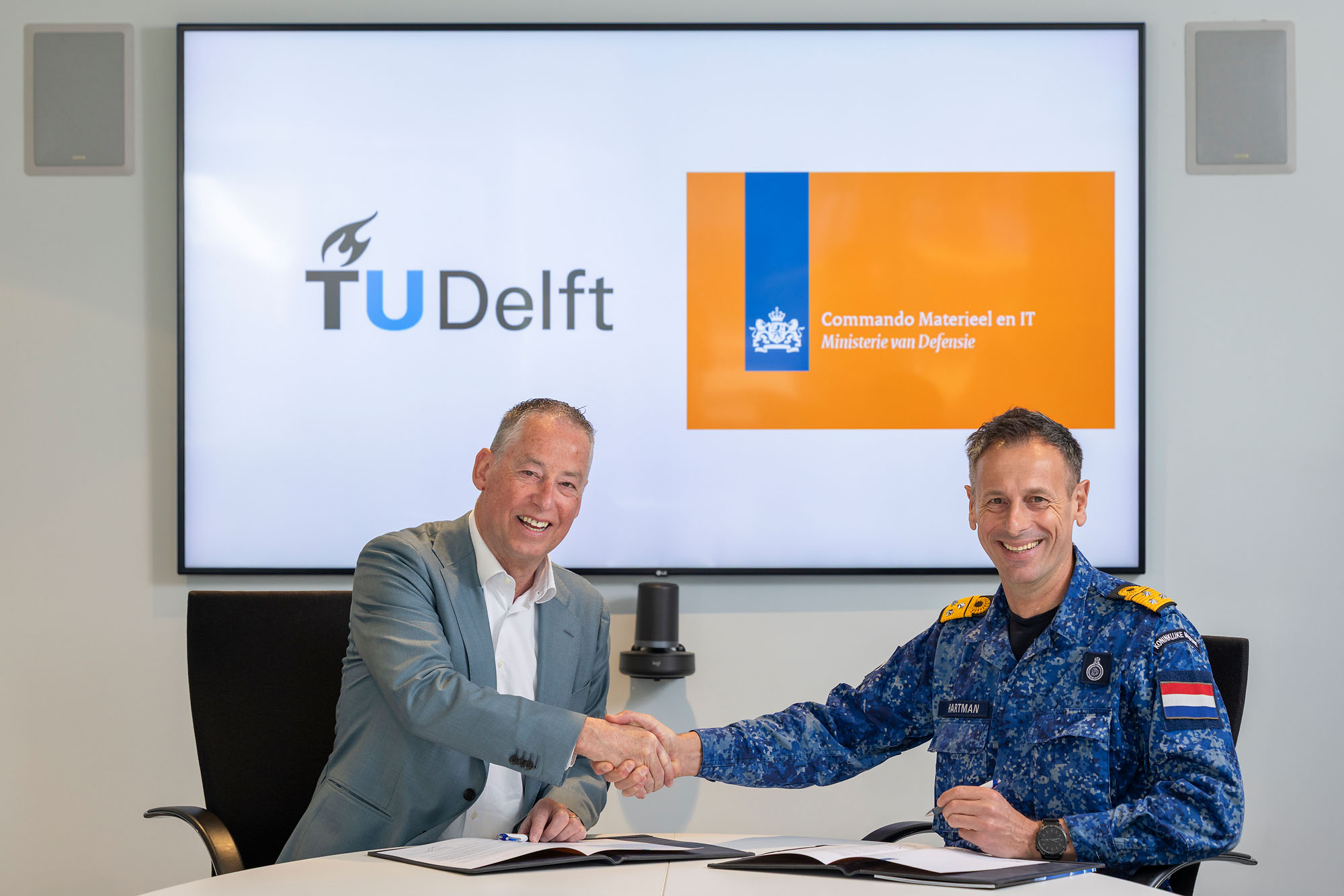
You signed (in Dutch) two declarations of intent with the Dutch Ministry of Defence. Why was no moral deliberation held before this?
“There is a huge amount of pressure, and has been for years, and it gets more urgent with every passing day. By signing, we primarily stated that we will work together and that TU Delft also sees the importance of contributing to our national security. It is not yet determined exactly what we will do. There will thus be a moral deliberation on this. We want to do this very carefully and not rush. After all, it concerns the values of TU Delft.”
What TU Delft values do you mean?
“You need to go back to the question of why we exist as a university. This is to make society better and not to occupy countries. Up to now, we have said that we will only work on subjects like security and self-reliance at low technology readiness levels . This is very fundamental research whose results can be shared externally as graduation reports or dissertations.
Dual use is also an interesting issue. Previously, it was mostly about how civilian research can be misused for military purposes. But it also works the other way around. A lot of security-related knowledge can also be used more broadly. And how should we deal with this? We need to talk about it.”
The Ministry of Defence can of course always call on TU Delft saying that it is in the interest of society that TU Delft works on radar systems or alternatives for the F35 aircraft.
“This is exactly why that moral deliberation is needed. It is not that black-and-white. We, as TU Delft, could decide that research on radar systems is in the interest of human welfare, but that individual researchers themselves cannot justify their personal involvement. Fine. There may also be people who do not want to work for an institution that works on radar technology. The only solution is then to work elsewhere.”
The second half of Van der Hagen’s term of office was a turbulent period for TU Delft. The Covid pandemic was hardly over when the Inspectorate of Education started an investigation into social safety at TU Delft. After a year and a half of investigation, the Government body concluded ‘mismanagement’, the worst conceivable qualification according to the education law. The conditions for employees had been neglected to such an extent that there was a ‘higher risk of the lack of social safety for all employees’.
After the university administration considered going to court and later rescinded, it slowly started taking action on the recommendations that the Inspectorate of Education had made. Among the outcomes was a social safety hotline and steps being taken for a new Code of Conduct. At the time of the last reappointment of Van der Hagen, the Inspectorate of Education’s draft report had already been made known. But it had not been shared with the representation bodies that also had a voice in the reappointment of Executive Board members.
‘We are now working a lot more on prevention, communication and aftercare’
The social safety issue has marked the last few years of your time in the Executive Board. Do you see it like this too?
“It is horrible what happened to some people. I sincerely offer my apologies as what happened here, happened under my watch. We have worked hard with a huge number of people, hundreds of them, to improve the situation. We called in support from specialists immediately. We are heading in the right direction, but we are not there yet. We now have to keep going.”
People are still reporting incidents and are often desperate.
“This is awful, and I really feel it. Yes, it is still happening. When I say that we are moving in the right direction, I am thinking that we can have discussions about social safety with each other. This is good. We realise that we still have a lot to do. We do not only have that system now, on which I relied much too much in the past, but we are now working a lot more on prevention, communication and aftercare. These aspects were not there before. We are still not there, absolutely not, but we are much further than we were a few years ago.”
It seems as though people who were accused of socially unacceptable behaviour now themselves feel less safe. They are not listened to, or only listened to late in the process. Do you recognise this?
“I think that it is now a lot better than it was a few years ago. At the time I saw that when people were accused, the people around them immediately started to talk about them and they did not dare enter the building anymore. My thought was that over a couple of months we would calmly investigate the situation and talk to everyone.
We have improved this by setting up a point of contact with a clarifying table. These are manned by professionals who can take action much faster. We still try to support both the person who lodged a report and the person that the report refers to. For administrators, this administrative balancing act is the hardest thing to do, including in the communications. So I recognise what you are saying, but I do think that things are better now than before.”

Is your departure related to the inspection report? The official story was that you left because the government model was going to change.
“That is not correct. I was rector for eight years, which is the normal term. The Dies Natalis is always the moment of transfer. So what was the problem? Rob Mudde had been appointed until 1 March 2026. Initially, the Supervisory Board felt it would not be convenient for us to leave at almost the same time. So they asked me to stay until my retirement in October this year. Ultimately, Rob left earlier due to personal circumstances. As a result, it was no longer necessary for me to stay longer, and a handover during the Dies Natalis was once again very logical. This immediately provided an opportunity to review the governance model. So that is the consequence, not the cause, of my departure at this time.”
Continuity was an important criteria of the Supervisory Board, but this is now not happening.
“That is a shame, but it was not intentional. Luckily Hester (Hester Bijl, the new Rector Magnificus, Eds.) is highly experienced, both with TU Delft and managing a university. So that is great. And Ingrid (Ingrid Thijsse, the new Executive Board Chair, Eds.) also has a lot of experience and a huge network. So I am very confident that things will turn out well.”
Upon taking office in September 2016, Van der Hagen said that he wanted to create a feeling of pride at TU Delft. “A feeling of ‘it is an honour to be able to work or study here and I am very proud that I am at TU Delft’,” the Administrator said in an interview (in Dutch) with Delta.
Staff members tell us that you exuded this sense of pride a lot, but that the other side of the coin is that criticism is not taken seriously that quickly.
“I recognise that. Social safety is the most striking example as I was in the angry and denial phase for a long time. My thought was that we were talking about TU Delft, a strong and great institution with wonderful people. But that does not mean that things were not right, that people were not hurt. I hope I listened enough and was open throughout my term.
For the rest, I took thousands of decisions throughout the years. Undoubtedly these included wrong decisions. It is sometimes like steering in the mist. You do not know everything, but something needs to be done. And this was certainly the case during the Covid period. People tend to think quickly that something is simple and needs to be done like this or that. But as an administrator, you have to deal with a lot of side effects and consequences. It is often that bit more complicated and you need more time.”
‘No, diversity is not yet there. Just look at gender’
In a farewell interview with TU Neuws (in Dutch) you say that you are proud that so many people were hired during your term of office who fit the culture at TU Delft. When does someone fit this culture?
“Over the years I talked to people who wanted to become professors about three times a week. I did not look at their research, but at who they were, what motivated them, how they viewed things, and what education meant for them. If you see education as secondary, you do not belong here. I looked for people who fit our culture of ambitious, pride and the desire to make the world a better place through good teaching and doing good research and doing it together. I was not looking for people who only said: ‘I am a top scientist, organise a lab and a technician for me so that I write even more papers’. Fine, but not for us.”
Is enough attention paid to diversity if you look at the TU Delft culture yardstick?
“No, diversity is not yet there. Just look at gender. We gave this much attention. I regularly spoke with deans about how things were going with female associate professors and assistant professors. But the staff turnover is very slowly so it is hard to change things quickly. And the austerity measures are of course disastrous as you have fewer available places. Diversity is also broader than that. It is also about ethnicity and religion. It is very white and Western-oriented here, so there is a lot of work to do.”
In terms of gender, could it not have been done differently? It is not a new phenomenon that we want and have to work on this.
“We have looked at this continuously. We just appointed Machiel van Dorst as the Dean of Architecture and the Built Environment. You cannot say not to appoint him because he is not female. All things considered, he was the best choice.”
If you had had a quota for the number of women, there would surely have been an equally good female candidate?
“We looked very deliberately at the faculty itself, asking who would be the best fit at this moment. That is, after all, Machiel. But you’re right. For at least four years there won’t be a woman in that position.”

In the interview, you said that you were proud that you hired people through your own networks. To what extent do you see a link with the lack of diversity in doing this?
“I hired a lot of people this way. You meet people at conferences who you think are doing well, are pleasant, and could be a good match. You then slowly introduce the person to TU Delft by having them come by and give a presentation. If you do this for a couple of years, that person may eventually join us. If you place a vacancy, you are dependent on who responds. You choose the best person out of 10 applicants, but you do not know for certain if he or she fits the culture.”
Is placing a vacancy not more honest and transparent? Academics from all over the world can apply. Everyone is biased in one way or another, and it is also the case for whoever you meet and talk to at conferences.
“You need to be able to wake up an academic in the middle of the night who should be able to name the top five colleagues in his or her field that he or she would like to have at TU Delft. And then not only researchers with track records, but those in their 30s too. And also other people in their field who are not white and Western. I realise that we are not there yet. It is your duty to continuously look around and seek diversity.”
‘For me, contact with people is a privilege’
You will still be around until October. What will you do until you retire?
“I would very much like to coach young academics, though coaching is a big word. I mean having conversations with them, listening to them and encouraging them. Young academics are often very worried about things like if they do enough for education, obtain enough grants, write enough papers, are visible enough and so on. They think that as long as they tick the boxes quickly they will make progress. I want to show them that they should also relax and continue doing the things that they were already doing. I hope I can give them a feeling of calm and value.”
What will you miss?
“The people. For me, contact with people is a privilege. I often walk around with a big smile on my face because of all the nice conversations I have.”
What will you not miss?
“That people can be unfair to each other by being judgemental while they only know 10% of the facts. People who can’t distinguish truth from stories, but have a big mouth about administrators or colleagues. I wonder why they do not simply drop by, ask questions, and ask why something was done. We can then explain the situation. I hope that in the future that discussion is a lot more human. First ask, then say if you agree or not, and hopefully in a more nuanced way.”

Tim van der Hagen (1959) was Chair of the Executive Board for 10 years and Rector Magnificus for eight years. He studied Applied Physics at TU Eindhoven and came to TU Delft 41 years ago where he then earned his doctorate. In 1999 he was appointed as Professor of Reactor Physics. He became Director of the Reactor Institute Delft (2005-2012) and later Dean of the Faculty of Applied Sciences (2010-2016). From 1 April 2023, he was a member of the Council of Commissioners of Gasunie. Van der Hagen lives in Delft and plays in a pop cover band.

Do you have a question or comment about this article?
delta@tudelft.nl


Comments are closed.