

Three top athletes from Delft have a chance of participating in the Olympic Games in Italy this coming February. Master’s student in Computer Science Tobias van den Hurk can qualify with the Dutch curling team in Kelowna, Canada, over the next two weeks. They’ll play their first match against China on Saturday, December 6th. How are things looking?
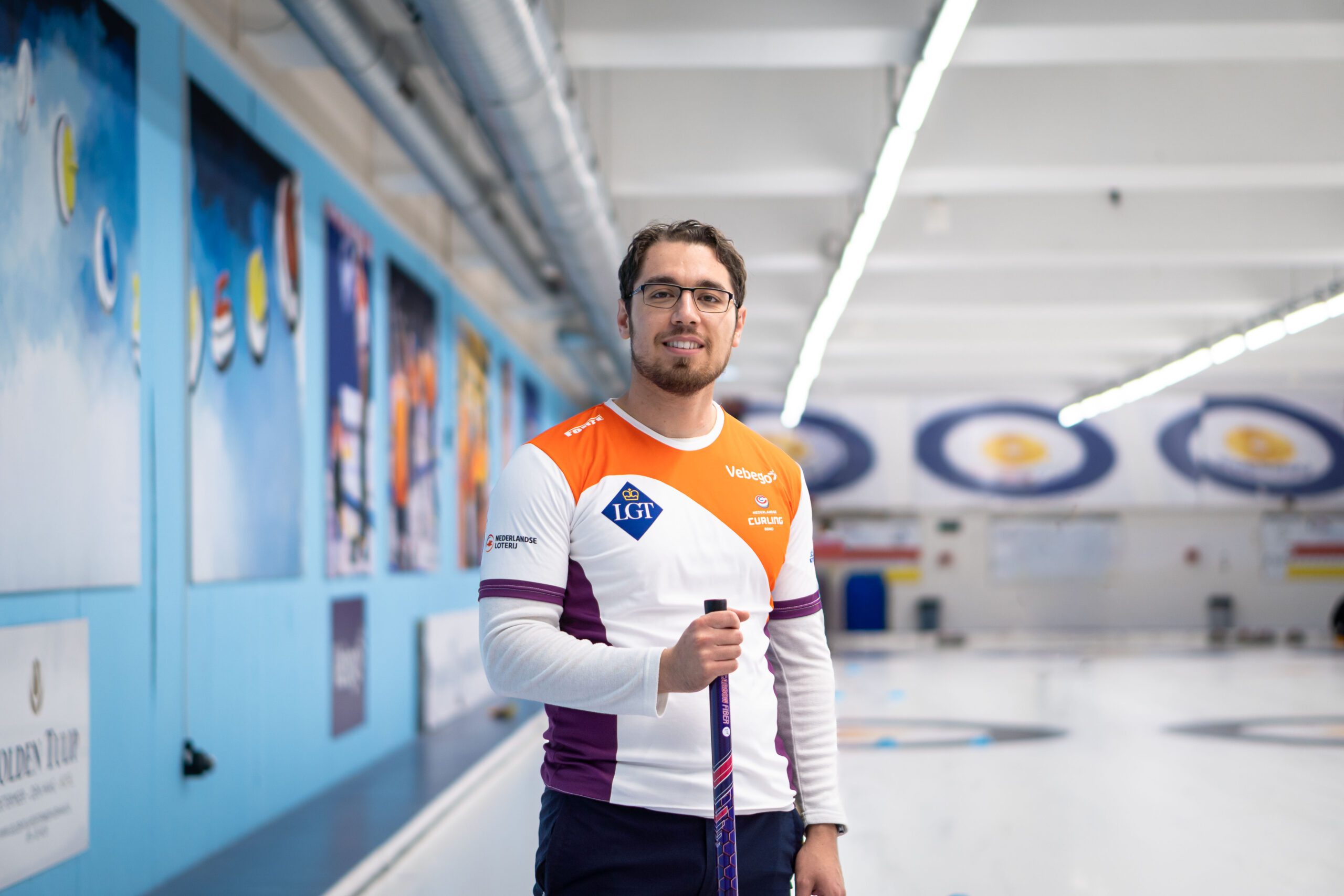
Master's student Tobias van den Hurk has a chance to qualify for the Winter Olympics with the Dutch curling team. (Photo: Thijs van Reeuwijk)
How did you get into curling?
“I grew up in Zoetermeer, home to the only real curling rink in the Netherlands. When I was ten, I saw a newspaper article about an open day. I went along to try it, and it stuck. Since 2022, I’ve been part of the full-time men’s selection.”
What’s your role? Do you throw or sweep?
“Both! That’s the standard question at parties. In curling, all four players throw two stones each in turn. I go first, as the lead. While a player throws, two others sweep and one stands at the far end: the skip. He stands at the house, where the stones need to go, so he directs how you should throw. Traditionally, the skip throws last. He’s decided the strategy, so he finishes it off.
The skip doesn’t sweep, and you can often tell. In a team, you’ll see three ‘well-built’ players while the skip can be a bit slimmer. He mainly needs to think.”
What do you like about curling?
“It is very varied. I throw as lead now, but I have played other positions in the past. I don’t just throw; I sweep as well. Plus, you need to think ahead, judge where the stone will end up, and communicate with your fellow sweeper and the skip. So you’re doing a lot at once.”
We want to make it look easy, while it is actually very difficult
How do you train?
“You can practise throwing on your own, but with your team you practise more the way it works in a match. We also do plenty of fitness and strength training in the gym. For curling, you really train the whole body. You need a lot of balance, but also strength, precision, and control for your sliding. And for sweeping, there’s more excercises.
We want to make it look easy, while it is actually very difficult. With sweeping, people think ‘oh right, just a bit of broom work’, but that is really tough, and we spend a lot of time in the gym for it.”
Do you sweep with an ordinary broom?
“They used to use real straw brooms, but now they’re highly advanced. A few years ago, a very hard broom came out that could influence the stones a lot. The manufacturer had applied for a patent on it. For a long time, we were at a disadvantage compared to teams that used that broom, until our brand also started making harder brooms. Last season, even harder brooms appeared, but then the World Curling Federation intervened. Now there are rules so everyone should have roughly the same broom. You want player skill to matter most, not broom technology.”
What does your life currently look like?
“My life is mostly curling and studying, but luckily I still have some time for hobbies. I did my master’s degree at two-thirds of the normal workload and am now working on my master’s thesis. That can be planned flexibly, but I have to make sure I have some free time left. Every two weeks, I have a meeting with my thesis supervisors, during which I try to set realistic goals for how much time I will put into it. Then it all works out fine.”
What are your chances of qualifying?
“That is difficult to say. There are many good teams and, essentially, too few spots. So, good countries will miss out. But the season is going reasonably well, so it looks promising.”
This would be the first time a Dutch curling team has qualified for the Olympic Games. How does that feel?
“Exciting, but I try not to think about that too much. I focus on what I can control.”
Curling explained
In curling, two teams of four players compete on a rectangular sheet of ice. They take turns sliding (‘throwing’) granite stones weighing nearly 20 kilos towards the “house”, a circular target at the end of the sheet. The player throwing the stone may only touch it during the first section of the lane. After that, two teammates can influence the path of the stone by sweeping, melting the top layer of ice. The aim is to place your stones closer to the centre of the house than your opponent’s. A match consists of eight or ten ends, with each team throwing eight stones per end.
Vital to the sport is an attitude known as ‘The Spirit of Curling’, Tobias explains: “Curling started as a gentleman’s sport. Umpires are rarely involved. For example, if someone accidentally moves a stone, you discuss where it should be placed. This attitude sometimes takes precedence even when a team could technically appeal to the rules: “You want to maintain a good reputation. If you are nice to others, they will be nice to you.”
Programme Olympic qualification event in Kelowna, Canada
Team NL men
December 6, 6:00 PM: China-Netherlands
December 7, 4:00 AM: Netherlands-Japan
December 7, 11:00 PM: New Zealand-Netherlands
December 8, 6:00 PM: Philippines-Netherlands
December 9, 4:00 AM: Poland-Netherlands
December 9, 11:00 PM: Netherlands-South Korea
December 10, 6:00 PM: United States-Netherlands
December 11, 4:00 AM: Semifinals
December 12, 12:00 AM: Final
Dutch time. In Kelowna, it’s 9 hours earlier.
Who: Tobias van den Hurk
Date of birth: 8 December 2000
Study: Computer Science (master)
Sport: Curling
Club: Curling Club Prins Willem-Alexander, Zoetermeer
Team: Dutch men’s curling team
Status: The team can secure a spot at the Olympic Winter Games during the qualification tournament from 6 to 19 December.

News editor
Emiel Beinema
Do you have a question or comment about this article?
E.S.Beinema@tudelft.nl


Comments are closed.