

Student Jesse Pieper puts all his time and money in fencing. His goal: the 2032 Olympic Games in Australia. “It is often impossible to see with your bare eyes who hits who first.” This is the fifth and last part of our series about unknown student sports.
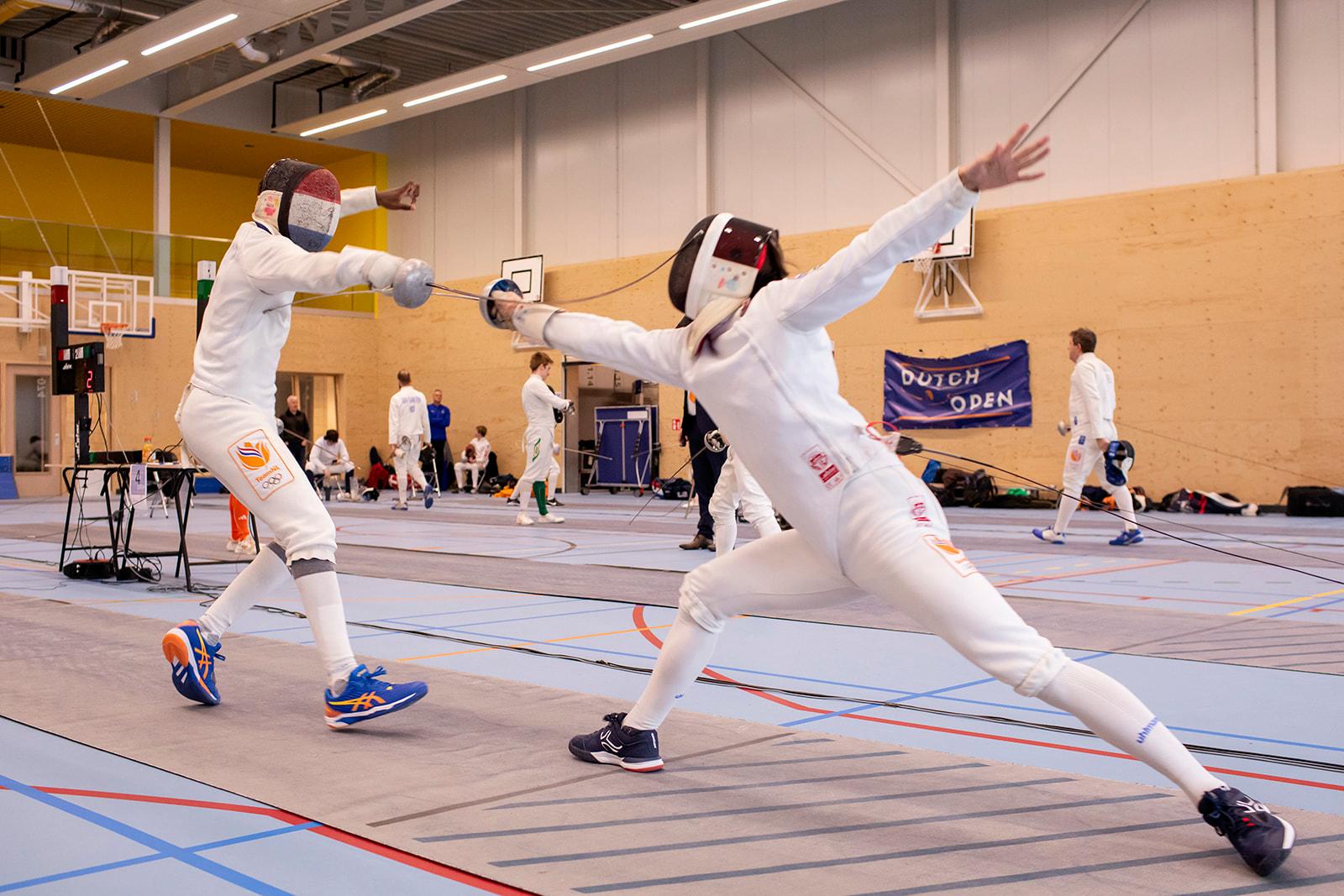
Jesse (right) at the Dutch Open in 2023. (Photo: Isabel Erkemeij)
What is fencing?
Fencing is a combat sport in which two opponents try to touch each other with a weapon while not being touched themselves. There are three different weapons in three categories: foil, épée and sabre. Each weapon entails different rules and targets. Competitions end when 15 targets are touched or after three times three minutes of pure play. This is the time in which the opponents are fighting. Pool bouts end either after five hits or one period of three minutes.
What do you enjoy about fencing?
“I especially like the speed. It is a very explosive sport. It is also tactical. It is like playing chess at 200 kilometres an hour. It is often impossible to see who hits who first.”
Why is the suit white?
“It’s tradition. Fencing used to be done with a sharp point. You bleed if you get hit, and blood is most visible on a white background. The épées don’t have sharp ends anymore. Both the épées and the suit have wires so that if you are hit, an electric signal is sent to the scoring equipment.”
Does it hurt if you get hit?
“I don’t feel the pain anymore. I used to often go home with painful bruises, but this is a lot less now. My body has got used to it. If you get hit 100 times on the same place, after a while your body does not get a shock anymore.”
Is fencing an expensive sport?
“It is not cheap. My entire salary and basic grant go straight to fencing. I have to replace the blade of the épée six or seven times a year. The big factory where these are made is in Ukraine, so the price has really risen since the war started. One blade now costs about EUR 180, while they used to be EUR 120. So add it up. On top of this, there are the costs of the training, competitions, airfares, hotels, entrance fees, referees etc.
‘I am busy, but I can do everything’
You study in Delft, live in Leiden and train in Den Bosch and at the Papendal professional athletics centre in Arnhem. You also regularly go abroad for competitions. How do you combine all of this with your studies?
“I’m taking longer to do my course. I often study in the train so the travel time is not that bad. The trainer always picks me up from the stations and this makes a difference too. I also work in the hospitality sector two evenings a week to pay for my competitions abroad. I am busy, but I can do everything.”
What was the high point for you?
“At a major tournament in Colmar, France, in 2022, I got through to the second day before I lost. I was among the remaining 64 competitors out of 300. It was very special to be able to fence there. You look around and you see someone that you have watched on TV. And then you see the Olympic champion.”
Do you have a special ritual before competing?
“The team and I always have Italian food the evening before. It means that we ingest a lot of carbohydrates. It also means that the chance of indigestion abroad is small. If you eat in a backstreet somewhere, you may have stomach problems. Things are always fine with pizza or pasta.
Then we work on our weapons. There is a contact spring in the point of the weapon. If you screw it properly, the spring makes contact faster if you hit the other person. You want it to go off as fast as possible without infringing the rules. This is always a precise job.”
What is your ultimate goal?
“The Olympic Games. I have watched them on TV since I was little. It is the most prestigious tournament there is. The Games in Los Angeles in three years’ time may be too early, so I have set my sights on 2032.”

Who: Jesse Pieper (21)
Study: Bachelor Systems Engineering, Policy Analysis and Management
Sport: Fencing
Association: Schermclub Den Bosch, Team NL

Do you have a question or comment about this article?
A.I.Elias@tudelft.nl


Comments are closed.