

Queuing for Coffee Star, the food truck, or – like last week – at the polling station is, of course, never fun. Or is it? Can standing in line be fun? What does it depend on? Delta takes a closer look at standing in line.
This article in 1 minute
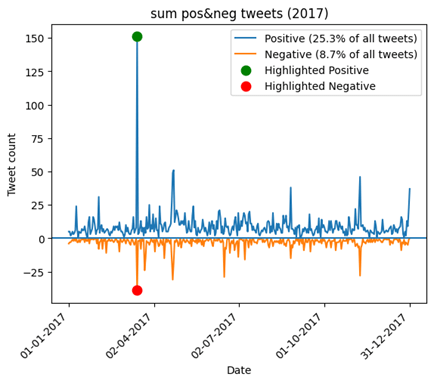
March 2017, elections. Not like last week for the municipal council, but for the House of Representatives. Turnout is quite high. At several polling stations, extra ballots have to be brought in. People are standing in line. And what do you do when you’re standing in line in 2017? You tweet (the platform X was formerly called Twitter). Quite a lot is tweeted that day about “standing in line.” And strikingly, it’s mostly positive. “Happy in line #ivoted.” “In line (6:41) to pay tribute to our #freedom! #ivoted.” “People are standing in line to vote. It makes me so happy and joyful. <3”
On other days people may be less enthusiastic (#fail #checkout #takeslong), but while voting, standing in line becomes something positive. That’s evident from an analysis of tweets conducted by Robert Jan Bood of SURF for Delta. At least in 2017. For other election years, such a positive queue peak is not clearly present. Is our feeling about standing in line changing?
Feeling in traffic jams
Let’s first take a closer look at our feelings about standing in line. Since being stuck in traffic is also a form of queuing, we ask Marjan Hagenzieker (Traffic and Transportation Safety Lab). As a traffic psychologist, she has been researching behavior in traffic for years, as well as people’s emotions and moods while driving. “Whether you get angry in a traffic jam depends partly on your personality; some people are more affected than others,” Hagenzieker explains. “If people feel they are being deliberately hindered, they get angry. But if—like last winter—there are huge traffic jams due to icy roads, people hardly get angry. It’s beyond their control, and therefore easier to accept. This consistent pattern appears in all studies.”

You can also get used to queuing. “If there are frequent traffic jams on a particular stretch of road, it’s not very productive to get angry about it every time,” explains Hagenzieker. “But if you need to be somewhere by a certain time and you can’t make it because of an unexpected traffic jam, you quickly get irritated.”
Controlled queue-jumping
Your expectations and sense of control are therefore important in how you experience a queue. Someone who cleverly capitalises on this is behavioural economist Anouar El Haji (UvA). He became intrigued by the phenomenon of queues whilst waiting in a long line at the airport. “A couple of rich types turned up far too late for their flight and wanted to jump the queue, but had to wait their turn in the queue. As an economist, I thought: this is hugely inefficient. I’m at the front of the queue and I’m far too early. If they pay me, I’d be happy to swap places.”
He couldn’t put his plan into action in that particular queue, but back at university in Amsterdam he decided to investigate it: what if you could sell your place at the front of the queue for a fee? “So it’s not about the fast pass you sometimes see at theme parks, or the priority service offered by airlines; it’s not a queue-jumping pass that puts others at a disadvantage. Everyone has their place in the queue, but you can sell your place at the front of the queue to someone who is in a great hurry, for example, and then go to the back yourself.”
According to El Haji, this makes queues more efficient. “By that I mean that people become happier with their position in the queue. The person who needs money gets money. The person who needs speed gets speed. Everyone becomes happier.”
The Panama Canal got so busy that they introduced an auction where you can sell your place in the queue
For the experiment, participants at the CREED lab at the University of Amsterdam were assigned a random place in a queue. “When it was their turn, they were allowed to leave the lab; otherwise, they were forced to wait until it was their turn and they could receive their payment. So you could get even more money if you swapped places with someone who had to wait longer, or you could pay money to go ahead in the queue,” says El Haji. “It had already been studied mathematically, but we are the first to have proven it in practice: it works.”
El Haji sees a wide range of applications, extending beyond just physical queues. “Think also of waiting lists for a place in a nursery, a connection to the electricity grid, or waiting lists in healthcare or for social housing.”
Application in healthcare or the housing market seems unlikely; surely no one would say, ‘I’ll just wait a bit longer for that heart or that council flat’? El Haji: “It really becomes an ethical issue: why shouldn’t you have the freedom to have a say in that yourself?”
Perhaps the mechanism has more applications in the business world. “The Panama Canal is a good example. There is limited capacity. It got so busy that they introduced an auction where you can sell your place in the queue. It’s bizarre to see that there are ships willing to pay millions to gain a time advantage and be the first to sail through. This highlights the value of time, which is often hidden.”
How do you prevent people from queuing up everywhere in the hope of getting rich from their position? “The money may only be spent on what they are queuing for. That removes the incentive to just join a queue anywhere.”
Happier in the traffic jam
So, having more control helps make queuing a happier experience. Can this be applied to traffic? There, it’s not possible to temporarily give up your place in exchange for payment. Marjan Hagenzieker: “Providing more information whilst driving – such as the estimated time of arrival – helps people feel more in control of the situation, making them less negative. Or putting on music that cheers you up, or soothing music so you don’t get so worked up. But I’m not aware of any research showing that people are happy in a traffic jam.”
Happy in a traffic jam: turn it into a game
Joost de Winter from the Cognitive Robotics department (ME) is investigating how tools can improve the driving experience. Because not every new technology makes for a happier time in the car. “Sometimes technology works quite well, but there are certain parts of the system that are frustrating, causing people to switch the system off. We call that disuse.”
De Winter cites lane departure warning as an example – a system that alerts the driver if they drift out of their lane. “It works very well, but if the system beeps too much, people switch it off,” says De Winter. One idea that is already being extensively researched, particularly in driving simulators, is gamification: turning it into a game. Think of points for merging smoothly, or giving feedback to other drivers. “We’re already using this in education; game elements ensure high engagement. I see no reason why it should be any different behind the wheel.”
Are we getting better at ‘queuing’?
Queuing, whether in a traffic jam or for a cup of coffee, can be made more enjoyable by having more control or interaction. But as to whether we are getting better at queuing – that is, whether our feelings about queuing are changing – we do not yet have a ready-made answer. Hagenzieker: “But as far as I know, no comparative research has been done on this.”
So let’s go back to Robert Jan Bood at SURF to see if there is more to be gleaned from his Twitter data.
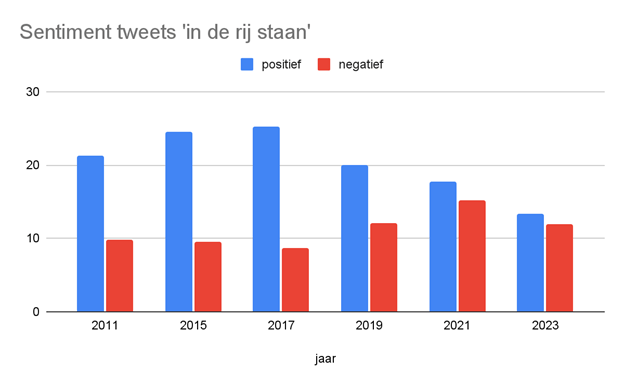
Bood analysed the sentiment of tweets relating to ‘queuing’ throughout the entire (election) year over a longer period. Up to and including 2017, the percentage of positive tweets increased annually, after which it declined. Bood himself has a few reservations about the analysis, but if the measurements are accurate, the positive attitude towards queuing declines. What could be the reason for this?
Food truck
A stroll across campus shows that students, at any rate, don’t seem to have a problem with queuing. The queue for the two food trucks stretches to over 20 minutes. “It’s a chance to catch up with friends in the meantime,” says Renardo. “It’s all part of the experience; it helps that the sun is shining,” says Daria. “We did choose the shortest queue, though.” “If there’s no queue at a food truck, that’s actually a reason not to go there,” say Mees and Huub.
‘Find a distraction, for example on your phone’
An interesting point: the queue as a recommendation – that’s what Anouar El Haji picks up on. “It has a signalling effect. Think of TikTok. Queuing can be a ritual you want to be part of. The purpose of the queue, ‘the good cause’, means that a long queue at the ballot box can be a positive thing. Or if you’re on holiday, you have time and you accept the queue. Perhaps the queue even validates your presence.
And it could be a cultural thing: in New York, people are happy to queue for half an hour for a coffee at a trendy café. You’re seeing that more and more in the Netherlands too. At the same time, companies like Flink are emerging that offer super-fast delivery. People place a high value on their time.”
‘Trick the time’
Or could a changing attitude towards queuing have another reason? “Find a distraction, for example on your phone,” suggests student Eneya from Milan, queuing at the food truck, as a tip “to trick the time going”. “If you’re on your phone anyway, you might as well be queuing,” says Huub whilst waiting for his lunch.
The smartphone is, of course, something we didn’t have in the past. A bit of swiping does indeed seem to make time pass more quickly, which probably everyone can confirm from experience. “The smartphone is a pacifier for adults,” says El Haji. “Even with a smartphone in their hands, people still want to be served quickly.”
According to the behavioural economist, sometimes you might even want to deliberately create a queue or waiting list. “Think of the Birkins of this world, the most expensive handbags. Just popping into a shop isn’t an option. To get your hands on a limited-edition Ferrari, you have to submit a CV. The waiting list and the associated waiting time contribute to the exclusivity.”
The future of waiting
So waiting can actually be enjoyable, it seems that our experience depends on control, expectation and meaning. But it’s difficult to determine whether we’re actually getting any better at it.
And how about the traffic jam, an unsolvable queue, can that final queue be tackled too? Marjan Hagenzieker: “Researchers are already working on making self-driving cars drive in such a way that you don’t feel sick, and can do something else, such as look at a screen or read a book.” Joost de Winter adds: “Driver assistance systems are taking over more and more tasks. On the motorway, you hardly have to steer yourself at all already. The car is thus changing from a means of transport into a place where you can make the most of your time.”
So perhaps it is not a question of whether we are getting better at waiting, but whether we will still perceive it as waiting in the future.

Do you have a question or comment about this article?
[email protected]


Comments are closed.