

Millions of euros are being channelled into research and innovation via the Ministry of Defence. This will start next spring, when scientists in the field of quantum technology will be able to submit research proposals.
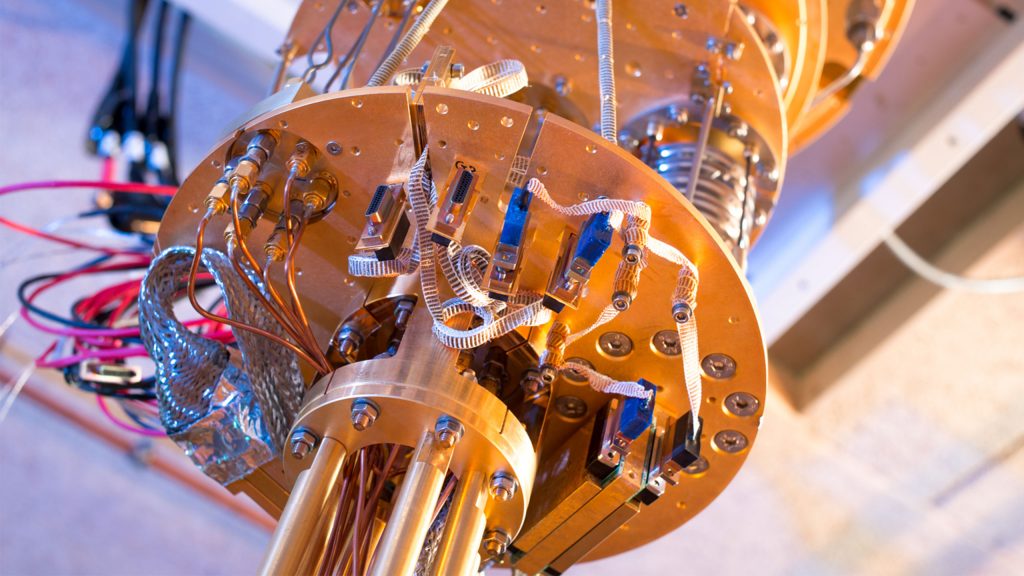
Quantum technology can be used to improve weather forecasting, but also to crack codes, for example. (Photo: QuTech)
Millions of euros are being channelled into research and innovation via the Ministry of Defence. This will start next spring, when scientists in the field of quantum technology will be able to submit research proposals.
The Dutch Ministry of Defence sure could use some knowledge and innovation, according to the Dutch government. The armed forces are mainly interested in smart materials, sensors, space technology, intelligent systems, and quantum technology. The government announced these five areas last April.
The Dutch Research Council (NWO) will distribute 35 million euros for research. The first call for proposals from scientists in quantum technology will be published online after the turn of the year, according to an update to this defence strategy sent to the Dutch House of Representatives by outgoing Minister of Defence Ruben Brekelmans on Monday.
Cracking codes
Quantum technology is expected to lead to superfast computers, among other things. Chips in ordinary computers use ones and zeros. But according to the physical insights of quantum mechanics, the state of the smallest particles is sometimes indeterminate. This makes it possible to develop computer chips that can be both one and zero at the same time. Once stable systems can be built with this technology, the computing power of computers could increase exponentially.
Quantum technology can be used to improve weather forecasting, but also to crack codes, for example. It could also be used to build a new type of sensor. The military applications appear to be countless.
Quantum and Airbus
TU Delft seems to be a logical future partner for the Ministry of Defence in this area, because the university is a leader in quantum technology. The business community recognises this too. Just last week, it was announced that TU Delft had signed a new memorandum of understanding with French aircraft manufacturer Airbus. The two have been conducting joint research into sustainable aviation and aerospace since 2023. Now there are plans for quantum research in aerospace. This includes quantum-inspired algorithms for optimising composite fuselage panels.
The aircraft manufacturer and TU Delft will also hold exploratory talks on establishing an Airbus university chair at the Faculty of Aerospace Engineering (AE). AE expects that this potential chair “could be a catalyst for all kinds of opportunities, from talent development to research and innovation”.
HOP, Bas Belleman/Delta, Saskia Bonger


Do you have a question or comment about this article?
[email protected]


Comments are closed.