

Hydrogen powered aeroplanes, quieter wind turbines, satellite technology and drones. A lot of drones. At the Aerospace Innovation Hub DEMOday (at Aerospace Engineering), start-ups tumble over each other to give the best pitches. They have one thing in common: potential interest from the Ministry of Defence.
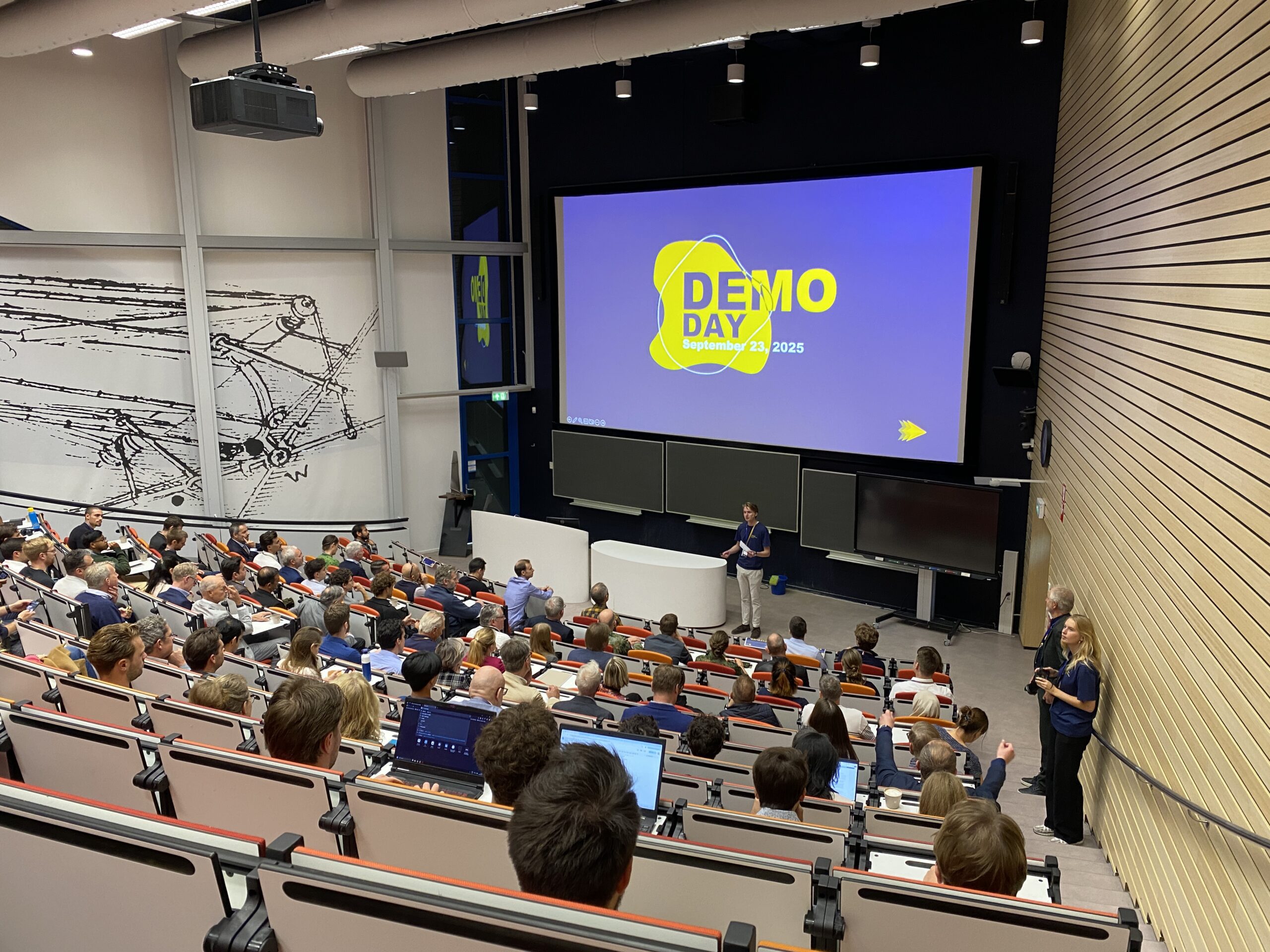
DEMO-day aerospace innovation hub. (Photo: Judith Laan and Jasmijn Smit)
Almost all the pitches had one thing in common: an emphasis on defence and security. The connections between the Faculty of Aerospace Engineering, innovative start-ups, and the Ministry of Defence are increasingly strong, especially in the area of space technology. “Yes, they have gone up a notch,” confirms David de Groot, Innovation Manager at the Ministry of Defence. He was at the Aerospace Innovation Hub DEMOday at the Faculty of Aerospace Engineering last Tuesday, looking for new groups to work with. “The developments over the last few years have meant that our innovation centres are growing and developing more strongly. TU Delft is unique in the area of aerospace engineering and that is why we are here today.”
He has already talked to various start-ups, including companies in the area of artificial intelligence and data processing. Can De Groot clarify what they are looking for? He refers to the incidents with unidentified drones in Danish airspace last week. “If you see all the developments around unmanned systems and drone detection in the news, you understand the interest in counter-drone systems. The start-ups that pitched here are all highly relevant.”
Enemy drones
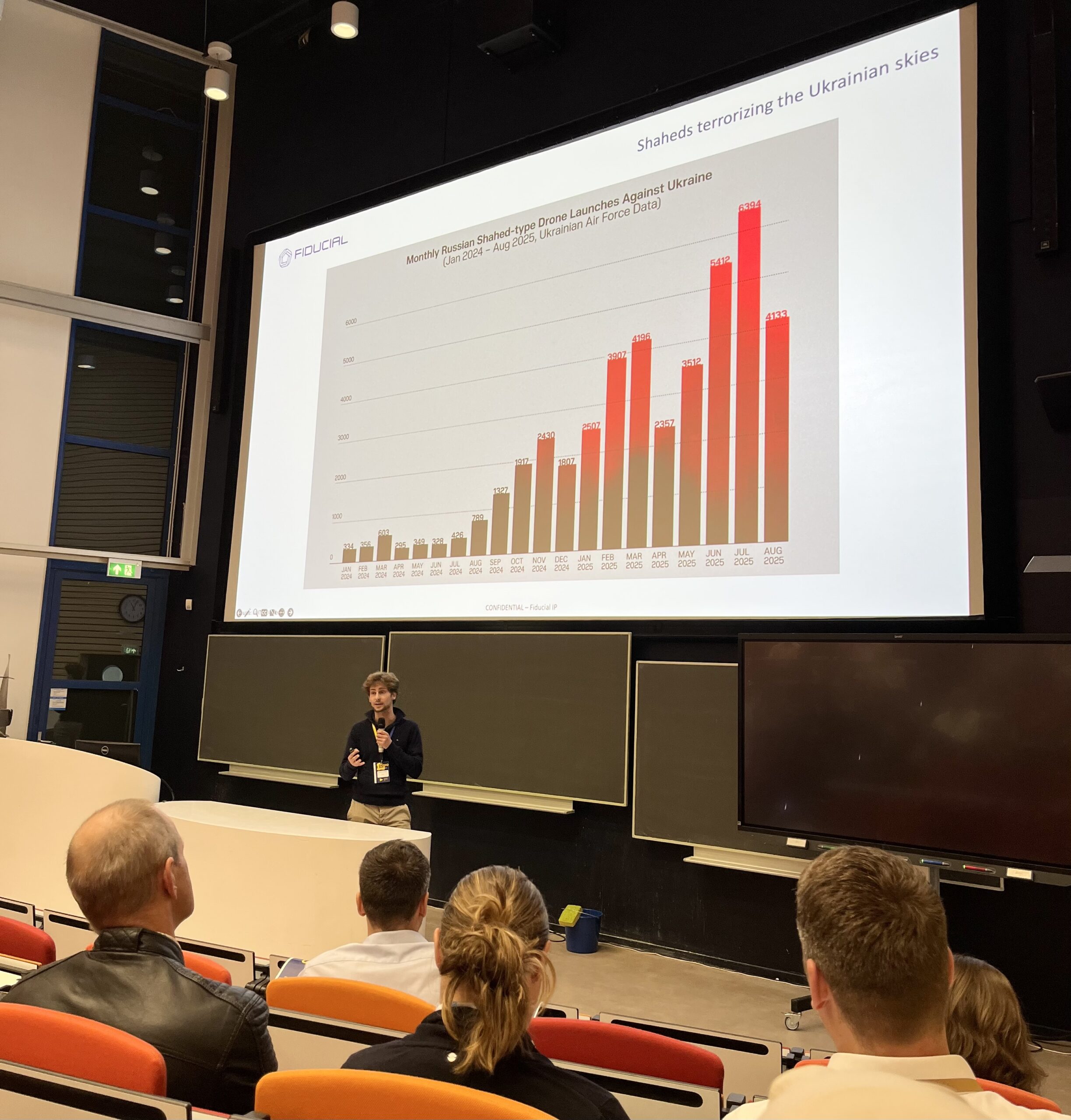
One such pitch was by Andreas Verbruggen, Chief Executive Officer and co-founder of Fiducial, a company that works on highly accurate positioning and data processing for drones and robots. Verbruggen mentions Shaheds – unmanned drones packed with explosives – that are terrorising Ukraine. At the beginning of 2024 there were a couple of hundred Russian Shahed type drones a month, but now this numbers thousands.
‘We cannot say too much about the interception tests for security reasons’
Fiducial’s mission is to use drones to automatically detect and take out enemy drones. They are working closely with the Dutch and Ukrainian Ministries of Defence. “We will perform interception tests either this week or next week, but for security reasons, we cannot say too much about this,” says Verbruggen.
One project that he can say more about and what they will test at the end of this year is the use of an array of cameras to identify small drones and to determine their route. “This can be done with a radar, but that is more expensive. Further, cameras are passive. In contrast to radars, they do not emit signals and are thus incognito.” The video demo shows how the software detects a bird. The difference between a drone and a bird is recognisable by the flight pattern.
So what’s next? Drones that move like birds to avoid detection? “Maybe. It’s definitely a race,” Verbruggen says with a touch of enthusiasm in his voice. “Of course I’m passionate about the company, and these are very interesting technical problems.” At the same time, he has mixed feelings. “You don’t want war, but you can’t take peace for granted. The company is moving in this direction because of necessity.”
Drones can be used for defense purposes, but of course, their potential goes far beyond that. So, what’s the next step? “I don’t feel very comfortable sharing that.”
Navy tender
Among the tables promoting the various start-ups and student teams, is the Aerogrid stall. They are presenting an unusual drone that can turn from a helicopter into an aeroplane. Energy efficient, says Tomaso De Ponti, co-founder and Chief Executive Officer. The aeroplane drone can lift off vertically and fly horizontally so that it has a longer range than other drones. It can also be used in strong weather conditions, as a film taken from a ship shows. “The current limit for hybrid drones is wind speed 4.5, but we can go up to wind speed 7.5.”
The small prototype looks fragile, especially when the system transitions from a drone to an aeroplane while flying in the air. De Ponti says that “In real life the aeroplane drone has a wingspan of three metres, weighs 25 kilos, and is able to fly for at least four hours. We test both the hardware and the software every day. We have submitted a tender to the navy.”
Swarms of collaborating drones
A couple of tables further on is Stijn Lafontaine of Emergent Swarm Solutions. The first partner he names is the Ministry of Defence. Why is the Ministry of Defence interested in swarms of drones? “The Ministry of Defence wants to safely collect data from dangerous environments. We can have the drones cooperate in a way that is decentralised. They communicate directly with each other without needing the usual tools such as satellites or transmission towers.” The drones map an area and return to deliver the data in time, which is useful in times of war. The next test is to have the drones fly through a village. That sounds interesting. “I don’t know if Delta may be there as the Ministry of Defence is generally quite strict about what they want to show.”
‘We would go for a safer world above extra income’
Lafontaine is happy with the additional financing that these dark times bring. “But our swarm technology is also relevant for civilian purposes, such as search and rescue missions and monitoring forest fires. Financially, the current situation may be better for us, but we would go for a safer world above extra income.”
Michelle Jagtenberg, a D66 party candidate for the House of Representatives who works at the Netherlands Aerospace Centre, walks around the various demonstrations with great interest. She also sees the Ministry of Defence’s increased interest. “When I studied here, it was almost taboo. But it is understandable – war speeds up technical innovation.” Jagtenberg’s goal today is mostly to get ideas from the people and start-ups present. “It’s wonderful to see these young people putting their heart and soul into their start-ups and innovations. I would like to help them turn their dreams into reality through politics. And to let a Dutch pearl grow into a European champion.”
From student team to a company worth millions
One such inspirational example is Jeroen Wink, co-founder and Chief Revenue Officer of Dawn Aerospace. In a presentation he explains how the company grew from a student team aiming to shoot a rocket into the air as high as possible into a company worth millions in just seven years. The company employs 120 people, has built 167 thrusters on 38 satellites orbiting the earth, has plans to refuel satellites, and so on. “We signed our satellite operator license with the Dutch Government last week. We are the first company that will dock with another satellite. Not bad for a company that, seven years ago, was still running tests with wooden constructions on the Architecture and the Built Environment field.”
And Wink has achieved even more with Dawn Aerospace. The company designed its own unmanned hypersonic aeroplane, whose initial purpose was to deliver satellites into Earth orbit. But given competition from SpaceX and increasing international unrest, the company is now also working on a different types of flights. “There is growing demand for affordable, repeatable methods to test thrust at high speeds in low Earth orbits. The next users will be defence users.”
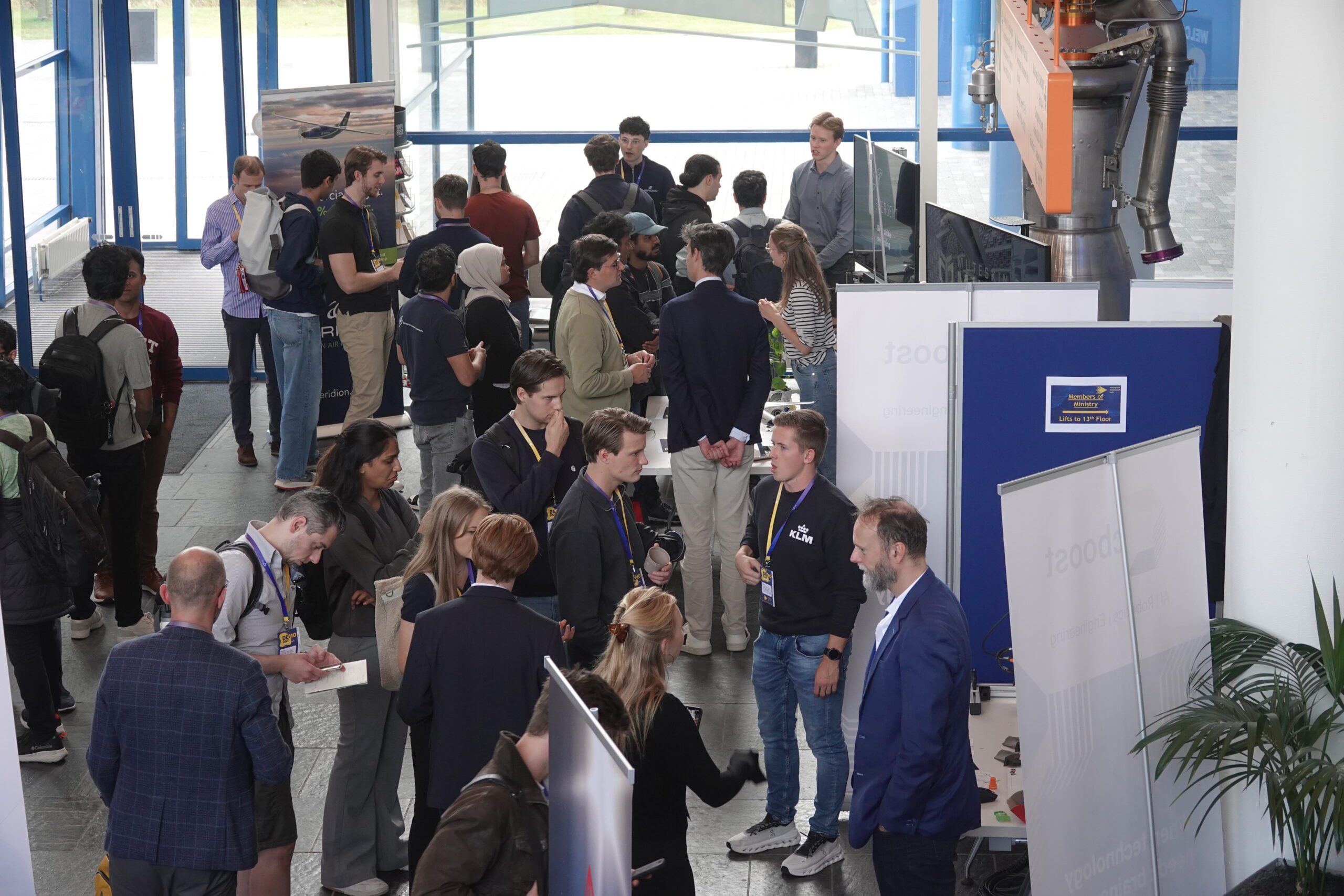
Wink calls for thinking big in his presentation. The audience, made up of students, researchers, start-ups and investors, listens closely. The DEMOday shows that the differences between civil and military applications are becoming more hazy given aerospace innovations. It is impressive to see how quickly the technology is developing and the new potential that there is. But it is also a reason to think things through. Is this a desirable development? How can we make sure that innovation always remains safe and societally responsible?
‘We expect that we will be defended should we be attacked’
In response, Constantijn van Oranje, as the figurehead of the Techleap innovation platform, wants to add something. “We expect that we will be defended should we be attacked. But the means to do this will not drop from the skies. To remain independent and safe, we need to make investments and develop technology ourselves and not be entirely dependent on external suppliers. It is very important for universities to work with the Ministry of Defence, both for observation and defence purposes, as well as for offence should that be needed. We need to be honest about this and universities need to speak up about this.”

Do you have a question or comment about this article?
[email protected]


Comments are closed.