

Nobel Prize for founders of quantum computer
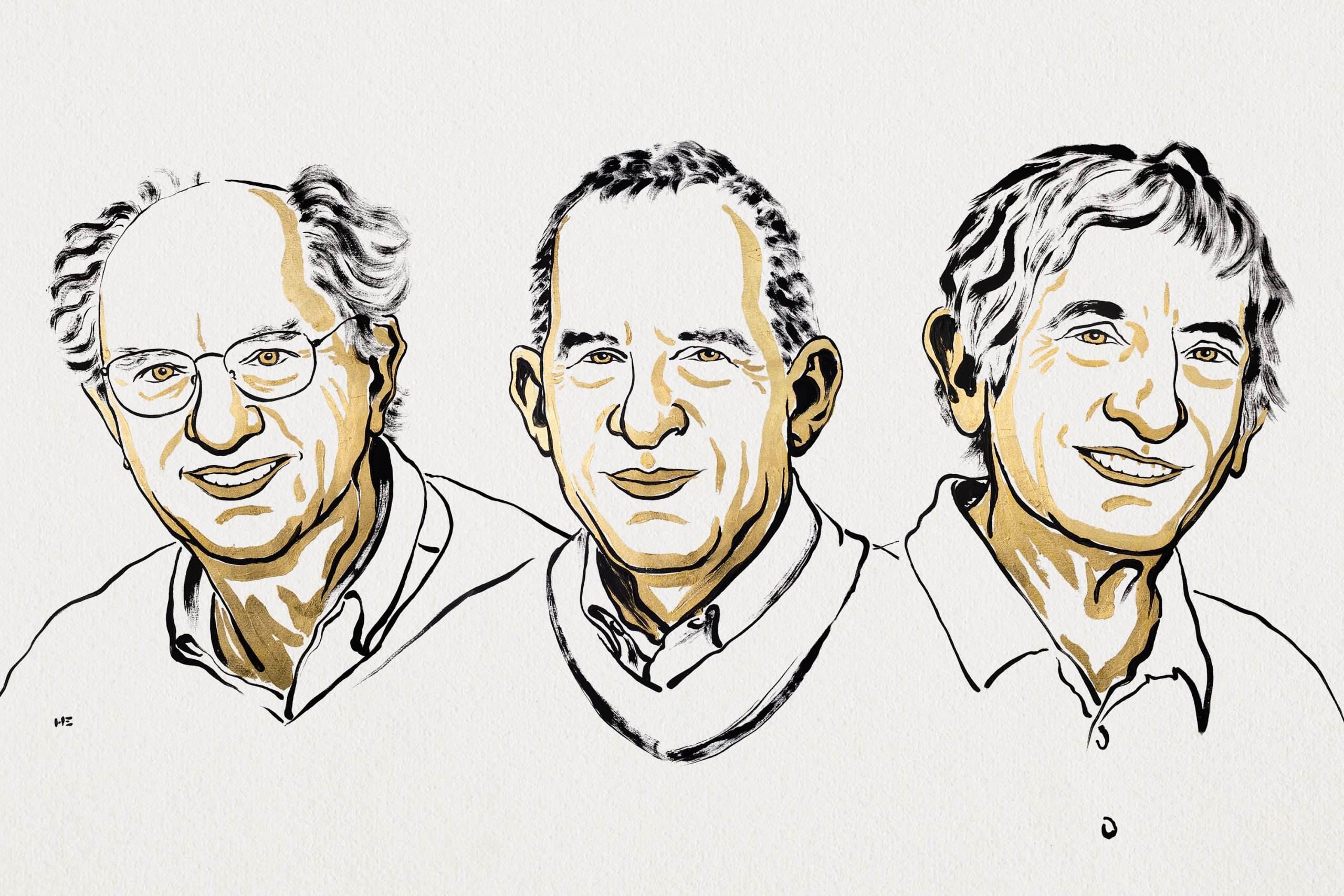
Three physicists have been awarded the Nobel Prize for their discovery that the remarkable world of quantum mechanics does not only play a role at the level of the smallest particles. It can also be used to create computer chips.
In quantum mechanics, you can demonstrate many phenomena, but you cannot explain them using classical logic. Particles sometimes pass right through an obstacle, even though that should not be possible: it is as if you throw a ball against a wall and it appears on the other side.
Tunneling
This ‘tunneling effect’ in quantum mechanics certainly plays a role at the level of the smallest particles, smaller than an atom. But in the 1980s, physicists John Clarke, Michel Devoret, and John Martinis showed that this effect can also be observed in the slightly larger ‘macro world’.
In 1985, the three winners demonstrated how electrons on a chip exhibit this ‘tunneling’. The technique is already being used in ordinary computer chips, such as those found in your cell phone.
This discovery also paves the way for the development of quantum computers, which would have extreme computing power. Chips would no longer be limited to ones and zeros (as they are now), but could – as quantum mechanics predicts – be both one and zero at the same time. In principle, this would enable enormous computing power.
‘Deserving winners’
Nadia Haider (group leader at QuTech) is working on this type of superconducting qubit. She speaks of deserving winners. “Clarke, Devoret, and Martinis are pioneers in this field. They demonstrated that quantum mechanics governs not only the microscopic world but also engineered macroscopic systems. Their discoveries laid the groundwork for modern superconducting qubits, the foundation of many of today’s quantum computers.
Without their groundbreaking contribution, the field of quantum technology would not have developed into the promising and rapidly growing area of research that it is today.”
11 million Swedish krona
The three researchers will share the prize of 11 million Swedish krona, equivalent to one million euros. Nine Dutch nationals have received the Nobel Prize in Physics. The first were Pieter Zeeman and Hendrik Lorentz in 1902.
The last Dutch laureate was awarded the prize in 2010. That was the Dutch-British Andre Geim, who grew up in Russia. However, to his disappointment, he lost his Dutch nationality when he also took British nationality.
HOP, Bas Belleman / Delta, Edda Heinsman


Comments are closed.