

It has emerged that an Israeli professor with ties to two Dutch universities has also been deployed in Gaza. In light of this revelation, the University of Groningen has decided to suspend its collaboration with the academic.
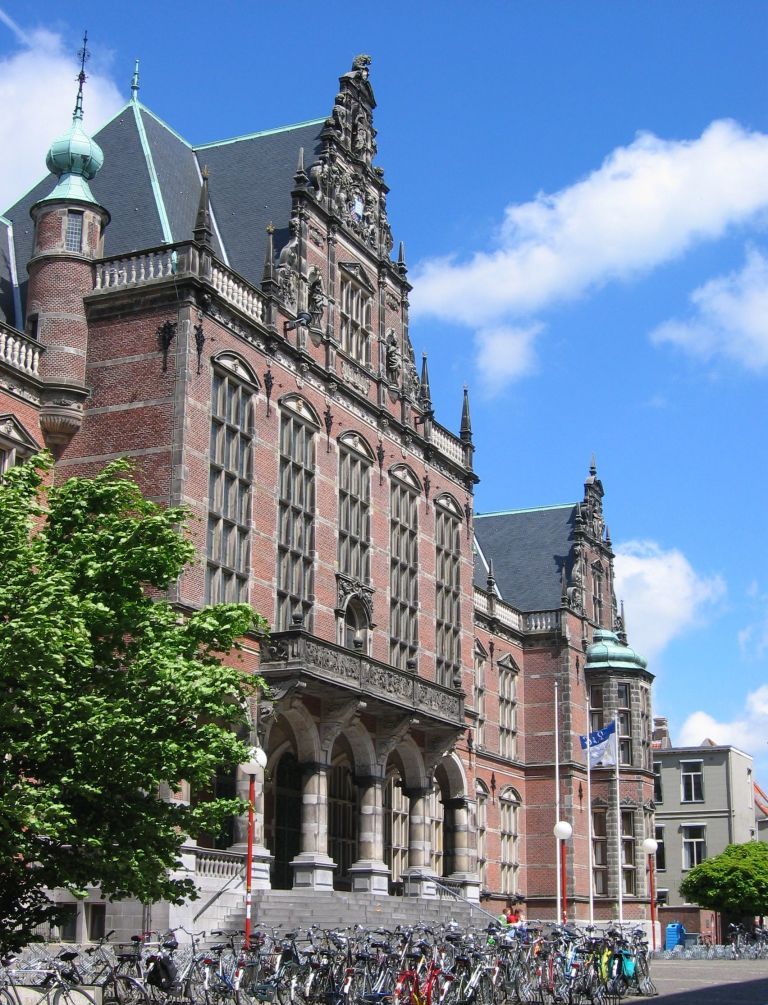
De Rijksuniversiteit Groningen. (Foto: RUG)
Dutch scientists from the universities of Groningen and Eindhoven are part of a European research collective exploring how new computer chips can mimic human self-awareness. The group also includes an Israeli professor.
But this professor, who is employed by the Israeli technical university Technion, also serves in the IDF as a reservist. He has written about his experiences in the Israeli military on social media, alongside pictures of himself in uniform, posing against a backdrop of destroyed buildings.
On Wednesday, the professor’s military activities were revealed by Investico journalists in the Dutch daily Trouw. The article’s publication has sown doubts at the University of Groningen. The research collective’s EU funding is subject to certain requirements, one of which is that the project must not serve a military purpose. All of the universities involved in the collective agreed to these requirements.
Dual use
The university is now reconsidering its affiliation with the project, a spokesperson told UKrant, the University of Groningen’s magazine. “It’s a reason for us to take a closer look at this research to determine whether its findings are being used for military purposes.”
According to the university, this will first be assessed by its Knowledge Security and Sensitive Partnerships Advisory Team. Rather than focusing on the links between Groningen and Israel, this inquiry will evaluate whether the project’s research results can be classified as ‘dual use’, meaning they can be used for both civilian and military applications.
Stir
At Eindhoven University of Technology, the collaboration with Technion already caused a stir back in August. Although the university had severed ties with Israeli institutions, this research project had been allowed to continue, university magazine Cursor wrote at the time. In its response, the university asserted that severing ties at an ‘institutional’ level does not necessarily have to have consequences for scientific collaborations.
A spokesperson for Eindhoven University of Technology now says that its researchers will never come face to face with the Israeli professor and reservist, explaining that the project’s main purpose is to train PhD students, which does not require collaboration between the universities involved. The university has informed Cursor that it does not intend to take any additional measures regarding this project.
In late September, Investico revealed that Dutch technical universities were collaborating with Israeli institutions to develop technology that could be used for military purposes. The institutions also have a financial stake in these research projects through their spin-offs, Investico reported.
What about TU Delft?
As of June this year, Delft University has adopted a “no, unless” strategy for institutional collaborations.
This applies to all collaborations that require a signature or dean’s approval, such as collaborations at institutional level and European projects. A reassessment framework for these types of collaborations is currently being developed.
Research by Delta in July of this year showed that the vast majority of Delft-Israeli collaborations remain unaffected because they are individual collaborations: research projects that scientists undertake on their own initiative with colleagues from other universities. Delft scientists are collaborating with researchers from seven different Israeli universities, all of which have close ties to the Israeli defence industry or offer training programmes for military personnel: Technion, Weizmann, Tel Aviv University, Ben Gurion, Hebrew University, Bar Ilan University and the University of Haifa.
HOP, Olmo Linthorst/ Delta, Annebelle de Bruijn
Translation: Taalcentrum-VU

HOP
Hoger Onderwijs Persbureau
Do you have a question or comment about this article?
redactie@hogeronderwijspersbureau.nl


Comments are closed.