Dutch technical universities are also involved in military research with Israeli partners through their spin-offs and start-ups, according to Investico, Trouw and De Groene Amsterdammer. In the fifteen consortia examined by the journalists, they came across two TU Delft spin-offs.
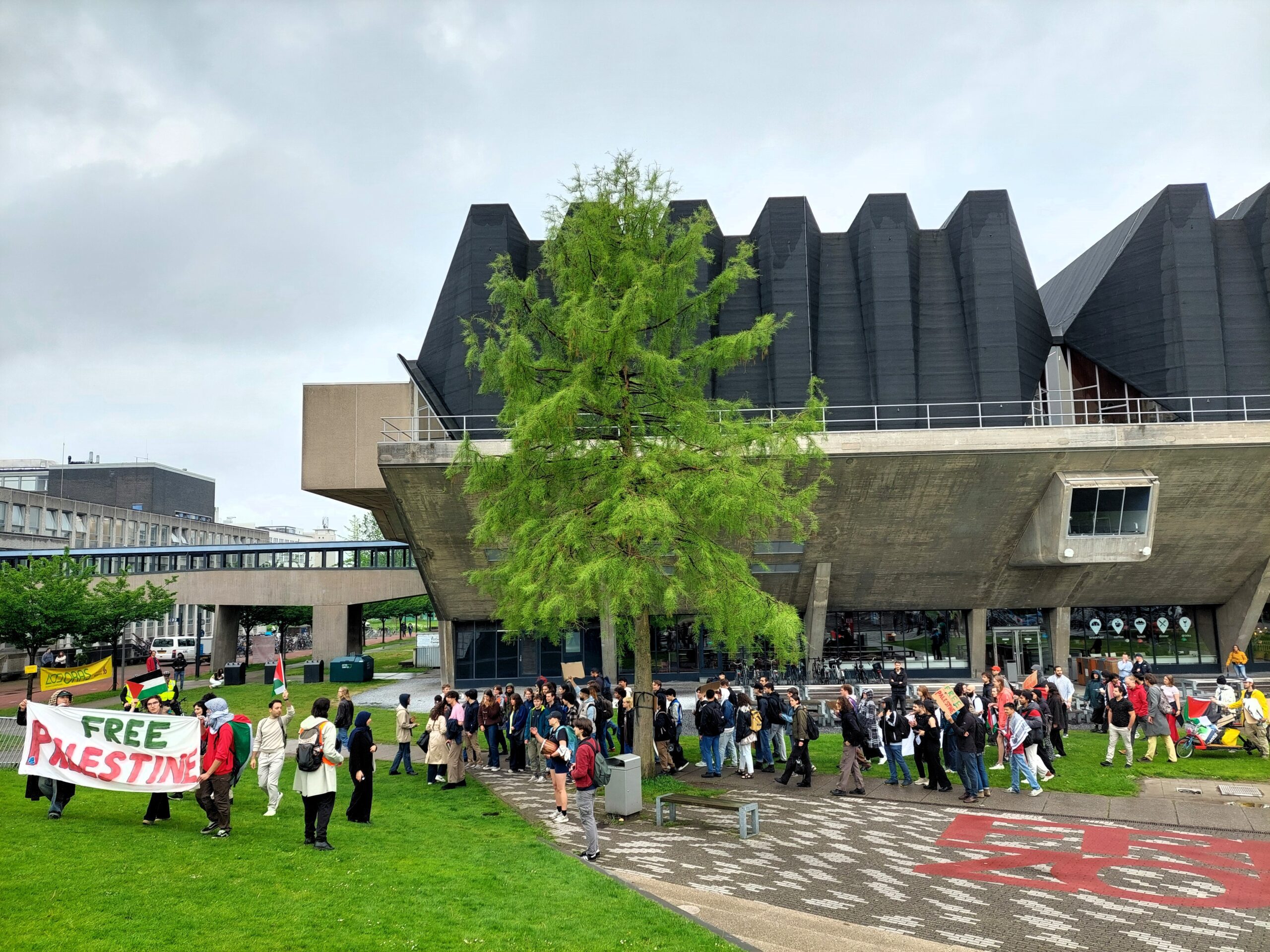
Protest on campus in May 2024. (Photo: Marjolein van der Veldt)
The journalists of investigative platform Investico, daily newspaper Trouw and weekly magazine De Groene Amsterdammer examined fifteen European-funded research projects in which Dutch and Israeli researchers are collaborating on technology that also has military applications. In addition to TU Delft, UTwente and TU Eindhoven, eight companies affiliated with the technical universities are participating in these fifteen projects. These are spin-offs and start-ups set up by scientific staff or students.
The technical universities are said to have shares in four of these eight companies, sometimes via an intermediary company. According to the researchers, this gives them a financial interest in collaborating with Israeli parties.
The journalists selected the fifteen Horizon projects in consultation with experts. They focused on the three technical universities and on technologies that are most likely to be used against the Palestinians in Gaza. For example, work is being done on technology that can help groups of drones fly in autonomous “swarms”. If one drone is disabled, the rest continue to fly towards the target.
TU Delft in four projects
Among the fifteen projects, there are four in which TU Delft itself is participating. Earlier this year, two of these four also surfaced in a longer list of projects involving military research in collaboration with Israeli partners, compiled by the research platform Follow the Money. These are Hera and Herwing, both of which are involved in hybrid flying. Investico now adds MLSysOps and Mosaic to this list, both of which focus on autonomous systems.
In addition, Investico found two projects involving Delft spin-offs
Investico also found two projects (Clever and Proactif) involving Delft spin-offs. These are Innatera Nanosystems (in which TU Delft has shares, according to its annual report) and CaptainAI, which is financed through Uniiq, the investment fund co-founded by TU Delft.
Own considerations
There are regular protests against the ties between Dutch knowledge institutions and Israel. Almost all universities have their cooperation investigated by special committees, but critics say this is too slow and inadequate.
All three technical universities say they are currently working on new rules that will allow them to reassess their cooperation with Israeli partners. For example, since June this year, TU Delft has had a “no, unless” policy. In a response to Investico, TU Eindhoven and the University of Twente stated that they do not wish to interfere with their spin-offs and start-ups. TU Delft wants to consider this on a case-by-case basis. ‘Ultimately, it is up to the board, the supervisory authorities and/or the shareholders of the spin-off to weigh up the options and make decisions,’ said a TU Delft spokesperson.
Incidentally, Investico’s documentation shows that the Mosaic project was launched in July 2025. This coincides almost exactly with the stricter guidelines introduced in June. According to the TU Delft spokesperson, the decision to participate in Mosaic and the decision on the guidelines crossed each other. That does not mean there is no way back. ‘We will use the assessment framework to determine whether to discontinue this collaboration.’
HOP, Hein Cuppen/Delta, Saskia Bonger

HOP
Hoger Onderwijs Persbureau
Do you have a question or comment about this article?
redactie@hogeronderwijspersbureau.nl


Comments are closed.