

The number of women professors at TU Delft remains far below the national average and its own target, even though five years ago that target was considered realistic. What went wrong and how can things be improved? Delta discussed this with Vice-Rector Hans Hellendoorn and Acting Chief Diversity Officer Cynthia Liem.

Dies natalis 2025. (Photo: Sam Rentmeester)
This article in 1 minute
The only Dutch university to see a decline in the proportion of women professors. The only one with a percentage below 20 percent. The university furthest from its own target of 25 percent for 2025 and the university with the lowest ambition for 2030 (again 25 percent).
TU Delft comes out badly in the Women Professors Monitor published this week. The figures in the report relate to 2024. A look at the TU management data shows that the gap will not be closed this year. However, there has been an increase. At the end of November, the average proportion of female professors was 19.9 percent, compared to 18.6 percent at the end of 2024. The national average is 29.9 percent.
Sugarcoating
It is nothing new that far too few women academics at TU Delft are advancing to the top. For years, the Women Professors Monitor has made it painfully clear that TU Delft has a problem.
Hans Hellendoorn, who has been acting vice-rector and vice-chair of the Executive Board since September 2024, agrees. “It’s very unfortunate and very regrettable,” he said during an interview in his office. “I’m not going to sugarcoat it.”
At his request, acting chief diversity officer and associate professor Cynthia Liem is present at the interview. She calls herself ‘the first chief diversity officer who is herself part of the target group’. For Hellendoorn, she is ‘our conscience’. “To keep us clear, sharp and focused, and to be critical of what happens here.”
What has gone wrong the past few years?
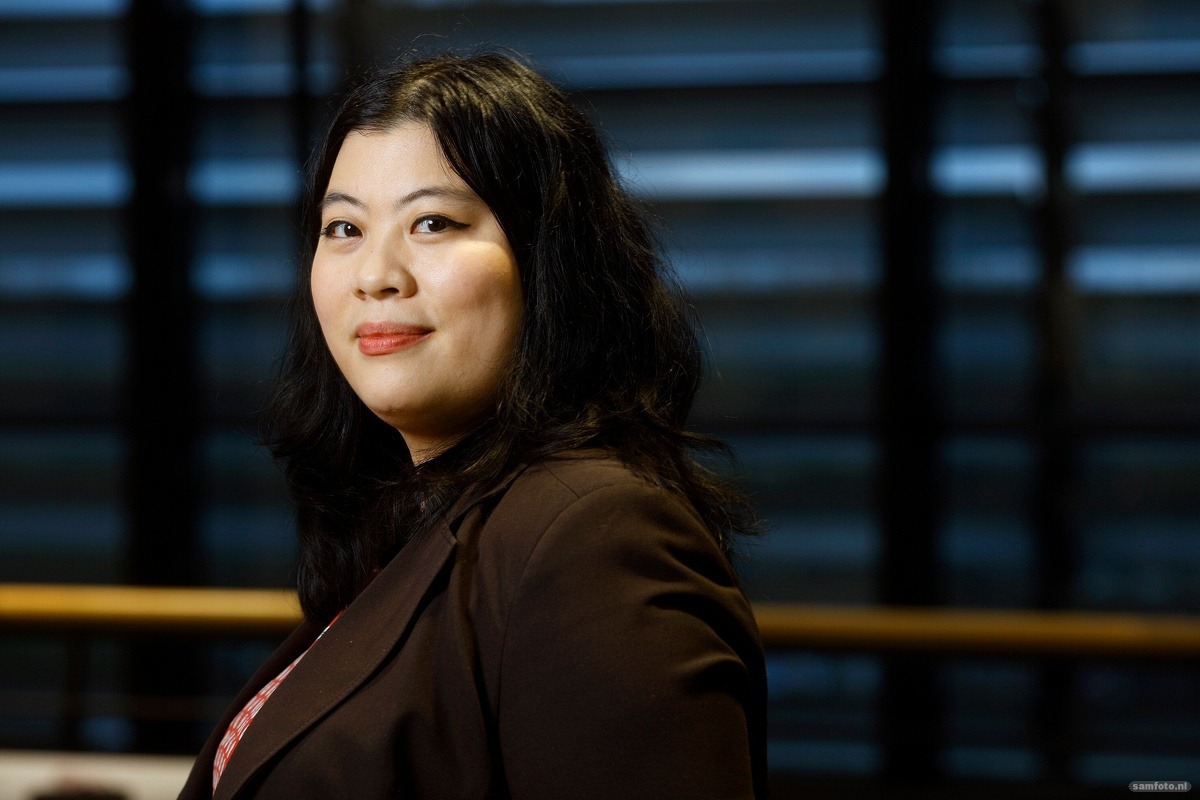
Liem: “The target figure of 25 percent has been too abstract. No faculty is anywhere near it: some are above it, some are below it. This year, we asked Hans to press harder on this issue during the autumn consultations with the faculties. It then became apparent that monitoring was not being carried out consistently. It seemed like a compulsory exercise: we are above or below 25 percent, and that’s it.
Applied Sciences did have a more refined analysis. They looked beyond just the percentage of female professors. They made projections by looking at female assistant professors and associate professors, the people who may become full professors in the future. This gives you a much more informed picture of the future.”
Hellendoorn: “Now we need to bring such good examples to the other faculties. So that we, as the Executive Board, can say: If you continue like this, you will not get there.”
In recent years, a specific policy at TU Delft has been to have at least one woman on every selection committee. Cynthia said on Radio 1 that this results in too much work for too few people. So that’s not the answer.
Hellendoorn: ‘That is indeed a problem. So we are looking for men who have a positive attitude, so that we can move them to the career committees.’
Liem: “I hope I’m not the only one who has to educate the men. We need to offer training and make room for it. This is especially important because, as academics in times of austerity, we are in a situation where we are completely overwhelmed, and diversity can easily fall off the radar.”
Documentation
Hellendoorn has documentation on the subject on his conference table. A printout of the Gender Diversity Dashboard from November, for example, showing the percentages of women among students and academic staff:

What is striking is the peak among assistant professors. Hellendoorn and Liem have what they believe to be a very likely explanation for this: the Sector Plans for Science and Technology, which set a quota of 35 per cent women. “That worked,” Hellendoorn acknowledges. “So we have to keep pushing. Because if it has to be done, it can be done.”
So why not impose a strict quota for female professors at TU Delft?
Hellendoorn: “The faculties vary greatly. Some are already above 25 per cent. That is why we want to move towards a target figure for each faculty.”
Liem: “A quota does not fit in with this institute’s culture. Much more often than you would like, the quality debate comes up. Over the past year, I have heard from various quarters, “Yes, but it should primarily be about quality.”
What do you say when people come up with that argument?
Liem: “What is quality, then? We know that in an initial intuitive ranking in a culture like this, a man often comes out on top. And he is then considered to be the best. However, research shows that a completely different outcome is possible if selection committees have to prove that they did not have any other qualified candidates.”
Hellendoorn: “The selection committees are the key.”
Liem: “The key lies before those committees meet, at the moment when a manager decides which employees are eligible for promotion. We have no idea whether they are alert to gender issues. I often hear about a difference: a woman has to have everything double-checked before there is no doubt about her, whereas this is not so much the case for a man.”
Hellendoorn: “I know that HR is working hard to improve the selection process and pointing out to people that they shouldn’t all hire copies of themselves. In addition, all the consultations and meetings about diversity are starting to have an effect. People’s thinking is changing.”
Predicting the future
The data supports this picture. In 2023, 2024 and 2025, there were 63 full professor appointments, 37 percent of which were women. What’s more, there is currently a significant number of women in the pipeline to become full professors: 50-50 male/female.
‘Instead of working on a multi-year plan and a code of conduct, I could have applied for grants for myself’
Good monitoring can help move things forward, says Liem, especially since you can see a promotion to professor coming two years in advance, which is how long the process usually takes. “If you can put that data on the table anonymously, it serves as a mirror for the next two years. Who will make it, who won’t? This gives you a better idea of what helps a promotion and what doesn’t.”
It is well known that publishing frequently in leading journals is particularly helpful, but not every good scientist fits that mould.
Liem: “That’s right. Another recent LNVH report shows that women are often given service and care tasks that are less likely to be seen and recognised.I am curious to see how that will work out for me after this year as acting chief diversity officer. Instead of working on a new multi-year plan and a new code of conduct, I could have applied for grants for myself and written articles, which would normally be a more strategic career choice.”
Discussing the new code of conduct: what is the relationship between a lack of diversity and social insafety?
Hellendoon: “The position of women and social unsafety are certainly related. Now that faculties such as Aerospace Engineering and Civil Engineering are rejuvenating their management and appointing more female department heads, you see a more contemporary culture seeping in, with more attention to diversity.”
Liem: “From insiders involved in professor appointments, I hear the hopeful news that sometimes the files of superstars who don’t have such good people skills are blocked. In the past, the attitude was, oh, if the person is excellent, then we’ll forgive the rest. Nowadays, it is less tolerated if your leadership skills raise doubts.
At the same time, it is difficult to implement new policies and follow up on good examples. Every department wants to be its own little island, with its own culture. People openly say that a new multi-year plan on diversity and inclusion does not apply to them. That is not acceptable, because this is one and the same employer. I could get angry about that, but I don’t have the mandate to call people out on it. You do, Hans.”
How do you ensure that faculties do not get away with falling behind too easily?
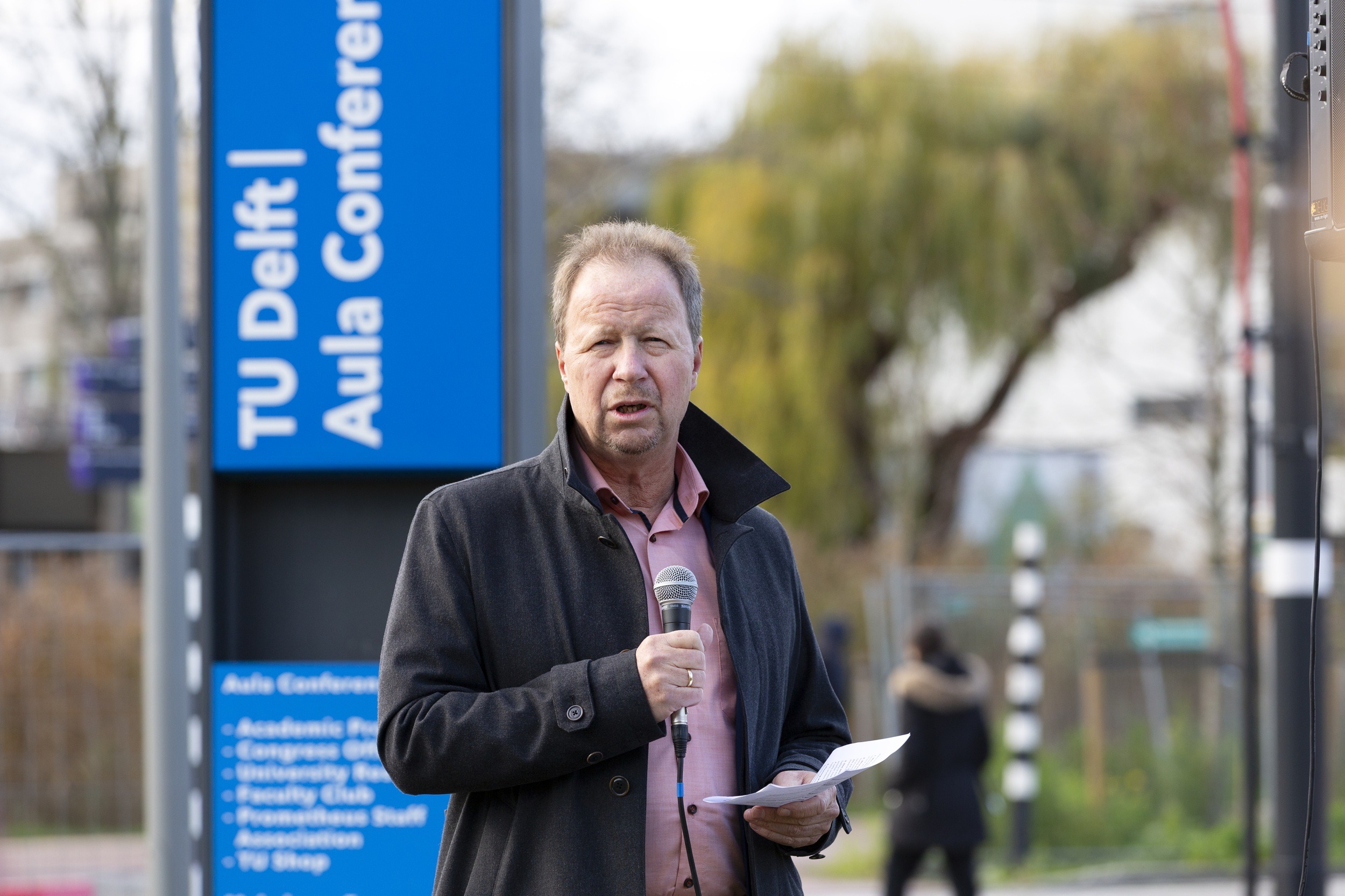
Hellendoon: “That is the message of social safety that we are trying to convey: in a socially safe environment, different types of people work together.”
Liem: “And give each faculty its own target. That 25 percent has had a paralysing effect on faculties that were so far behind that they could never achieve it. Agree, for example, that you have to increase by at least three percent and stick to it. I don’t think the discussion has been held at that level yet.”
Hellendoorn: “That’s right, but I want to be cautious, because we are now really on our way.”
Isn’t it time to be less cautious?
Hellendoorn: “We want the faculties to take responsibility themselves, to strive for a quarter of female professors overall and for that to be a stepping stone to the next level. The Executive Board will discuss this with them.
‘Don’t let the introduction of new policy documents be an excuse to delay taking action’
We don’t want to resort to hard figures and penalties just yet. You have to open things up, put women in exemplary positions and change your management style. This week, the Equity, Diversity & Inclusion (EDI) multi-year plan will be decided upon. And the academic development guide has just been published. It sets out how we want to recognise and value people on different career paths. So whether it’s purely scientific, or more focused on education, valorisation or outreach.”
Liem: “We really need to adhere to all these new policies, but please don’t let the introduction of new policy documents be an excuse to delay taking action. It took years for the academic development guide to be finalised. In the meantime, I sometimes heard people say that things would definitely improve once it was in place. No, you just have to get started.”
What does the EDI multi-year plan say?
Liem: “We are linking local diversity initiatives, which are often supported by minorities, more specifically to the organisation’s larger strategic goals. This is to better monitor and appreciate this work: many minorities (not only women, but also members of the LGBTQI+ community, for example) do this on top of their regular work, while under emotional stress. You shouldn’t ask too much of them as academics, or leave them to find the policy table on their own.
I also hope that the new code of conduct can help to stimulate a different culture. The new basic principles of equality, eagerness to learn and responsibility are inclusive and community-oriented. We want to see some vulnerability, that you learn from your mistakes and take responsibility.”
Why are there only now concrete plans to actually achieve 25 percent women professors?
Hellendoon: “I can’t answer that. I know what I’m doing, but not what happened before my time.”
Liem: “I have no insight into how my predecessors handled this. I don’t know on what basis we set a target of 25 percent female professors at the time, or why it wasn’t recognised much earlier that we wouldn’t achieve that.
I would like to raise the issue of portfolios. Appointments are the responsibility of the rector, while diversity is the responsibility of the vice-rector. Diversity should actually be the responsibility of the rector. I’m not saying that there was a lack of awareness, but I don’t know whether diversity was discussed in a structural manner.”
‘A target of 25 per cent female professors at TU Delft in five years’ time is a very realistic scenario’
The responsibilities are not clearly defined?
Liem: “In any case, the subject has never been properly framed. The same applies to the diversity officer. I wouldn’t wish my successor to have to chase after the faculties. That’s the board’s job. They need to take a firm stance on this. It shouldn’t be the job of a diversity officer to play diversity police.”
Hellendoorn: “This topic is now on the agenda for the spring and autumn meetings, and I am already noticing a positive response in all faculties. Given our current population, the importance we attach to the subject, and the pressure we are going to exert, 25 percent women professors at TU Delft in five years’ time is a very realistic scenario. We must and will keep our spirits up.”
With the cooperation of Edda Heinsman.
Do you have a question or comment about this article?
[email protected]


Comments are closed.