

Three in ten professors at Dutch universities are women, according to newly released figures for 2024. TU Delft remains at the bottom of the list and is the only university to see a decline. This means that the target of 25 percent female professors by 2025 now seems definitively out of reach.
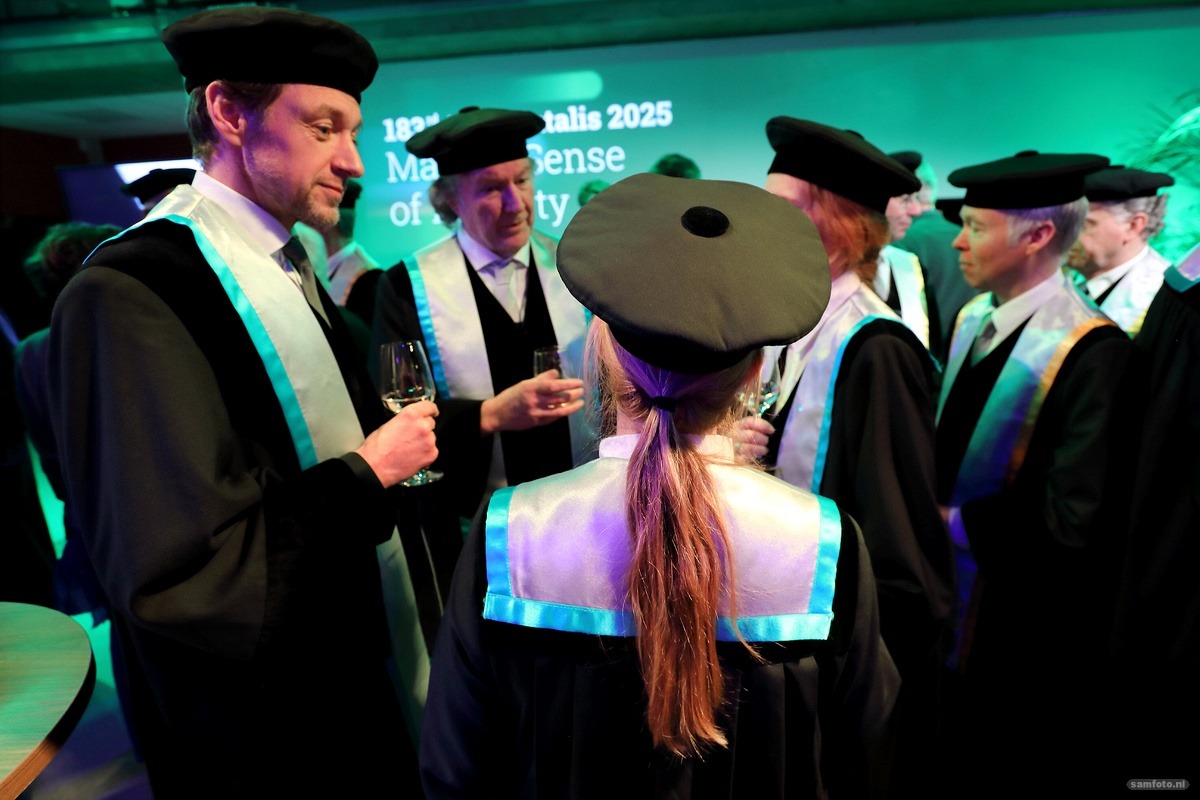
The Dies Natalis 2025. (Photo: Sam Rentmeester)
This article in 1 minute
The new figures come from the Monitor Vrouwelijke Hoogleraren (Women Professors Monitor), which was published on 8 December. In it, the Landelijk Netwerk Vrouwelijke Hoogleraren (National Network of Women Professors) lists the differences between men and women in Dutch science every year. Thirty percent is a symbolic threshold, the authors write. Women are no longer an exception at the top of science and together form a critical mass for change.
But in fact, that milestone has not quite been reached yet. In the latest figures (reference date 31 December 2024), 29.9 percent of all professors were women. Moreover, that figure is converted to full-time positions (FTE). In terms of individuals, it is a few tenths less. ‘We have chosen to mark this as reaching the 30 percent threshold,’ the authors write nonetheless.
TU Delft fails to meet its own target
The proportion of female professors increased at all universities except TU Delft. Here, it fell from 18.9 to 18.6 percent after a few years of increase. TU Delft is the only university with less than 20 percent female professors.
This is despite the fact that TU Delft had set itself the target of achieving 25 percent women professors by 2025, without imposing a strict quota or steering policy. The target itself was not particularly ambitious. In 2000, the European Union set the same percentage of female professors for 2010.
But in 2021, the then vice-rector Rob Mudde called the 25 percent goal a ‘realistic target’. “If we don’t succeed, we’ll really have some explaining to do.”
Alpha male culture
Cynthia Liem, interim chief diversity officer at TU Delft, responded to this on Radio 1 (in Dutch) on 8 December. According to her, there has not been enough discussion over the past five years about what a target of 25 percent women professors actually means. “Because we have many different faculties, each with their own policies and their own balance.”
‘I also wonder what has happened in recent years’
In addition, Liem and her colleagues concluded this year that TU Delft does not monitor the data properly and ‘does not have the right conversation.’ “That is rather late. I also wonder what has happened in recent years, but I wasn’t at the table then.”
She still sees that you have to be ‘well connected’ for academic promotion: “People have to know you and believe that you can do things. Many technical universities still have a bit of an alpha male culture, so if you behave and present yourself in a certain way, you are recognised and acknowledged more quickly.”
Diversity police
To counteract this, attempts have been made in recent years to include women in selection committees, Liem said. But she sees an important downside to this: it places a lot of work on the shoulders of a few people. According to Liem, these women run the risk of having to ‘play diversity police on their own’. “Was this the right approach, or should we take a broader view? We need to make men truly aware of the issue, so that they can apply that awareness in all their own selection processes and don’t have to look to women like me for guidance.”
A total, six universities remain below 30 percent. Apart from Delft, these are VU Amsterdam, Wageningen University, Erasmus University Rotterdam and the technical universities of Eindhoven and Twente.
The rest are above this figure, with the Open University alone at the top. At this small Limburg institution, which specialises in distance learning, 42.8 percent of professors are women.
Many universities have revised their targets upwards for the coming years. But not TU Delft. It is the only university that still has a target of 25 percent for 2030 (TU Eindhoven and the University of Twente also had this target for 2025, but they are raising it to 30 percent).
Cynthia Liem is nevertheless hopeful, she told Radio 1. She believes that the arrival of two female senior executives next year will help to normalise this and get the conversation going.

In any case, there are often many more women on the executive boards. Of the 41 board members, 21 are women. At TU Delft, there are currently only men on the Executive Board, but that will in 2026 . In mid-January, Hester Bijl will take office as the first female Rector ever. On 1 March, Ingrid Thijssen will join her. She will become Chair, also the first woman to do so. The third member of the Executive Board will then still be the interim chair, Nick Bos.
Nationwide, 36 percent of deans, who head a faculty, are women, and the same applies to the directors of research institutes. At educational institutions, women account for up to 47 percent.
Other countries
Compared to other countries, the Netherlands is certainly not leading the way. There are countries where the situation for women is even more skewed, such as Germany and Belgium, where the percentage of female professors in 2022 was below 25 percent. But there are also countries where women are more likely to reach the top of the scientific world. In Romania, more than half of the full professors are women.
KNAW and NWO
In this monitor, the LNVH also looks at the man-woman ratio at the institutes of the KNAW scientific society and research funder NWO. However, researchers there are not called full professors.
In comparable high salary scales, 23.8 per cent of NWO employees are women. According to the monitor, these NWO institutes focus primarily on science and technology, and this percentage is slightly higher than the average in that sector. The KNAW institutes have 28 percent women in that salary scale.
No reason for complacency
Are things moving in the right direction for women in science? The LNVH warns against complacency: “Growth is still modest and unevenly distributed across institutions and disciplines,” the monitor states. It could easily take twenty years before there are as many female professors as male professors.
HOP, Bas Belleman/Delta, Saskia Bonger

Do you have a question or comment about this article?
redactie@hogeronderwijspersbureau.nl


Comments are closed.