

The Sustainability Core Team will cease to exist and the tasks will be taken over by the Climate Action Programme. Is TU Delft putting its green plans in the freezer? No, says Andy van den Dobbelsteen, the departing Sustainability Coordinator. “We have created systems that will not disappear just like that.”
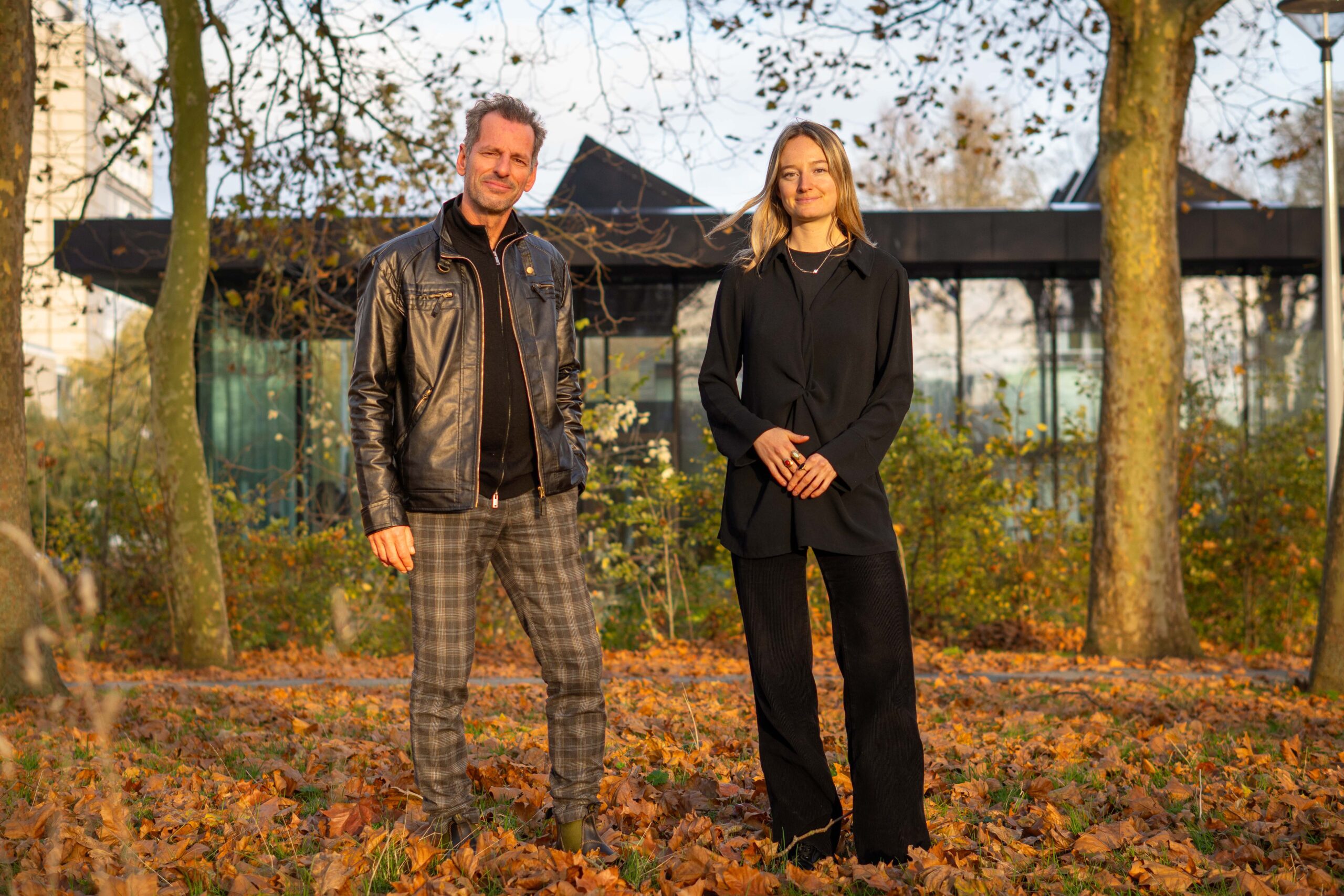
Andy van den Dobbelsteen en Puck Wijnia are saying goodbye to the sustainability team. (Photo: Thijs van Reeuwijk)
This article in 1 minute
While the rest of the Netherlands was enjoying their New Year’s Eve of 2018, Andy van den Dobbelsteen found himself in an old-fashioned Twitter storm. That evening, the Professor of Climate Design & Sustainability heavily criticised a Telegraaf newspaper article in which some academics, without any understanding, expressed their doubts about climate change.
Enough is enough, he thought after the flood of online resentment that followed. He believed that his own TU Delft should contradict all those climate deniers and critics, and play a greater role in stopping climate change. The Executive Board agreed with him and created the Climate Action Programme in 2020. A year later, the Sustainability Core Team joined.
Van den Dobbelsteen became Sustainability Coordinator and Head of the Core Team that puts its energy on greening TU Delft and its campus – literally and figuratively. Its most important goal is achieving a 0 CO2 footprint in 2030.
Pulling out the plug
Five years after its founding, in 2026, Van den Dobbelsteen will step down from his job as Sustainability Coordinator. TU Delft will also pull the plug on the seven-member team. A new Coordinator will take on his tasks along with a new ‘figurehead’. The sustainability efforts will continue under the umbrella of the Climate Action Programme – up to now mostly a gathering place for people at TU Delft interested in climate and sustainability research.
This state of affairs raises a crucial question: will the disbanding of the Core Team affect achieving the sustainability goals?
In a meeting room at his Architecture and the Built Environment Faculty, Van den Dobbelsteen says that he saw the end of the Core Team coming for a while. “The Team had been appointed to the end of 2024. This was extended by one year, after some hassle in relation to the cutbacks last year.”
Ambitious goals
Since its founding in January 2021, he has dedicated two days of his working week on making TU Delft more sustainable. “When the Executive Board approached me for the job, I immediately said that I wanted someone else to work with me who was able to work on this full time.” The person appointed was Deirdre van Gameren. She was later replaced by Puck Wijnia, who finished her master’s in Industrial Ecology one-and-a-half years ago and who is also present at the meeting. Wijnia is sorry that because of her temporary contract, she is to not allowed continue as Sustainability project leader.
The Core Team’s plan is the blueprint for TU Delft’s sustainability efforts. The goals are quite ambitious. Van den Dobbelsteen admits perhaps a bit too ambitious. More about this later. By 2030 TU Delft must be circular, protect itself from the effects of climate change, and enhance the wellbeing of all life on campus.
Good example
Further, TU Delft wants to then be completely climate neutral. So by 2030, 20 years earlier than the Paris Climate Agreement requires this. TU Delft will then set a good example for the rest of society, exactly as Van den Dobbelsteen envisioned it after the Twitter storm on New Year’s Eve of 2018.
To carry out the plans, the Core Team recruited more members. One staff member coordinated making the buildings and energy systems more sustainable, another looked at the attention paid to sustainability in the education at TU Delft, and another worked on the financial picture.
The Team also managed the internal sustainability coordinators. They steer the sustainability efforts in the faculties and management. They did this on top of their regular work, and sometimes even voluntarily.
Between 2019 and 2023, TU Delft’s total CO2 footprint gradually shrunk from 99 kilotons to 76 kilotons
Taking action on a wide range of minor and major activities, from banning disposable coffee cups to having more solar panels installed, the Core Team achieved countless results. Between 2019 and 2023, TU Delft’s total CO2 footprint gradually shrunk from 99 kilotons to 76 kilotons, which equates to more than 23%. And TU Delft even grew in this period.
Smaller footprint
Most – 87% – of the remaining footprint consists of so-called scope 3 emissions. These are the emissions generated by students and staff members commuting, or the production processes of the new items that TU Delft purchases. The other emissions, including gas and electricity use, dropped by 32% between 2019 and 2023.
Van den Dobbelsteen and Wijnia thus believe that the Core Team can hand over their tasks to the Climate Action Programme without worry. “We would have preferred the sustainability team to have been appointed up to 2030. But we are happy that we have been able to do our work up to now and that we have created systems that will not disappear just like that,” says Van den Dobbelsteen.
His colleague Wijnia says that the transition to the Climate Action Programme even has an advantage. “Making the campus more sustainable will then have a stronger connection to TU Delft’s forte – research.” She expects that, over time, this will create greater support among staff members and students.
Herman Russchenberg, Professor (CEG) and Director of the Climate Action Programme explains on the telephone that the Programme’s goal is for climate action “to permeate right through to every fibre of TU Delft”. Various ‘theme leaders’ are working on a range of sustainability research topics that are organised in ‘pillars’. Making the campus more sustainable is one new pillar. Russchenberg believes that this will promote the cross-fertilisation of the sustainability plans and climate knowledge at TU Delft.
Fear of slipping away
However, the Young Academy does not believe that all that optimism matches recent findings. In a report, the platform for young academics look at the climate plans of all universities and university medical centres in the Netherlands. Cees Haringa, Biotechnologist and Assistant Professor at the Faculty of Applied Sciences, is the co-author and Van den Dobbelsteen is named as ‘co-reader’.
The report shows that TU Delft does indeed have relatively ambitious goals – being CO2 neutral in 2030 despite the scope 3 emissions mentioned above – which it is working to achieve through the ‘intense efforts’ of personnel.
The young academics urge universities to firmly hold onto their sustainability plans
But the authors warn against slipping away. They write that austerity measures tone down the climate goals of universities. This can be seen, for example, at Erasmus University, which did away with its sustainability officer. Climate policies at universities seem to be pushed aside more and more often and this is in line with a worldwide trend.
Continuity
The young academics urge universities to firmly hold onto their sustainability plans. They emphasise the importance of sustainability coordinators and teams to be in place for a long time. Their motto is: continuity prevents lethargy.
This is ironic as the current reorganisation at TU Delft seems to be getting in the way of continuity. Nevertheless, Wijnia understands the dilemmas that the austerity measures are bringing to TU Delft. “For supervisors, the choice between firing employees and spending a little less money on sustainability is a no brainer.”
Yet, a TU Delft spokesperson says that the disappearance of the Core Team is not a budget cut measure. The purpose of the reorganisation is to ‘create one recognisable programme that manages sustainability and climate action at TU Delft as one’, he says in response to Delta’s questions. TU Delft says that the goals will remain, although the cutbacks in higher education are making it harder to ‘put all their efforts into every goal’.
Planting trees
Van den Dobbelsteen says that it remains to be seen if the goals are achieved. “When I first started, I said that 10% or 15% percent of the CO2 emissions in 2030 (compared to 2019, Eds.) was doable. That was perhaps too enthusiastic. I now hope that we achieve 25%.” The rest will be compensated by planting trees. But this is receiving criticism, including in the Young Academy report. The TU Delft spokesperson says that the degree of compensation that will ultimately be needed, will become clear in the years to come.
What remains unclear is how far TU Delft currently is from achieving its goals. In previous years, the progress could be seen in a detailed CO2 footprint report, but a report about 2024 is nowhere to be found. Whether and when it appears, the spokesperson cannot say. He points to the less detailed general annual report (in Dutch) for the most important emissions figures.
The expectation is that the remaining emissions will probably fall under scope 3. The obstacles at the moment are mostly financial. The Core Team is struggling with presenting plans like a public transport pass or walking and cycling reimbursements to staff. Paying internal sustainability coordinators fairly is also problematic. Van den Dobbelsteen and Wijnia have noticed that enthusiasm within TU Delft has waned somewhat. They see that the cutbacks are making ‘short term thinking’ leading.
Backlash
Luckily, Wijnia stresses, this does not go for all of TU Delft. She is not afraid that TU Delft will let itself be led by the worldwide anti-climate trend. “I have the impression that the desire to make research and education more sustainable is only growing, including as a backlash to the political climate. The Climate Action Programme continues to grow and all the teachers that I talk to say that a climate policy is very important.”
Climate Action Programme DirectorRusschenberg does see hurdles though. “The cutbacks will ultimately just mean less budget for the plans, and with less budget you can achieve less. The renovation of buildings, for example, may take a little longer.” The budget for making the real estate portfolio more sustainable is indeed dropping from EUR 95 million to EUR 85 million, the TU Delft spokesperson said when asked.
It is not yet known who will become the new figurehead and coordinator. Interested parties had until the end of November to apply. “If there’s a good candidate among those applicants, it could go fast,” says Russchenberg. “For the new figurehead, we are still at an early stage in the process of finding, so that will probably take longer.”
Green engineers
The position of the new coordinator will be 0.4 FTE. Together with the figurehead, one support student assistant and the GreenTU student team the total team will consist of 1.8 FTE. This is less than half of the current 3.8 FTEs. Given the connection with the Climate Action Programme, this will not lead to a drop in outcomes, the TU Delft spokesperson expects.
‘If we continue to send engineers who think in terms of green out into the world, we will make the biggest difference’
Van den Dobbelsteen does not want to stand in the way of his successor, but he does have some personal advice. “Be pragmatic and think about your health. I had a cerebral infarction last year, and the rehabilitation took a long time. It was largely caused by hard work and stress.”
And in terms of content? “Make sure that current projects can progress, and start new important projects. On top of these, bringing about a shift in mentality is the most important thing. If we continue to send engineers who think in terms of green out into the world, we will make the biggest difference.”
Do you have a question or comment about this article?
nathan@hgsmk.nl


Comments are closed.