

Sea levels are not always calculated accurately, according to a major comparative study by Wageningen University & Research (WUR) and Deltares in Nature. In some places, sea levels are up to a metre higher than previously thought. This means that millions more people are coming into the danger zone. What went wrong? Elevation modeler Maarten Pronk explains.
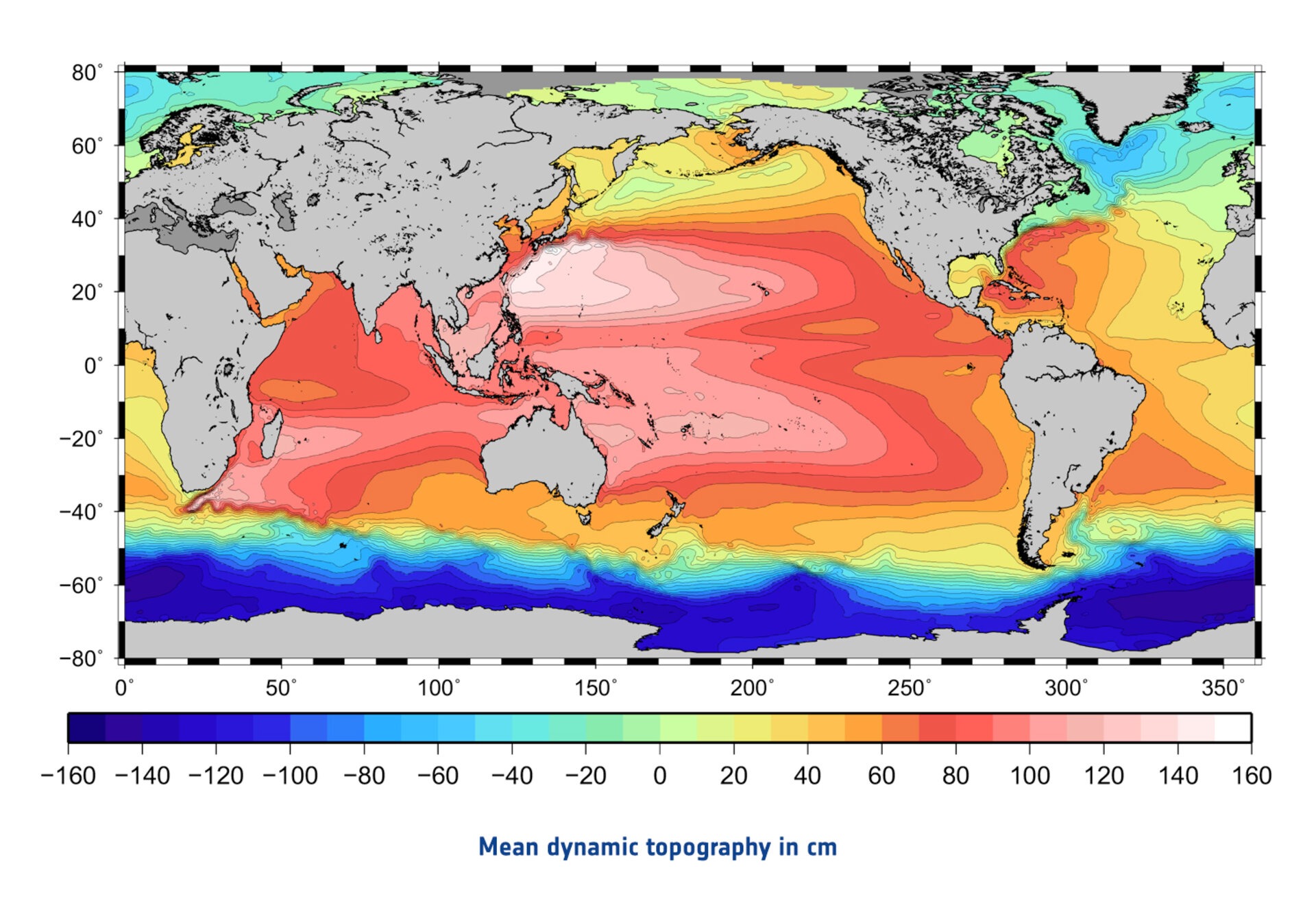
The difference between the geoid and sea level. (Image: ESA/CNES/CLS)
If we say that the TU Delft Library is 1 metre below NAP (Amsterdam Ordnance Datum), how high would the water rise in the event of a flood? The surprising answer: not 1 metre. “It’s a reference level that doesn’t necessarily have anything to do with the current sea level,” explains Maarten Pronk. The elevation data expert at Deltares is completing his PhD at TU Delft on the subject of global elevation models. He is not involved in the recent Nature publication that caused such a stir, but his earlier elevation model is used in the studies examined in the publication.
The publication reveals that errors were made in previous studies on the impact of sea-level rise. “I didn’t realise this blind spot was present in so many studies; it’s good that this has been investigated,” says Pronk. “The common mistake is the assumption that the zero level in the elevation model is the same as sea level. In some places, particularly in Southeast Asia, these two levels can differ by as much as a metre, but in most places worldwide the difference is smaller.” The total land area under threat increases by only a few per cent in the recalculation. “But if you look at how many people live on that extra area, we’re talking about millions more people.”
World’s next elevation model
To understand why these errors are only now coming to light, you first need to know how one actually models the global impact of sea-level rise. To do this, scientists combine a model of water depth with a model of the land’s topographic elevation.
‘In global studies, local data is sometimes unavailable’
For the topographic elevation model, Pronk uses satellite data, which he compares with field measurements. “The previous generation of global elevation datasets still had an error of perhaps as much as 10 metres in some locations. So there might be a forest on the coast, and the measured elevation would actually reflect the height of the trees.”
That sounds like a huge margin. Isn’t elevation monitored extremely closely? “In the Netherlands, this would never happen because we have a very accurate local elevation dataset, which is updated every year. But in these global studies, local data is sometimes unavailable, which is why you get these kinds of uncertainties. The elevation dataset is then the most important parameter for the outcome, alongside other parameters such as coastal protection and how the water flows. The more recent global elevation models have a much smaller margin of error, but it is still more than half a metre. It is possible that other model components, such as the vertical reference, are now more noticeable due to their uncertainties.”
Artificial sea level
Global land surface models already have a considerable margin of error. For a sea-level model, the height of the seawater is also required. Due to the dynamic nature of the sea, scientists estimate this height using an idealised reference surface. “It’s as if you were to freeze the Earth and the sea were to come to a complete standstill,” explains Pronk.
‘The actual sea level is close to the model, but it is certainly not the same’
“The height would then be determined solely by gravity and rotation: an idealised figure, the geoid. A sort of artificial sea level, a zero line. The actual sea level is close to that, but it is certainly not the same.”
“The sea has varying temperatures, salinity levels, currents and planetary waves.” This leads to different sea levels. Exactly how different, depends on where you are on Earth. “In the Pacific, you have much stronger currents; the ocean is warmer and has a different salinity than here in the North Sea. As a result, you get much greater upwelling or downwelling relative to the reference level. And that deviation hasn’t been properly accounted for in every study.”
The message remains unchanged
Errors in the use of sea-level models at a time when climate deniers are gaining ground. Do people still believe in science? “Gaining new insights is part of science; existing studies can be improved and the uncertainties can then be reduced a little further.
The insight itself isn’t new and has been included in studies for some time, but it takes a long time before it becomes widely accepted. For example, it took a year to publish this study in Nature,” says Pronk. “And the ultimate message hardly changes. Sea levels are rising. Thanks to this publication, the impact is now being measured more accurately in a greater number of studies, enabling us to carry out more targeted local research.”
‘Thanks to this publication, the impact is now being measured more accurately in a greater number of studies’
Does the researcher feel responsible for how his models are used? “Certainly. Following this article, I’m now having many discussions with colleagues; should we include more instructions when publishing a new elevation dataset? Minderhoud and Seeger, the authors of the Nature article, are now republishing existing elevation datasets with an adjusted reference, so that you can indeed use the zero level as sea level. Perhaps that is the solution: make it easier for researchers to use the dataset correctly.”
TU Delft Library
Returning briefly to the question: suppose there is a flood, how high would the water actually rise at the TU Delft Library – which lies one metre below NAP? Pronk makes a number of reservations, mentioning storms, dykes and the friction of the landscape. “Even in the government’s most severe flood scenarios, this location does not flood. But purely on the basis of elevation, so if you were to extend the sea level to Delft, that would be approximately 1.10 metres, because the current average sea level is about 10 centimetres above NAP.”
Do you have a question or comment about this article?
[email protected]


Comments are closed.