

What do you do when your solar cells are already so efficient that further development runs up against a limit? Stop? Or devise a new route? At the Photovoltaics Materials and Devices research group (Faculty of EEMCS), they chose option two. Professor of solar cells Olindo Isabella: “What if you stack two innovative cells on top of each other?”
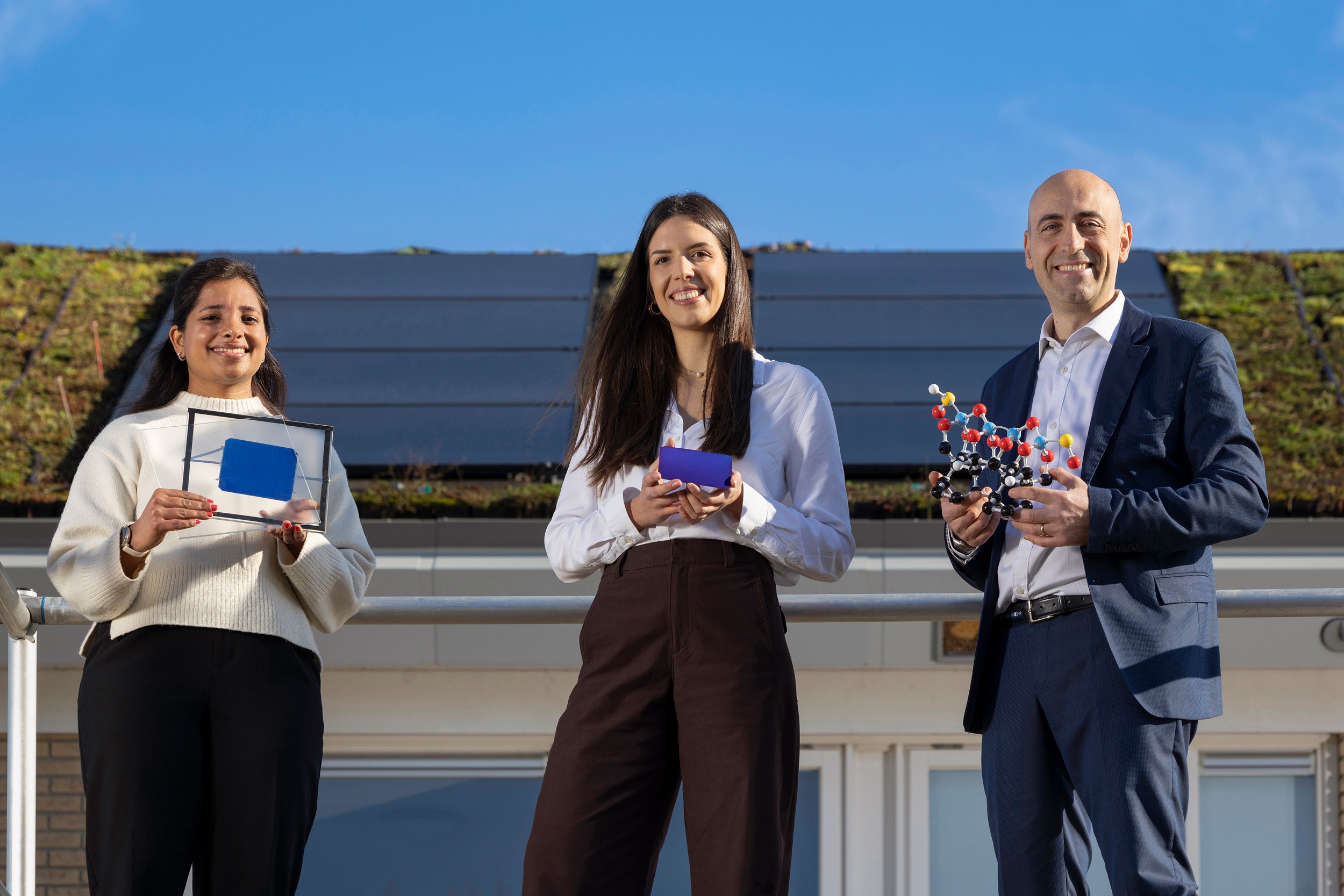
Urvashi Bothra, Katarina Kovačević and Olindo Isabella. (Photo: Studio Oostrum)
“The sun is the world’s largest supplier of green energy,” Olindo Isabella explains. “When you look at sustainability, reliability and cost, the sun is far ahead, even compared with other green sources such as wind energy. No moving parts, the light is always ‘on’, and the technology has proven itself for years to be reliable, sustainable and relatively simple. And partly thanks to our work, solar cells are becoming ever better.”
‘Solar cells can hardly become more efficient; they approach the theoretical limit’
To put that “ever better” into perspective: the latest generation of ‘Delft’ single‑junction solar cells – with one semiconductor layer – is now able, under ideal conditions, to convert almost 24% of captured light into electrical energy. “Much higher efficiency is hardly possible; they are approaching the theoretical limit,” Isabella explains. “However, by working with multi‑junction solar cells, with double or multiple semiconductor layers, further gains can still be achieved.”
Combining silicon and perovskite
To explain how this is possible, we need to briefly delve into the theory. In the world of solar panels, two materials dominate that can be used on a large scale and at relatively low cost as the ‘power plant’ in a solar cell: silicon and perovskite. The former technology is the best known and has been widely used in solar panels for years.
Perovskite technology refers to a family of materials that are much thinner than silicon. It is a relatively new technology that can be applied not only to silicon, but also to glass or flexible plastic. The layers can be made much thinner and are effective across a broader spectrum of light frequencies.
Both technologies are highly suitable, but things become truly interesting when you combine them. Isabella: “A solar panel with a silicon base layer, combined with one or more perovskite top layers, achieves a much higher efficiency, with theoretical values well above 40%. By combining a silicon cell from a partner with a perovskite top cell, we recently achieved efficiencies of nearly 33%. We are now further optimising that process with our own perovskite technology, for example by ensuring that each layer captures exactly those light frequencies that yield the highest efficiency.
Recyclability of the material
In addition to the race for higher efficiency, there is more to innovate in the solar cell. Recyclability of the material, for example: currently, a silicon panel – apart from the plastic junction box and metal frame – is usually shredded to reappear as filler material in asphalt. Worldwide, solar panels already account for 8% of all e‑waste. A waste of material, such a linear lifespan.
Postdoctoral researcher Urvashi Bothra (also EEMCS) has therefore focused on developing a solar cell with a circular life cycle. Bothra: “Instead of bonding the layers together with adhesive, we are investigating the use of a liquid as a filler between glass and the solar cell. This liquid can easily be removed, making such a panel easier to recycle. Moreover, the liquid preserves the optical performance of the panel and helps to cool the cell, which increases efficiency.”
Super‑rough and extremely matt black
The solar cell itself is more difficult to separate mechanically into individual parts, because the layers from which it is composed – such as the top and bottom layers, the silicon absorption layer and metal contact elements – are bonded together with adhesive.
‘Cheaper materials and simpler production methods help make solar panels even more accessible’
Nevertheless, considerable work is also being done here by PhD candidate Katarina Kovačević (Faculty of EEMCS), who focuses on simplified and sustainable production processes for conventional crystalline silicon solar cells. She managed to reduce the number of process steps in the production of her solar cells from nine to six and successfully developed a conductive copper layer as an alternative to the more expensive silver in the metal contacts. Kovačević: “Cheaper materials and simpler production methods help to make solar panels even more accessible. Fewer materials also make recycling easier.”
Kovačević also worked on efficiency by developing a new top layer for solar cells that is extremely matt black. She explains: “The less light a cell reflects, the more light remains available for the semiconductor. For this new design we use silicon dioxide, a material that can be made extremely rough at the microscopic level. As a result, virtually no light is reflected back.”
Eight times the production capacity of Borssele nuclear power plant
“Solar panels are getting better and better, battery technology is becoming cheaper, and we are making major strides,” Isabella concludes. “To give you an idea: in a single year, in the Netherlands we have already installed solar panels with eight times the production capacity of the Borssele nuclear power plant. And now that batteries are becoming better, more powerful and more accessible, we can store excess energy on sunny days more effectively, especially if we make use of ‘vehicle‑to‑grid’ technology, where electric cars function as home batteries or energy storage for the neighbourhood.”
The future of solar energy therefore looks bright, according to Isabella. “If we want to keep energy sustainable, accessible and affordable worldwide, this really is our best option.”

Science editor
Jaap Van der Sar
Do you have a question or comment about this article?
[email protected]


Comments are closed.