

Squatting has long been a popular housing option for students in the Netherlands, but a bill currently being considered in the Dutch Parliament aims to finally make squatting illegal.
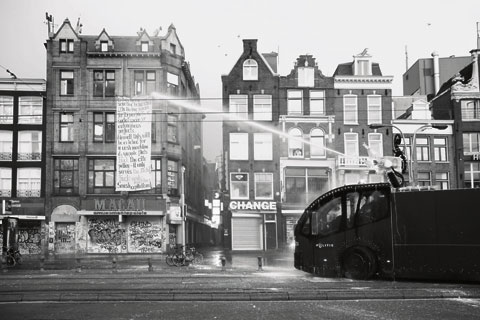
Nevertheless, as the squatted building on the TU campus attests to, students still avail themselves of this three hundred year old tradition of finding and moving into vacated buildings and homes.
For many non-EU international students especially, the idea of squatting – claiming somebody else’s legal property as your own – must strike them as odd if not suicidal – what happens when the building’s owner shows up in black Mercedes with ten of his baseball bat wielding henchmen in tow, a Russian student might ask?
In the Netherlands, at least, squatters (or krakers, in Dutch) currently enjoy widespread protections under Dutch law. Squatting is the act of occupying an abandoned or unoccupied building that the squatter doesn’t own, rent or otherwise have permission to use. Squatting is widespread in many urban areas throughout Europe, particularly in urban areas that are decaying in physical, social and legislative ways.
Squatting as a movement dates back to 1649, during a time of social unrest in England, when a group known as the ‘Diggers’ took over and cultivated vacant lands in Surrey, Buckinghamshire and Kent. The Diggers’ motto was: ‘the poorest man has as true, title and just right to the land as the richest man’. Needless to say, wealthy local landowners disagreed, hiring thugs to beat the Diggers and drive them off the land. The Digger colony was eventually abandoned, but the idea from which the modern squatting movement stems was born.
In the years following the Second World War, the squatting movement began to grow and evolve across Europe. Today, the Netherlands remains one of Europe’s most squatter-friendly countries, with many residential squats in cities like Leiden, Rotterdam, Groningen and Amsterdam. In some cases, Dutch squatters have managed to forestall eviction from their squats for years; for example, Rotterdam’s Poortgebouw was a squat for nearly three decades before finally becoming legalized.
The law regarding squatting in the Netherlands states that if a building has stood vacant for one year, it can be legally squatted, although would-be squatters may not enter the building by force – i.e. breaking a lock. Once a building has been squatted, the squatters must inform the buildings’ owners and also invite the police in for an inspection. A bed, chair, table and a working lock on the door is all that is required to prove a building is indeed being inhabited by squatters.
Ban
According to Hein de Haan, a Dutch architect, urbanist and teacher at TU Delft’s faculty of Architecture, who is also a former squatter himself, there is a scarcity of affordable real estate in the Netherlands, especially for artists and business-starters, and squatting offers a solution, especially when it’s regulated. De Haan argues that squatting can stimulate urban dynamics, as buildings are no longer left unused on a city scale, having either been redeveloped by their owners (to prevent squatting) or directly reused by squatters. De Haan: “Squatting encourages people, keeps them alert and compels owners and squatters to negotiate towards more affordable square meters.”
The roots of squatting legalization in the Netherlands date back to 1971, when the Dutch Supreme Court ruled that the concept of domestic peace (huisvrede – meaning a residence cannot be entered without the current user’s permission) also applied to squatters. Since then, a building’s owner must take squatters to court in order to evict them.
In 1994 a law passed making it illegal to squat buildings that were empty for less than one year. In 2006, a parliamentary effort to ban squats failed. But in 2009, some center-right Dutch politicians are once again pushing to ban squatting. “Squatters are just people too, there are good ones and bad ones”, De Haan says. “It’s difficult to defend all squatters, but a squatting ban goes much too far.”
An example of a squat currently in action is the building directly in front of BK-City, the TU’s faculty of Architecture, which was squatted by Dutch students from various universities, including TU Delft.
“I wouldn’t say that squatting is good or bad, but something beyond”, said one of the squatters, Jan K., who requested his real name not be used. “Our aim in squatting is to create autonomous social centers, like cafés, bars, libraries… places where people can meet and experience life. For us it’s like a political movement to fight against the fact that there are lots of empty buildings around the city, yet there’s a big shortage of affordable housing for students.”
As for the fate of the squat on the TU Delft campus, the current squatters have agreed to move out of the building in December, when the building will be redeveloped by its owner. “But we’ll squat somewhere else”, Jan says. “We’ll never stop squatting, even if government makes it illegal!”
Anti-kraak
In a typically Dutch, pragmatic way, a middle-ground was found on squatting called anti-kraak (anti-squat), which recognizes that there’s a housing shortage that empty buildings can help alleviate, yet also protects the owners’ legal rights to their properties. Anti-kraak agencies fill all types of empty buildings with anti-kraak tenants who sign contracts stipulating that they’ll promptly vacate the premises when a decision is taken to sell, renovate or demolish a particular building. It’s a win-win situation for the buildings’ owners, whose buildings are no longer empty and vulnerable to being squatted, and for anti-kraak tenants, who get inexpensive places to live for months or years. Living anti-kraak is especially popular among students, because they’re able to move into buildings on short notice. Anti-kraak housing agencies are found in most large Dutch cities, or by googling anti-kraak plus the name of the city where you’d like to live. Ad Hoc is one the largest Dutch companies providing anti-kraak housing. Most anti-kraak housing sites are in Dutch only, so non-Dutch speakers will need help registering at the various sites.
Professor Marc de Vries made a case for a more professional approach to the didactics of science, during his inaugural speech at TU Delft on 6 February. In his speech, De Vries briefly outlined various views of what makes a good science teacher: “Some people think it’s a matter of being able to teach a few tricks of the trade and being competent in your own scientific discipline. Others think that being a teacher is a true vocation, and that all the teacher training in the world will do nothing to change this. I put forward a third view, in which didactics a discipline is that lends itself to scientific research. The findings should result in better education. In short, we should be working towards an R&D culture for the didactics of science.” De Vries will head the Delft Science Education and Communication (SEC) group, which will conduct research into the didactics of specific educational subjects, with the researchers opting for a ‘design-based research’.



Comments are closed.