

Red faces, heavy panting and regret. For the second time, the tallest building at TU Delft was the setting of a stair climbing competition on Friday evening. This year it was also open for non-athletes. “It was a lot worse than I expected.”
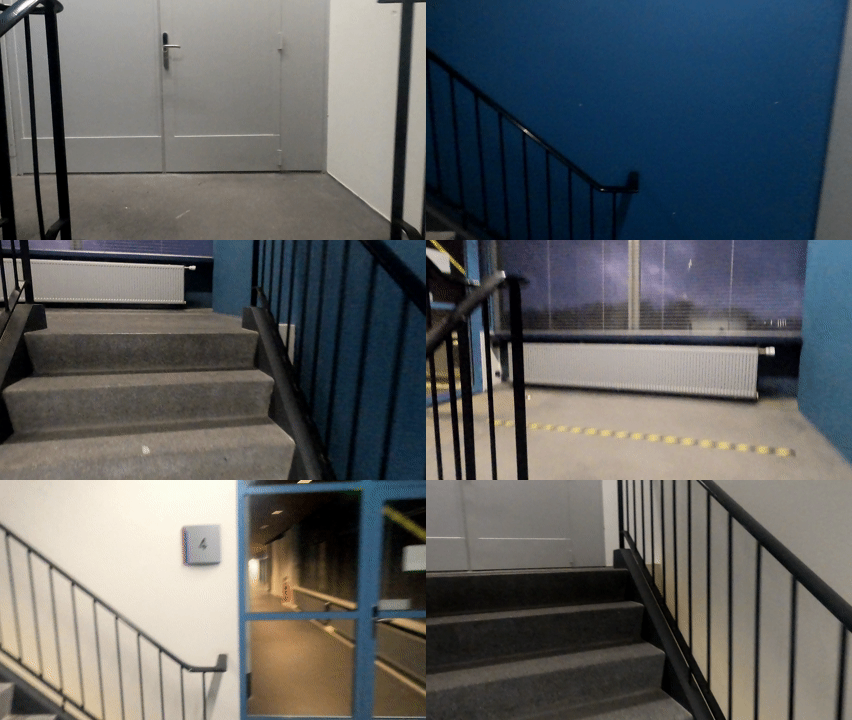
(Image: Annebelle de Bruijn)
Training for the tower running competition? Hmm, study mates Yoshua, Cian and Antoni (all 20 years old, Aerospace Engineering) did not really do so. High expectations? Absolutely not. As a former resident of the 17th floor of the Roland Holstlaan, Antoni is the only one with serious stair climbing experience. “Even though I never ran upstairs.”
But that is the intention this evening. Twenty floors, 40 staircases, and 402 steps mark the way to the highest point on campus, in other words, the top of the tower of the Faculty of Electrical Engineering, Mathematics and Computer Science (EEMCS) which was submitted for designation as a listed building a few months ago.
The study mates are three of the 170 entrants in the staircase climbing competition that was organised by Dodeka (in Dutch), the student athletics association. Last year, it was held for the first time. It was then a Netherlands Student Championship where the best student athletes in the country started the race. This year, the entrants are battling for the Delft title.
Also open for non-athletes
This year, the registration was explicitly open to other students in Delft, student sports associations, and staff members, the organiser told Delta a few weeks ago. So this year, the evening opened with a staff member part (see box). The programme also includes a relay race., which was cancelled during last year’s edition.
In the queue is Erik (19, Applied Physics). This athlete at the AV’40 athletics association in Delft had already signed up when, amazingly, he had broken both his arms. With two hands still in plaster, he is now mentally preparing for having to pull out after a few minutes. Not joining in was not an option. “But I can’t hold the railings and I absolutely must not fall over. So this will not be the fastest run.”
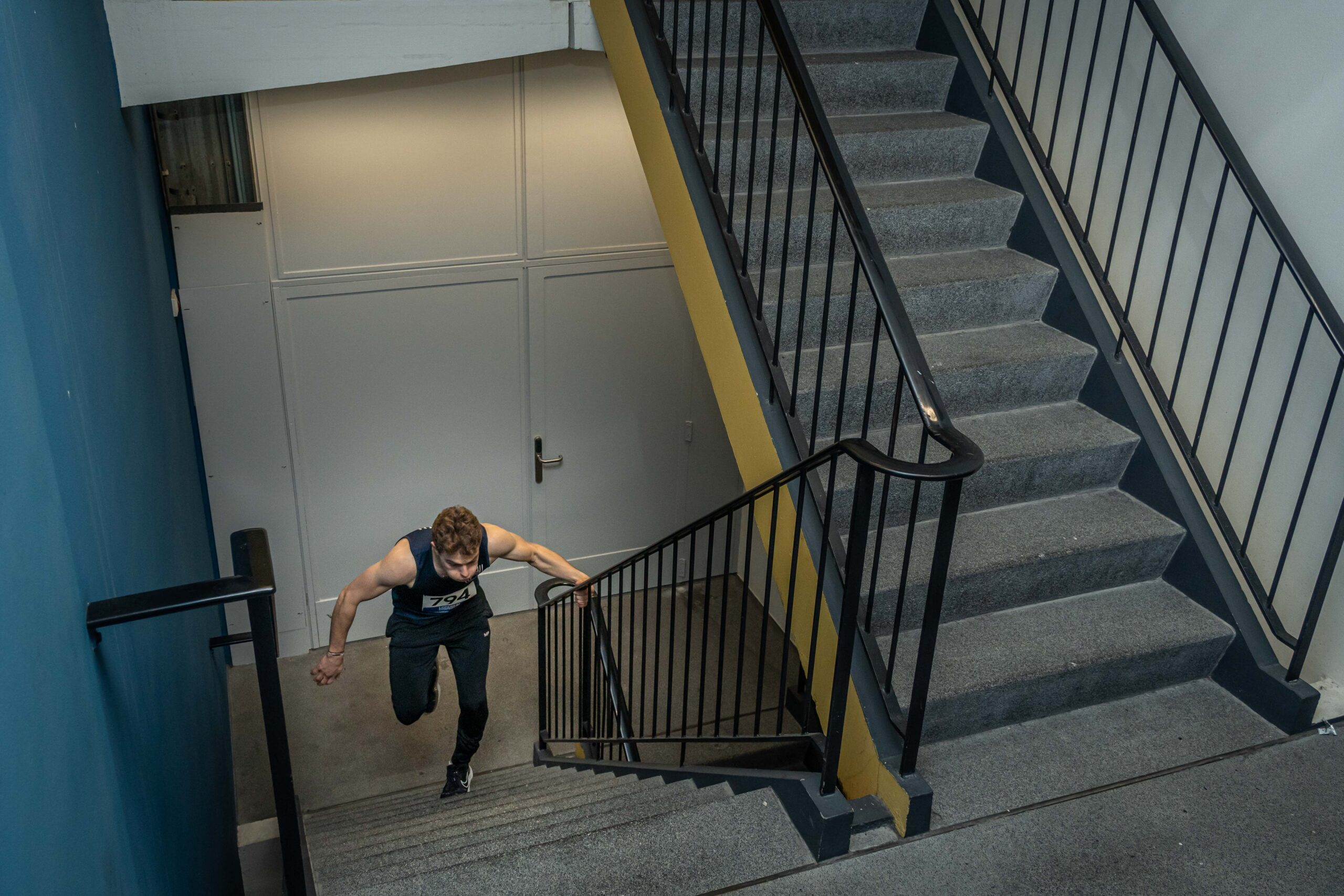
Next to him is Emily (19, Health and Nutrition). This student athlete at Wageningen University came specially to her hometown of Delft, to improve her running time, although she does not exactly remember her time. In two weeks’ time she will do the NSK Stair Climbing competition in Nijmegen, so this is the best occasion to train. She says that you can run up in a jiffy. “It hurts for a while, but then passes.”
Flew over specially
Not yet in the queue is Troy Alston from the United States of America. He already did the 10 floor part and is taking as long as he can to recover and run the big event. The former hurdler came over from Florida specially for this race as – uniquely – the programme includes a relay race. This evening’s race is his 143rd race.
The American took up tower running after a failed Olympic Games qualification. What he enjoys about the sport is the mental aspect, he says. “It is an incredible mental challenge. The only person in the stairwell is you. You have to do it completely alone. If you can do this, you can do everything that life throws at you.”
Will Alston beat the 1 minute 49 second record? He says that he has run 22 floors in 1:55 and 1:40. “But every staircase is different so it’s hard to compare.” He has two tips for his fellow competitors. “Run two steps at a time and hold the railing, preferably both if the stairwell is narrow enough.”
Ten floors and a relay race
The stair climbing competition started on Friday evening with a section for staff members. The 18 entrants ran 10 floors up. Of the 15 men, Fabian Portner was the fastest (47 seconds). Of the three women, it was a Delta editor, Annebelle de Bruijn (1 minute 15 seconds).
There was also a 10 floor run for students. Eighteen people signed up. The fastest woman was Lou Bijma at 53 seconds, and the fastest man was Marien Sips at 39 seconds.
In the relay race, ‘Traplopen Elite’ (stair climbing elite), which included the American Troy Alston, was the fastest at 1 minute 27 seconds. The winning team was put together by Dodeka.
After the 10 floor section, it is time for the entrants in the main event to strengthen their nerves of steel for a big explosion. Every 35 seconds, a Dodeka volunteer is starting a participant with a number on their shirt. After their hellish run, they press a red button on the 20th floor that records their time.
A completely hellish run it is. Arriving on the 20th floor, the three AE study mates gratefully drop into chairs and gulp down the cup of water they are offered. “I thought it would be fine,” sighed Cian, panting. “But it was not fine at all.” He was not even half way through when he had had enough. “I started walking from the eighth floor.”
Breaking down
Daan (24, Aerospace Engineering) too gets a cup of water pushed into his hands. The sports rower, not unfamiliar with ‘breaking down’, looks refreshed after just a couple of minutes. But looks can be deceiving. “It is bizarre how you can mess yourself up in such a short space of time.”
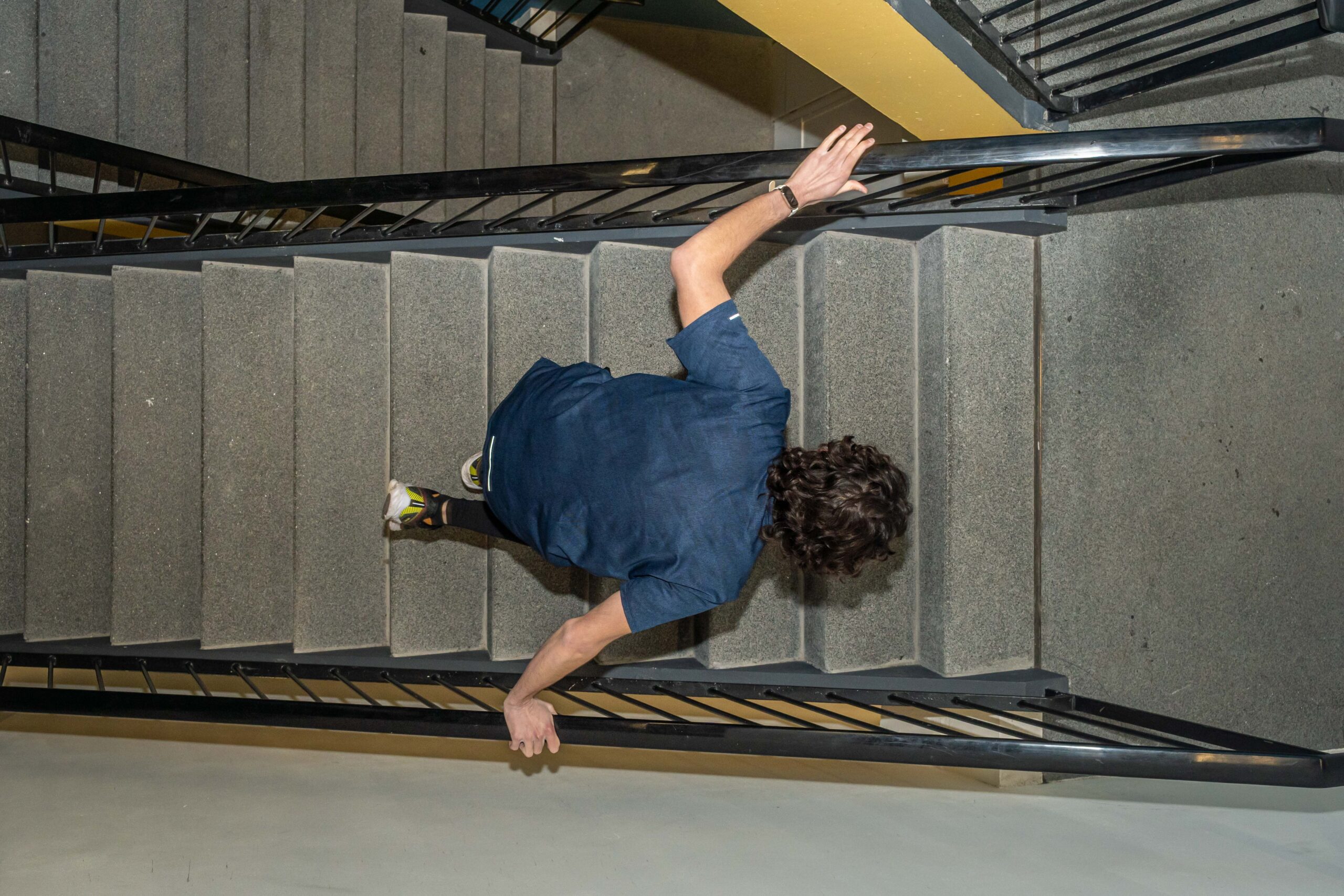
Emily too is exhausted when she arrives at the top. “It was a lot worse than I expected,” she says, gasping for air. “I survived, but it was really hard. I don’t think I was faster than last year.”
New record
On reaching the 20th floor, the near professional Troy Alston drops to the ground like a ton of bricks. He gave his all, he says panting. And yes, the new record of 1 minute and 46 seconds is his. In second place is Jorik Bokelman at 1 minute 47 seconds – also faster than the 2024 record. The fastest woman is Margharita Bonan at 2 minutes 33 seconds. The 2 minute 20 second record thus remains unbroken.
How did Erik do with his two broken arms? Looking fresher than most at the finish, he says it went better than expected. “But at a certain point I was too tired to keep running without risking falling over. So I had to slow down.” He is planning on revenge next year. “Next year, I’ll stand at the start with two working arms. One hundred percent.”
- Do you want to know how fast the entrants ran? Then visit Uitslagen.nl.

Do you have a question or comment about this article?
[email protected]


Comments are closed.