
Under the motto ‘Delft gets moving’, Pro, D66 and STIP will govern Delft in the coming years. The coalition agreement builds on existing policy. A notable element is an action plan in which EUR 20 million is allocated to more affordable housing, although issues such as grid congestion and limited space complicate its implementation.
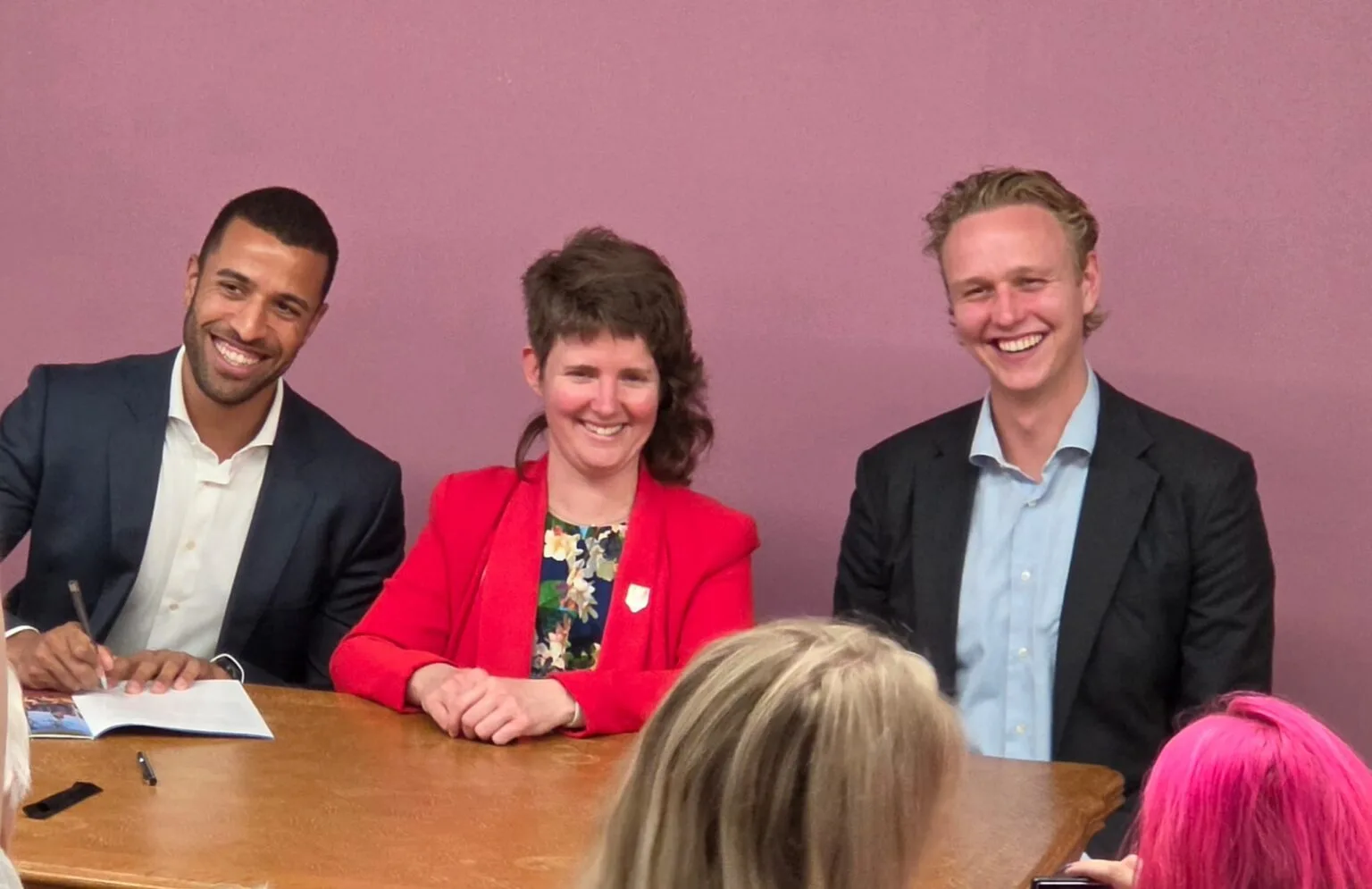
Party leaders Brendan Analikwu (D66), Rinske Wessels (Pro) and Jelle Stap (STIP) signing the agreement. (Photo: Willem de Bie)
The coalition agreement (in Dutch), in which the winners of the March elections set out their plans for the coming years, was presented on Tuesday evening not at City Hall but at DOK Tanthof library. That location was not chosen at random: Tanthof is considered a working-class neighbourhood where the PVV and the local party Hart voor Delft perform well.
In this ‘lion’s den’, the new aldermen from Pro, D66 and STIP were briefly introduced. Although their names had already been announced earlier, it has now also become clear who will be responsible for what:
Frank van Vliet (Pro)
Finance and shareholdings, Mobility, Public space and waste, Biodiversity and animal welfare, Delftse Hout and regional green areas, Nieuw Delft.
Hélène Oppatja (Pro)
Housing, Work and income, Poverty and debt, Heritage and shared past, Organisation, Kop van de Buitenhof.
Sophie Koek (D66)
Youth and youth care, Care, Wmo and supported housing, Sport and exercise – health, Delft-West implementation programme, Integration, Elderly people, Social care, Subsidies.
Minke van Velzen (D66)
Education (housing), Local economy, Visitor economy, City centre, Real estate and land policy, Services, Digitalisation.
Maaike Zwart (STIP)
Energy, Circular economy, Climate adaptation, Innovative economy and Innovation District Delft (IDD), Inclusive society, Public facilities, Permits, Schieoevers, Biotech Campus Delft, DSM East.
Ida de Boer (STIP)
Spatial planning, Area development, Culture, Events, Engagement with the city and participation, Environment.
Housing action plan
In terms of housing, the new coalition plans to accelerate. An ‘Affordable Housing Action Plan’ is to be introduced, with the aim of quickly building 2,000 affordable homes. Half of these should be social housing. To achieve this, the coalition is allocating EUR 20 million.
And it does not stop there. By 2040, Delft is expected to have as many as 11,000 more homes than it does today. This goal is not new: the previous coalition aimed to add 15,000 homes, and these 11,000 have yet to be realised.
The question is whether the coalition can achieve this goal. Challenges include, for example, grid congestion. To counter the effects of an overloaded electricity network, Pro, D66 and STIP want to allocate an additional EUR 1 million.
Student housing
It already became clear last January that the ambition to build 3,500 new student homes is unfeasible. A range of persistent problems is at play: planning processes are lengthy and complex, suitable building locations are scarce, and planning and administrative obstacles delay projects. In addition, national policy is uncertain, construction costs continue to rise, and there is a shortage of personnel to carry out projects.
Just like the previous coalition, the new one wants 33 per cent of Delft’s housing stock to consist of social housing
Specifically for student housing, financing for non-self-contained rooms – which are preferred, also by the new coalition – is difficult to secure, partly due to national regulations on housing benefit.
Pick-your-housmate policy
Although DUWO’s proposed new student pick-your-housmate policy was certainly a major issue for the student party STIP during the election campaign, there is no mention of it in the new coalition agreement. In the run-up to the elections, the subject was discussed at length on several occasions in the city council, which even passed two motions on the matter. However, it was already clear at the time: this is not a matter for local politics, but for the student housing provider DUWO and its tenants.
Social housing
Like the previous coalition, the new city administration wants 33 percent of Delft’s homes to be social housing. During negotiations, this is likely to have been an issue on which Pro had to compromise. The party has campaigned on the ambition of making as much as 50 percent of housing social.
In this matter, D66 appears to have had the upper hand. During the presentation of the agreement, D66 party leader Brendan Analikwu said, with some pride, that 33 percent social housing will be achieved and – importantly for D66 voters – 40 per cent mid-range housing.
Asylum policy
Little will change in the area of asylum policy. The coalition will continue the current policy and maintain plans for a permanent reception location for asylum seekers.
According to the most recent requirement under the Distribution Act, Delft must provide space for 406 asylum seekers from 2028. With a planned asylum centre for 350 people at Brasserskade and a reception facility for fifty unaccompanied minor refugees at Adri Boslaan, Delft will have 400 structural reception places.
To meet the current national requirement, the municipality therefore still needs to find a handful of additional places. However, this requirement may change in the future, as the number of required places is reassessed every two years.
Energy transition

The course of the energy transition also remains largely the same. Delft will continue expanding its geothermal heating network, meaning that in the coming years more homes in particular in Voorhof and Buitenhof will have to be taken off gas.
The targets are ambitious: by 2030, 10,000 homes must be better insulated and 9,500 homes must be disconnected from natural gas. In addition, the municipality is exploring whether it can participate in a local heat company. Whereas the previous coalition mainly drew up the plans, this coalition aims to focus more on implementation.
Debate on the coalition agreement
The aldermen who are to carry out these plans still need to be formally installed. A hearing will take place on Tuesday 16 June, where municipal councillors can question them. This will be followed on 24 June by a debate on the coalition agreement, during which the aldermen will be officially appointed.
-
This article is an adapted version of a piece by Omroep Delft (in Dutch), written in collaboration with Omroep West.
Also read this interview with Delft Mayor Pechtold:


Do you have a question or comment about this article?
[email protected]


Comments are closed.