

Typing with vibrations and keys that light up. For people with Parkinson’s disease it is a blessing, TU Delft alumna Alessandra Galli thought while studying. Her idea has now brought her EUR 36,000.
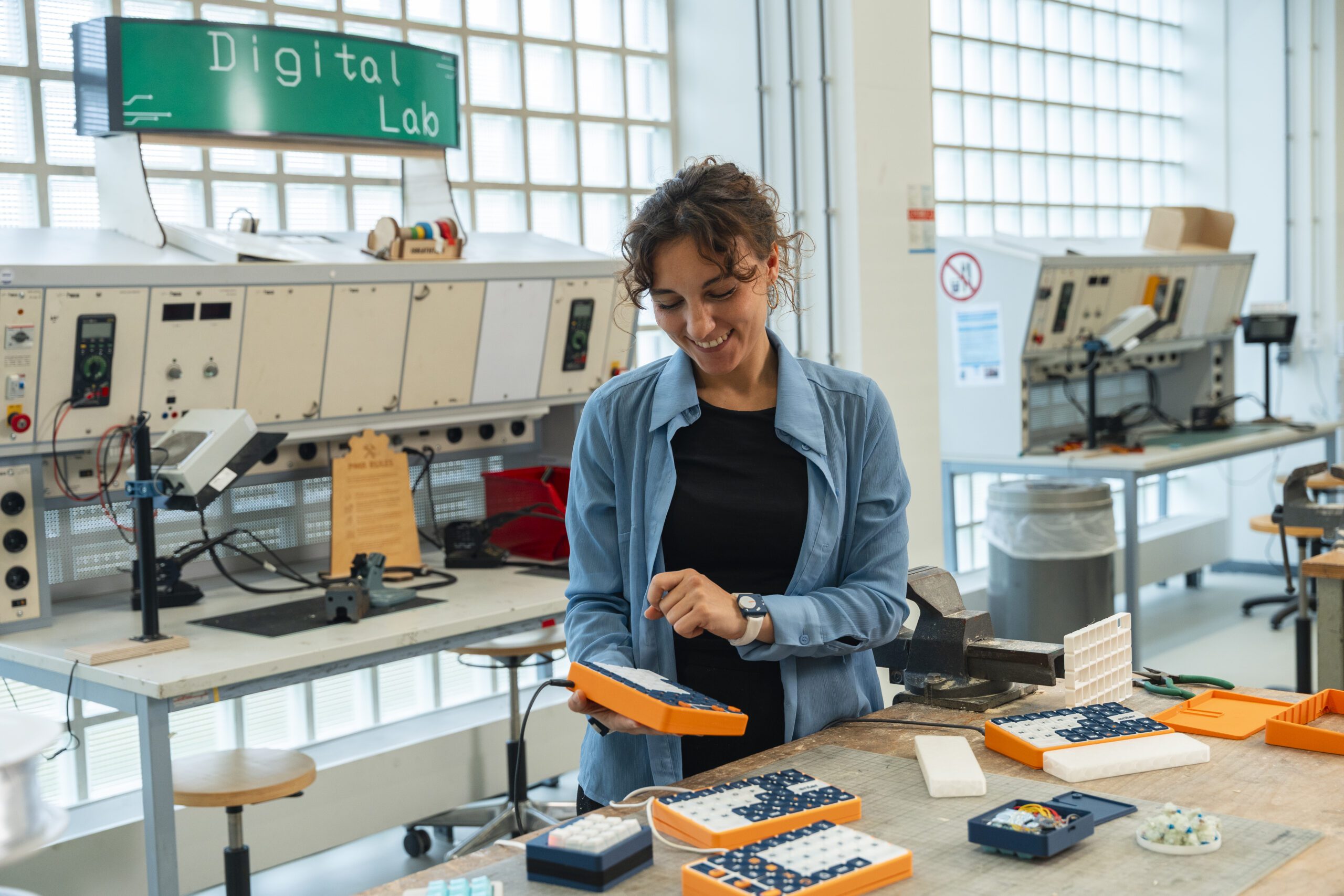
Allessandra Galli operating the keyboard she designed for Parkinson's patients. (Photo: James Dyson Award)
The fine motor skills are the first to be lost for a lot of people with Parkinson’s disease, a brain disease. Everyday actions which they never thought about become increasingly complicated. Their handwriting becomes illegible, coffee spills over the top of the mug more often.
Working with a computer also gets more and more challenging, since a heavy dose of fine motor skills is needed to use a regular keyboard. The ParkinsonNederland Foundation believed that this could be different. They sought the cooperation with master students at the Faculty of Industrial Design Engineering and inspired Alessandra Galli, then a student (Master of Integrated Product Design).
During a phone call, Galli, from Italy, said that she was determined to make a difference. “I realised that I take so many things, like typing, for granted. But this is not the case for Parkinson’s patients.”
Alternative keyboard
So Galli designed an alternative keyboard for Parkinson’s patients who cannot type that easily. She earned her master’s for this and was awarded a nine. Worldwide recognition followed this week when she won the international James Dyson Award.
This is the main award in a competition for students who want to solve the world’s problems with a good design in two categories: health and sustainability. The competition has been held by the James Dyson (known for its vacuum cleaners) Foundation since 2005 and the winners in both categories are awarded prizes of EUR 36,000.
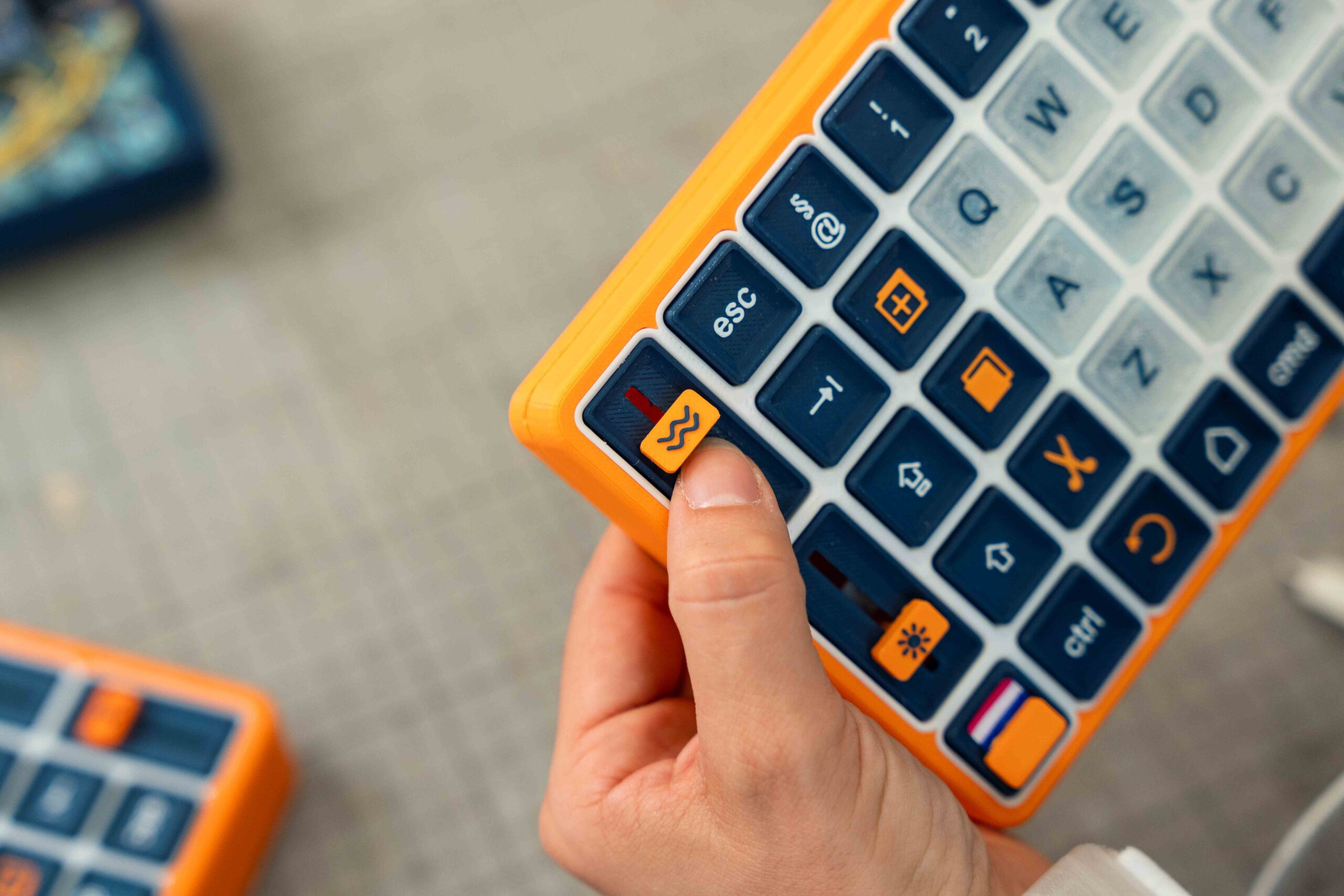
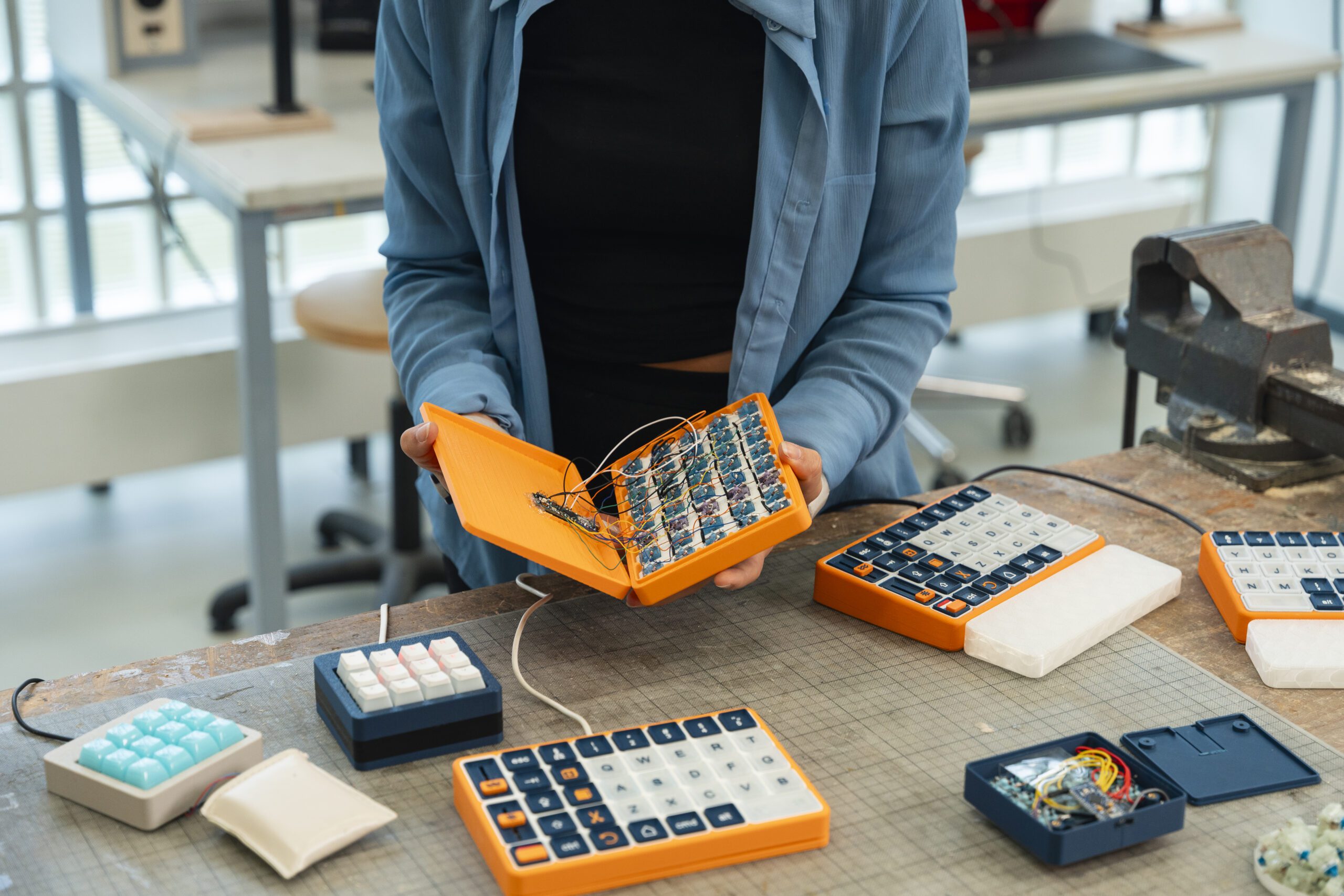
The first thing you notice about the keyboard is that it is in two separate parts. Galli explains that this idea comes from the gaming world. “You can put the parts down wherever you want and are thus not tied to one position.” This is important as many Parkinson’s patients get stiff muscles and the freedom of movement is essential for them.
Upright edges
The keys have upright edges that help prevent fingers from unintentionally slipping to other keys. Artificial intelligence predicts the key that the user will press next and it lights up.
Galli explains that lighting up is a typical cue that helps Parkinson’s patients. “They are external triggers that facilitate movement. Some patients stiffen or freeze. A light, sound or vibration can help them break this.”
Every time a user presses a key, the wristband that is part of the system vibrates
Vibrations are another cue that Galli used. Every time users press a key, the wristband that is part of the system vibrates. This also helps them continue moving.
International top 20
Galli is not the only TU Delft student or former student that climbed their way to the top of the competition for young designers. Pedro Yániz González and David Soche (both Industrial Design Engineering as well) won places in the international competition’s top 20.
Yániz González did so with Pompa in the health category. He also won the Dutch James Dyson Award and received EUR 6,000. Galli was the runner-up in the Dutch competition. Out of the top 20, James Dyson (the brainchild of the well-known vacuum cleaner after whom the foundation is named) ultimately chose her as the international winner in the health category.
Reusable
Yániz González redesigned the inflator, a piece of equipment that is used more than 100,000 times a year in the Netherlands in hospital operating theatres. The instrument is usually disposed of after use as it is not made for repeated use. Yániz González designed a version that can be taken apart after use, cleaned and reused frequently.
CropKit designed by TU Delft student David Soche also reached the international top 20 in the sustainability category. Soche designed a device that can be attached to existing agricultural tools, such as a manual plough, that can be operated from a distance. Soche’s idea was that this would help small-scale farms to remain viable without having to invest and scale up.
The first prize in this second category went to Filip Budny from Poland. He designed an AI device that monitors water quality and signals pollution early.
Start-up
The keyboard adventure did not stop for Galli after she graduated last summer. She wanted a ‘regular’ job, but after much encouragement she set up the OneCue company, the same name as her design. She took part in Yes!Delft’s Validation Programme which got her a fixed spot in the building that accommodates new start-ups.
The plan is that the device can ultimately be adapted to individual users
And Galli believes that the keyboard has a lot more potential. She is using the EUR 36,000 that she received from the James Dyson Foundation to further develop the keyboard. The plan is that the device can ultimately be adapted to individual users. Each individual patient benefits from different cues. And the keyboard may help users who have difficulty typing for other reasons.
So it is build and test, test, test, test, says Galli. The Parkinson’s foundations in both the Netherlands and in her homeland of Italy want to work with her. Galli hopes that the keyboard will be put on the market in 2027. The big money prize is sure to help her with this.
Do you have a question or comment about this article?
[email protected]


Comments are closed.