

Point systems and campus contracts. You will not make huge profits on renting out rooms anymore. So landlords are trying to empty their student houses as fast as possible to sell them. Students are the victims: “My landlady tried to force me out.”
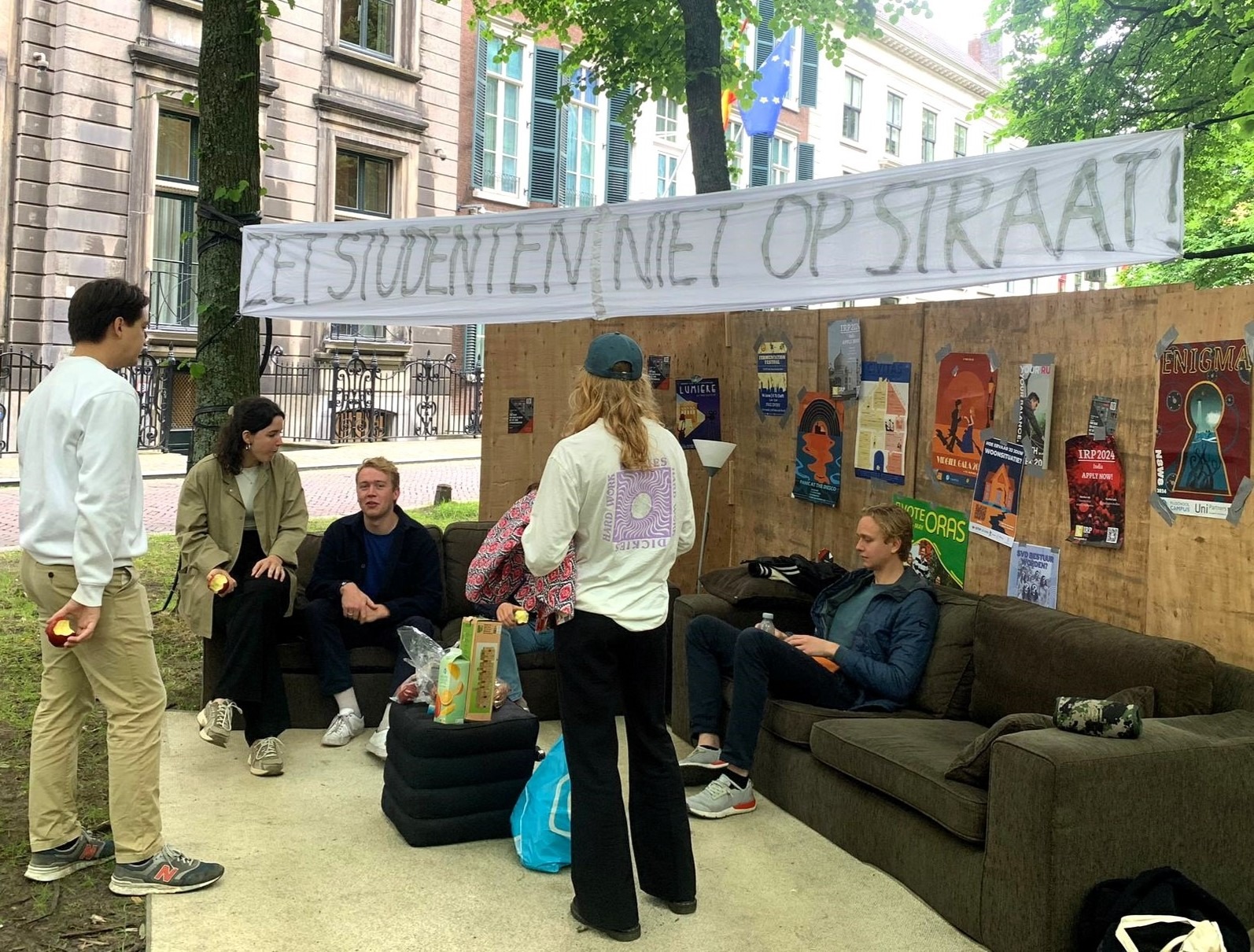
(Photo: Oras)
This article in 1 minute
Luka is stressed. One month ago his landlady told him that he had to leave within two weeks. He has slept on friends’ sofa since then and there is no prospect of a permanent home.
“When I signed my temporary contract, the landlady assured me that she would do her best to extend it to a permanent contract,” says Luka. “But just before it was to end, she told me that she could not make a profit anymore without illegally raising the rent significantly. She wants to sell the property and I had to leave.”
Carlos too will have to leave. He has now lived for more than a year in a pleasant student house with four others. They share a group contract and jointly pay the rent for the full property.
Then his landlord announced that no more new housemates could sign a contract so that the house can be vacated for sale. Three of Carlos’ housemates were about to leave. But the rent still needs to be paid without new housemates. Carlos: “Two of us suddenly had to pay the rent for five people. We are just students so we don’t have that amount of money.”
Forced evictions
And then there is Rohan, who has lived in a studio outside Delft for three years. The relationship between him and his landlady has seriously worsened over the last few months. “She got the idea that she could earn more from this studio with a new contract and thus a new tenant. Since then she has tried to force me out, even though I have a permanent contract.”
It is going from bad to worse. She regularly turns up unannounced, demands a higher rent and even turns off the gas and water as she thinks that Rohan uses ‘too much’, even though his rent is inclusive of gas, water and the lights.
Luka, Carlos and Rohan are among the 35% of TU Delft students who rent in the private sector. For their landlords, changes in the law and new tax regulations mean that it is less attractive for them to rent out student rooms. It seems that many landlords in Delft are on the point of, or are thinking about, selling their student accommodation, writes the Municipality of Delft in the Actieplan Studentenhuisvesting (student accommodation action plan, in Dutch) that was issued in March.
Plans to sell
This was also the conclusion in the DSHO report (Delfts StudentenHuisvestingsOverleg, Delft student accommodation consultation, in Dutch), that ORAS, STIP, SHS, WijWonen and VerenigingsRaad (VeRa, Association Council) issued in January. They investigated the housing experiences of students. More than one quarter of the respondents said that their landlord was intending to sell the house. Only 36% were sure that their landlord did not have such intentions.
This is not just a trend in Delft, the figures from the Kadaster (The Netherlands’ Cadastre, Land Registry and Mapping Agency, in Dutch) show. Across the country, private investors in university cities sold 1,200 homes last year, 33% more than the year before. In total, they sold more than 5,000 houses last year than they bought. This is a significant change in direction compared to 2016–2020 when on average private landlords bought 1,700 homes more than they sold.
In its plan of action, the municipality says that the main reason why landlords want to get rid of their properties is the high tax on real estate, that will only further rise from 2026 onwards. This tax is based on high estimated incomes from real estate.
But the actual income from renting out student rooms is often lower than estimated given high maintenance costs and a low maximum rent for rooms. On top of this, the price of housing has risen by 9.6% since 2022, which makes selling attractive. And then add three new rental regulations on top of this. They give tenants more rights and impose stricter rules on landlords.
Landlords are stuck with one tenant for a longer time than before
Campus contract
First, there’s the law on permanent rental contracts that has been in force since 1 July 2024. For students who move house within Delft, a permanent contract or campus contract, that remains valid for the duration of the study, is now the norm. Landlords can offer students who move from other municipalities to Delft a temporary contract, but if it gets extended, it becomes a permanent contract. This makes renting properties less flexible for landlords and they are stuck with one tenant for a longer time than before.
Second, the Affordable Rent Act. Since 1 July 2024, if tenants ask for it, landlords have to justify the price of the rooms based on a points system. Rooms get points for things like surface area, facilities, and sustainability. Tenants can calculate this themselves. The more points, the higher the maximum rent.

This system was already in existence, but the municipality may now enforce it and fine any violations. The points system also takes sustainability more strongly into account, and many student houses in the private sector do not score well on this.
Lower rents
Many students pay more than the maximum rent, notes the Fair Rent Team Delft, which was founded in 2023 and where students can go for help with rent problems. One quarter of the reports that the Team receives is about overly high rents, says Eva Luijendijk, the Team Manager. She and her colleagues help students force the rent to be reduced. Since it started in September 2023, the Fair Rent Team has advised 54 tenants.
And then there’s the third law. This is the Landlords (Good Practices) Act introduced on 1 July 2023. This clarifies what a landlord may and may not do. The Act also gives municipalities the power to check that the regulations are being enforced and, if necessary, give out fines. The Act also describes that municipalities have to create a help desk for tenants. In this case it is the Fair Rent Team Delft, stated above.
Rental problems? Here’s where to go
- Fair Rent Team Delft (Huurteam Delft)
For free support with excessive rent, overdue maintenance, or issues with your landlord, you can register here. - Rental Committee (Huurcommissie)
For an impartial and independent assessment of a dispute between you and your landlord. The committee issues binding decisions that both parties must follow.
For questions about the Rental Committee, visit the website or call 088 – 1 600 300.
You can also start a procedure here. - Legal Help Desk (Juridisch Loket)
For general legal questions, including those about tenancy law. Visit the website or call 0800 – 8020.
The new laws give tenants greater powers, while for landlords it means ever less freedom in the private sector. They have less power about how long tenants may occupy their property, less freedom in setting the rent, and a greater chance of opposition from tenants.
Labour migrant
This is why several private landlords are throwing the towel in the ring. Some of them prefer to sell their real estate rather than keep it. Logically, the landlord then wants the property to be empty as quickly as possible. But the laws mean that this cannot be done just like that, so some landlords wangle their way into emptying their property as soon as they can.
Fair Rent Team: ‘Last year the landlord placed a labour migrant in a women’s student house, a man’
Students finish their studies at different times and rarely all leave a shared house at the same time. And empty rooms which are not paid for means a loss. To keep the rooms filled until the last campus contract is ended, landlords sometimes opt to use the exceptions where temporary contracts may be given. Eva Luijendijk of the Fair Rent Team Delft, mentions a women’s student house in Utrecht. “Last year the landlord placed a labour migrant in the house, a man. Other than students, he was allowed to be given a temporary contract.”
Luijendijk explains that in the eyes of the Landlords (Good Practices) Act, this is intimidation. But discrimination is not permitted either. A labour migrant is also a person that needs housing. Despite the students knowing their rights through the Fair Rent Team, they all left one by one.
In a trap
Martin (real name known to the Editorial Office) rents out student housing in Delft. He understands that some landlords choose to fill a room with a temporary tenant. “Your preference would be to give a student a temporary contract that ends when the rest of the household leaves. Placing a labour migrant in a student house is of course not nice for the students. But as a landlord, given the new laws you try to find ways to keep it affordable. You are stuck in a trap so you try to find a way out.”
An unwanted housemate with a temporary contract is not the only way to make the house unattractive. Rohan’s story shows that things can also go wrong in studios. His landlady does not want to sell the property, but Rohan thinks she wants to get him out to charge a new tenant a higher rent, despite Rohan having a permanent contract.
Rohan: ‘My landlady regularly intimidates me by threatening with a higher rent’
Rohan says “She regularly intimidates me by threatening with a higher rent or telling me I have to leave. She even tries to force me to let potential tenants view the studio, even after I have said that I will not move. I have not felt safe in my own flat since then, and sleep badly.”
Bleeding to death
And then there is the group contract, as Carlos had. In 2023, NOS op 3 (in Dutch) revealed that many landlords avoid the point system by having a group contract. All the housemates jointly pay the rent. This means that the entire house can be checked according to the point system and a higher rent can be charged to each person.
If a housemate leaves, the remaining tenants are not always able to find a new person themselves. Landlords who want to sell the property thus allow the house to ‘bleed to death’. Luijendijk of the Fair Rent Team sees this happening regularly. “Every time someone leaves, those remaining pay a higher amount each. The contract may then be right, but the methods are not.”
Point system
Martin, the landlord in Delft, has already let one third of his 150 rental contracts end. He said he started doing so once he saw the direction that the housing market was moving in. “If the laws only bring about havoc and do not benefit you at all, why would you continue?”
Landlord: ‘The discussions are sometimes like a full-time job. This is not renting out anymore, it is making each other’s lives unpleasant’
He says that he does not enjoy renting out student housing anymore. “I used to be very involved in the houses. I was often invited round, and people enjoyed living there. There have even been students who fell in love in my houses and got married.”
But now the students are exploiting the laws, landlord Martin believes. “The residents in one of my houses even measured the house themselves. Their finding was a little higher which led to a rent decrease of EUR 10 to EUR 15 per person. I understand that every euro is important for students, but these discussions are sometimes like a full-time job. This is not renting out anymore, it is making each other’s lives unpleasant.”
Action plan
The Municipality of Delft and the Fair Rent Team are keeping a close eye on private rentals, they write in the Student Housing Action Plan. They are also working on making the Fair Rent Team better known so that students can approach them if need be. Luijendijk (Fair Rent Team) says that “We see that students are afraid that their contract will be terminated just like that. Or that they do not want to be on a wrong footing with their landlord.”
The municipality is happy that the new legislation gives them the tools to ensure that the regulations in private rentals are adhered to. “Students often enjoy living in their homes. It is a shame if a few are victims of badly maintained houses which are out of sight for many authorities,” says the municipality spokesperson.
The municipality would prefer that as many students as possible rent through Duwo, as now more than half do. “Then we know that things are well organised and that everything is above board. Our focus is now on bringing about new building projects for student housing,” the spokesperson said.

Room without windows
How did it go for the three students who we met at the start? Luka did not need to sleep on friends’ sofa for long. He quickly found a temporary Duwo room. He can move into the flat of a friend in July. He can live there in a room without windows until October. After that a pleasant room will be available where he will hopefully finish his study.
Rohan’s situation has worsened. His landlady is doing everything to get him out. Rohan does not feel comfortable, but is happy with his accommodation and permanent contract. He does not want to be bullied into leaving and intends to start a procedure at the Rental Committee if the situation does not change.
For Carlos it was all for nothing. After conferring with his landlord, he and his housemates were understood – new housemates were permitted temporarily. The contract will terminate for them all in June. Carlos has to find a new house before that.
Accountability for anonymity
The students who shared their experiences with housing and rental contracts chose to remain anonymous because of concerns about possible consequences for their current or future housing. They are concerned that being open about conflicts with landlords could lead to intimidation, loss of housing, or interference in find new housing. For these reasons their names and any recognisable details are excluded or have been changed.
At his request, the landlord in this article remains anonymous. While he says that he thinks his story is important for understanding the consequences of recent rental laws, he is worried about negative reactions or reputational damage.

Do you have a question or comment about this article?
I.J.Duursma@tudelft.nl


Comments are closed.