

A year ago, there was a tent camp on campus; on Tuesday, TU Delft announced it would not establish new ties with Israeli universities. What is the current situation at other Dutch universities?

A man removes graffiti after protests on campus in June 2025. (Photo: Kim Bakker)
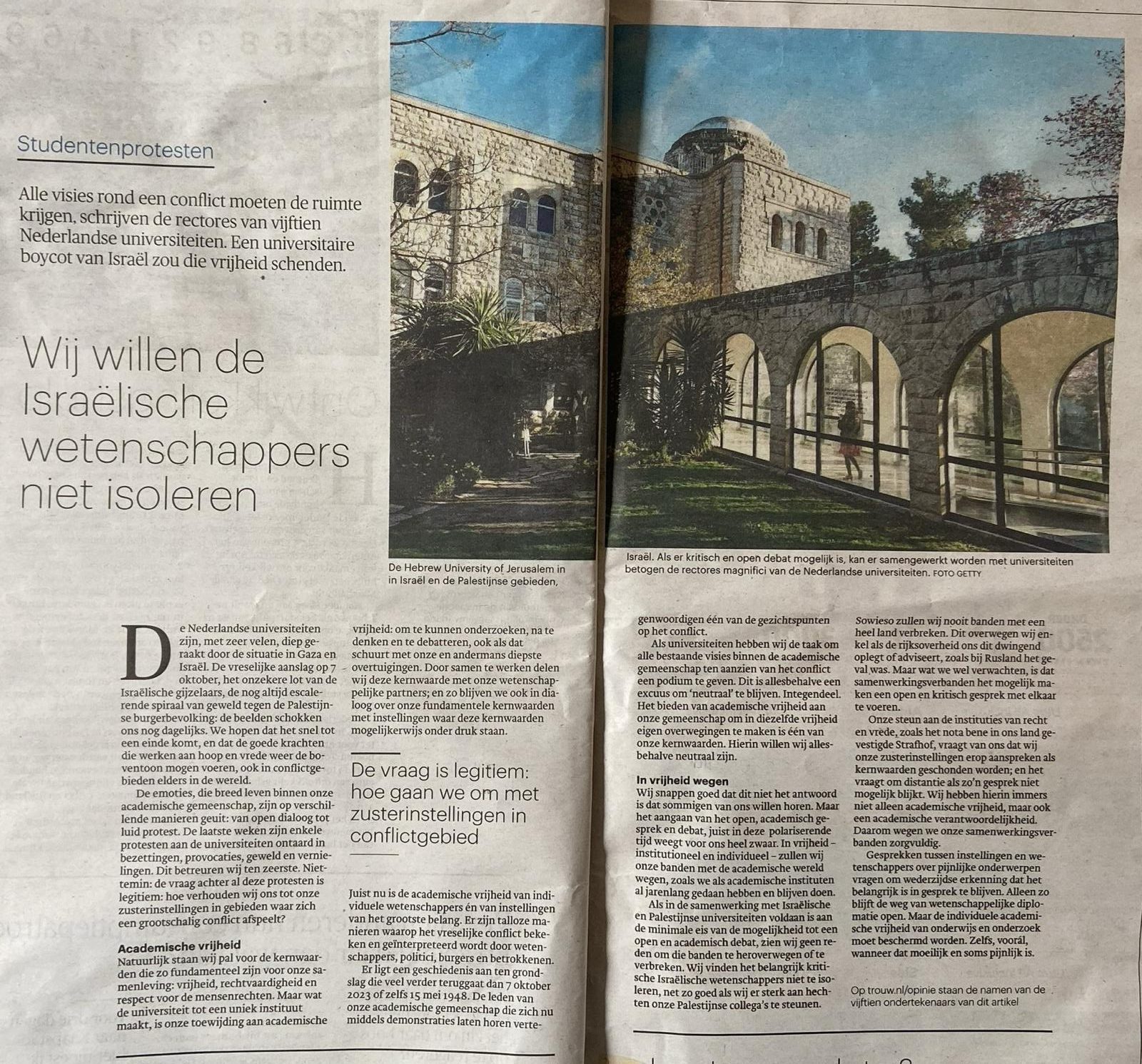
‘We see no reason to reconsider or sever ties with Israeli and Palestinian universities. We believe it is important not to isolate critical Israeli academics, just as we are strongly committed to supporting our Palestinian colleagues. In any case, we will never sever ties with an entire country.’
This was written by fifteen rectors of Dutch universities on June 8, 2024, in a joint op-ed in the Dutch newspaper Trouw. They cite academic freedom and the opportunity for academic debate as their main reasons.
A year has passed since the op-ed, and the situation in Gaza is even worse than it was a year ago. Israel says it is waging a war against the terrorist organisation Hamas, intending to get back the hostages kidnapped on October 7, 2023. But the violence is focused to an extreme degree on the Palestinian population. International treaties are being violated, and more and more organisations are openly qualifying it as genocide.
Over the past year, students and staff at Dutch universities have pushed for a more radical decision through tent camps, walkouts, protest marches, letters, (guest) lectures, occupations, and petitions: they want Dutch universities to sever all institutional ties with Israeli universities.
They argue that Israeli universities are so closely linked to the Israeli state that they can be held jointly responsible for the genocidal violence, so Dutch universities should not collaborate with them.
The effect of this varies from one educational institution to another. Apart from the op-ed in Trouw, there has been no further joint statement from the universities. Each university has its own policy.
At present, only three universities have maintained their position since the spring of 2024. The Eindhoven University of Technology and Wageningen University do not wish to alter their cooperation with Israeli universities. They argue that the university is not a political organisation and that Israeli universities cannot be equated with the Israeli government. The third university is the University of Groningen, which argues that it collaborates with three Israeli universities in the context of exchange programmes, something that is not aimed at military research or research on security issues. For this reason, the partnership is still not up for discussion.
Committees International Partnerships
Other universities have seen changes. Ten universities have set up a committee to review international partnerships, though the exact terms of this review vary from university to university.
The technical universities of Twente and Delft are sticking to their existing partnerships for the time being, but would like to tighten up moral and ethical considerations when it comes to human rights. The statements from 2024 to continue collaboration with Israel have therefore not yet been amended, but this could happen.
VU Amsterdam has set up a committee
In Maastricht, the Executive Board decided to set up a committee to determine whether the university can collaborate with a particular partner, on the basis of rulings by the International Court of Justice in The Hague. No concrete recommendations have been made yet.
In Leiden, an ethics committee (link in Dutch) was established last June to investigate the university’s ties with Israel. A year later, the committee has yet to begin its work, as reported by Mare (link in Dutch) last week.
Six universities with amended statements
Six universities amended their statements last month: Radboud University, the University of Amsterdam, Tilburg University, Erasmus University, Utrecht University and since Tuesday Delft University of Technology.

Last Thursday, Erasmus University from Rotterdam froze immediately the cooperations with Israël. As a result, collaborations with Bar-Ilan University, Hebrew University, and the University of Haifa are immediately put on hold. Collaboration in international consortia with the universities from Tel Aviv, Jerusalem and Haifa remains possible, but only if the involved researchers from Rotterdam do not have to work directly with the Israeli institutions. In the decision, the board sharpened the recent advice of the Sensitive Partnerships Committee.
Radboud University decided to suspend university-wide partnerships with Tel Aviv University and Hebrew University
In Tilburg, the board announced in early May that it was suspending its collaboration with Bar-Ilan and Reichman University. It proved impossible to engage in dialogue with these two universities “about the risks of our collaboration for systematic and gross violations of human rights and fundamental freedoms”. They remain in touch with Hebrew University. Tilburg is following the advice of an independent committee.
In May, Radboud University, in Nijmegen, decided to suspend university-wide partnerships with Tel Aviv University and Hebrew University, on the advice of a committee.
Later that same month, Utrecht University announced its decision not to seek any new partnerships with Israeli universities and to sever institutional ties with the University of Haifa. The 23 existing partnerships will be maintained because they are not related to military purposes or human rights violations.
There is one exception, a health project in which the Ministry of Health is directly involved. The possibility of terminating this particular partnership is being explored. In the future, a new ethics committee will advise on projects taking place in countries involved in armed conflict.
Human rights violations
The University of Amsterdam has also amended its statement. In March, following advice from a committee, it announced that it would put student exchanges with Hebrew University to a halt because students could be exposed to human rights violations. Two weeks later, UvA announced that it would revisit its cooperation with Hebrew University after Jewish alumni protested the decision.
TU Delft will not enter into any new partnerships at institutional level
And finally, Delft University of Technology. On Tuesday, it announced that it would immediately cease entering into new partnerships with institutions in Israel. All existing collaborations will be critically reviewed. The method for doing so has yet to be developed. The decision was made based on the outcome of a moral deliberation, a group of employees who recently considered the issue. The university has largely adopted their advice.
The moral deliberation only made statements about institutional collaborations, is stated in the accompanying report. This also includes Horizon projects, which are financed with money from the European Research Fund. The Dutch platform for investigative journalism Follow The Money reported (link in Dutch) last week that after 7 October 2023, the day of the Hamas attack on Israel, the Delft University of Technology started at least four new (dual-use) collaborations with Israeli institutions.

New wave of protests
At many universities, activists find the positions on cooperation with Israel insufficient. In Nijmegen, the new statement has led to new protests. Activists stormed the administration building last month, after which the police were called. During the arrests, a woman was bitten in the leg by a police dog and had to undergo several surgeries. Many people are angry at the university after the incident.
Shortly after the new statement, activists in Tilburg occupied the Dante building, where an annual science and campus festival was being held. They were removed from the premises by the riot police.
The same thing happened in Utrecht, where students first camped out for a week on the courtyard of the University Library and then occupied a building. They, too, were forcibly removed by the police. In Utrecht, after the statement, professors also started a protest against the Executive Board. They wrote a letter and started a petition.
Discussions between university administrators and activists are proving difficult
At the University of Amsterdam, a new wave of demonstrations took Roeterseiland last week. Protesters spent several nights in tents on the university grounds. Rector Peter-Paul Verbreek spoke in consultation with the activists for the first time about genocide
Discussions between university administrators and activists are also proving difficult. Various universities have attempted to establish a dialogue over the past year, but to no avail.
In Maastricht, a planned dialogue was cancelled at the last minute because the risk of disruption was too great. In Rotterdam, a meeting of medical students was almost cancelled. In Utrecht, the board organised a dialogue last summer, but the pro-Palestine activist only read a statement out loud and then walked out. In Leiden, the board members did not show up (link in Dutch) for a public discussion about Gaza. In Nijmegen, a dialogue between students and staff on this subject was prematurely terminated.
Participation in decision-making in the background
It is striking that the role of participatory bodies is not dominant in this discussion. In some cases, administrators explicitly refer to councils as the place where decisions on this issue should be discussed. The councils of Nijmegen and Tilburg agreed with the committees’ recommendations but would have preferred to see more robust measures. At the University of Amsterdam, the Joint Assembly of the Student and Staff Councils voted on May 28 to suspend all ties with Israel.
Universities are struggling with the question of how to position themselves when it comes to academic cooperation in a conflict zone where human rights are being violated. In the case of Russia, universities usually refer to the boycott imposed by the government when the war with Ukraine began.
Last year’s op-ed by rectors published by Trouw also refers to that. However, Gaza has brought the moral and ethical debate back to the fore, and the rectors’ opinion of now seems outdated. However, the steps taken by universities are only very cautious lines in the sand.
Cooperation with Israel is not a major issue in higher professional education
While the discussion is heated at the universities, it remains in the background at universities of applied sciences. Last month, Rotterdam University of Applied Sciences decided to stop its exchange programme with Israel (link in Dutch). This university has an active pro-Palestinian movement, which also organises protests. However, most other universities of applied sciences have no direct contacts with Israel, so the debate is not as present there. In some cities, students are joining the movement led by university students.
This article was produced in collaboration with higher education magazines that are members of the Higher Education Media Circle: Ad Valvas, Bron, Cursor, Delta, DUB, Erasmus Magazine, Hanzemag, HvanA, Mare, Observant, Profielen, Punt, Resource, Sam, SaxNow, UK, Univers, U-Today and Vox. The article was written by Ries Agterberg (DUB) and edited by the Delta editorial team.

Do you have a question or comment about this article?
delta@tudelft.nl


Comments are closed.