
Face masks, keeping distance, opening windows. How much do these really help in preventing the spread of viruses? Scientists in the Mist project, in which TU Delft researchers are also involved, are looking into this. The Mist project will hold a public event on Monday 2 June.

A still from the Mist project film. (Photo: Oculus Film)
A middle-aged woman in a business suit breathes in deeply. Fresh outside air. Then she puts on a mask covering her whole face and walks into her office through the revolving door. There are big posters on the wall in the corridor saying things like ‘Stay safe, breathe your own air’ with pictures of people with gas masks. It is no more open in the meeting room. Everyone is stoically sitting around the meeting table in gas masks.
This scene comes from a short YouTube film made by scientists in the Mist project. The video is intended to wake people up and make them aware of the importance of ventilation and clean air, explains post-doc researcher Elham Maghsoudi Nia. She is involved in the Mist project through TU Delft. The Mist project is a partnership that is doing research on the airborne transmission of viruses in indoor spaces and looks at how this can be prevented through, in part, good ventilation.
Covid
Why is good ventilation so important? To answer this, we go back to 2020 and the Covid pandemic. The Covid virus spread around the world. The number of infections and deaths were sky high and hospitals got fuller and fuller. Governments were at their wits end and – for good and bad – followed advice.
But a lot was not clear. For example for a long time the Outbreak Management Team (OMT) thought that the virus could only be transmitted through direct bodily contact and that washing hands was enough. Later, there was a lot of proof that the virus was mostly transmitted between people through droplets in the air. Scientists, including at TU Delft, had to bang on doors about the benefits of ventilation for a long time before governments understood it. In the end, the Government took them seriously and good ventilation was included in the national guidelines to stop the spread of the virus.
‘We are not sure that during the Covid period the guidelines and measures were properly tested’
When peace returned after the pandemic, Detlef Lohse, Physics Professor (Physics of Fluids, University of Twente) believed it was time to create clarity. He started the MIST project in 2023.
Good ventilation systems
The project, funded by the NWO (Dutch Research Council), involves 38 companies, institutions, universities and research centres. From TU Delft, the project is led by Prof Atze Boerstra (professor of building installations). Research is done in different fields such as virology, epidemiology, fluid dynamics, medicine, installation technology and architecture, on the transmission of viruses through the air in indoor spaces, and how this can be prevented as far as possible through using the right ventilation systems and air purifiers. The project looks further than only Covid. Also measles, tuberculosis, influenza and regular cold viruses are spread through airborne droplets.
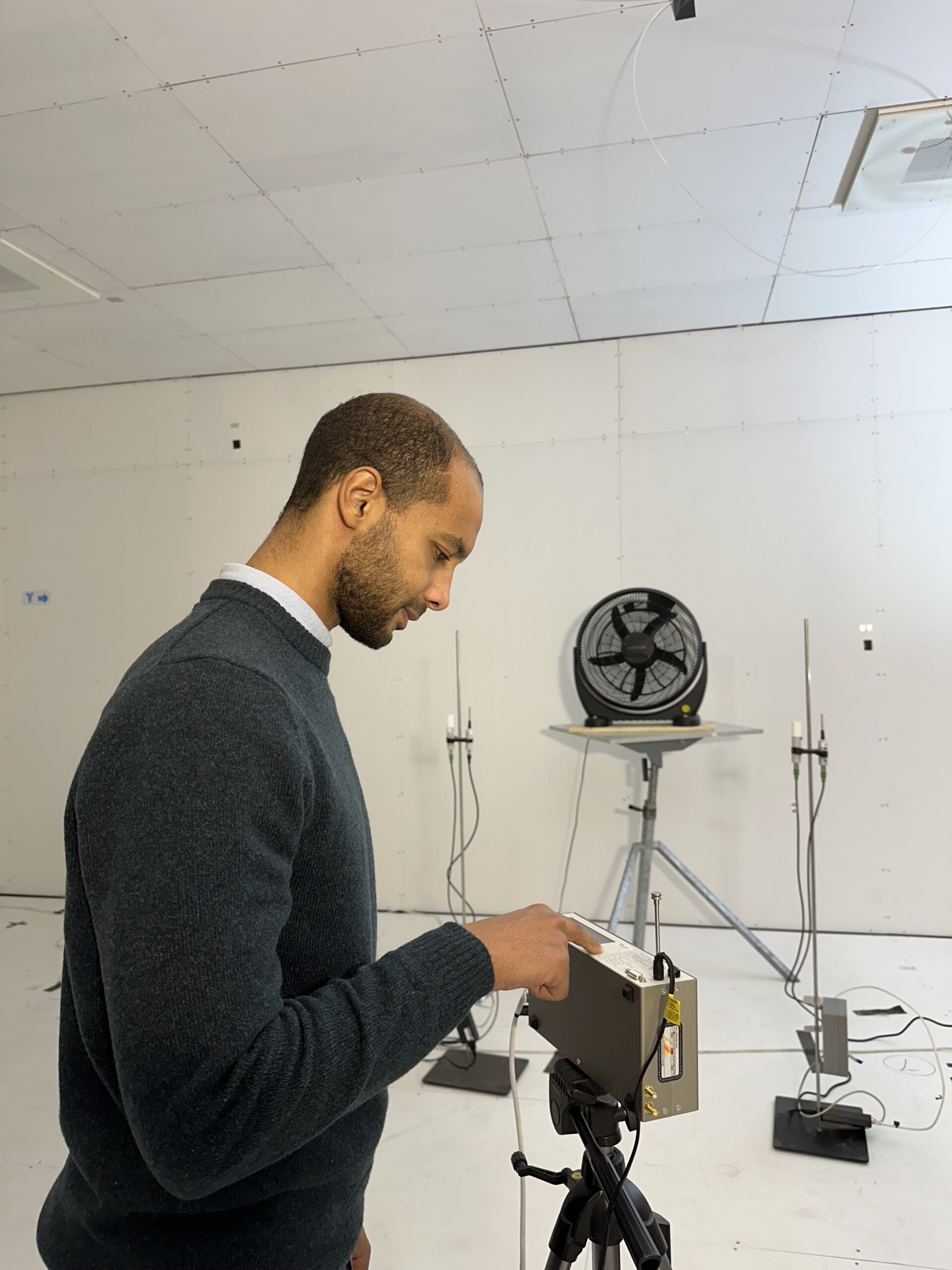
It is intended to ensure that, should we be affected by another virus outbreak, we can have better ventilation guidelines. Postdoc Maghsoudi Nia says that “We are not sure that during the Covid period, when everyone was under a lot of pressure, the guidelines and measures were tested well. So we are testing them now. We will then be able to return to policymakers, manufacturers and building managers with recommendations based on scientific evidence.”
Droplets
In the meantime, the research group now knows that the droplets that are emitted from your mouth into the air when breathing and talking and which could contain a virus, are smaller than previously thought, says Lohse, the founder and project leader. “The droplets stay floating much longer and therefore can then be spread far further around a space. This affects the measures and guidelines to prevent transmission.”
‘Not many people are prepared to listen to us’
Maghsoudi Nia is trying to bring the Mist project’s scientific guidelines across to policymakers, manufacturers, and building managers. Despite everyone experiencing the importance of ventilation during the Covid pandemic and the scientific underpinning, the post-doc experienced a lot of resistance. “Not many people were prepared to listen to us. They did not feel the urgency. Everyone had reverted back to their everyday lives and mostly wanted to forget the Covid pandemic.”
Professor Lohse sees this too. “In terms of science, we are now better prepared for a new pandemic, but in general society is not. This is because of the current political climate which ignores science.” But they should, says Maghsoudi Nia. “It is now five years since the Covid pandemic, so it is high time to look back, learn, and look forward to the future. Are we prepared for another virus outbreak?”
Lessons
For this reason the scientists not only made a short YouTube film, but they will hold an event on Monday 2 June at TU Delft. The keynote speaker is Lidia Morawska (Queensland University of Technology), an expert in aerosol transmission. Her presentation is entitled ‘Seven lessons from the Covid-19 pandemic for ventilation and the quality of outdoor air: did we have to learn them the hard way?’
The event targets policymakers, architectural advisers, installation specialists, facility managers and building owners, but is also for anyone that is interested in cleaner air in their environment. We hope never to live in a world where everyone is obliged to wear a face mask.
Information about the event:
When: Monday 2 June from 13:30 to 18:00
Where: Berlage Hall, Faculty of Architecture and the Built Environment
Register via link


Do you have a question or comment about this article?
[email protected]


Comments are closed.