Students who work full time on Dream Team projects now pay tuition fees while they do not follow any courses. The Dream Teams and Student Council party ORAS believe that this makes participation too elitist. It also leads to fake registrations which seriously distort the inflow and dropout rates of some degree programmes. The students thus argue for a tuition fee waiver.
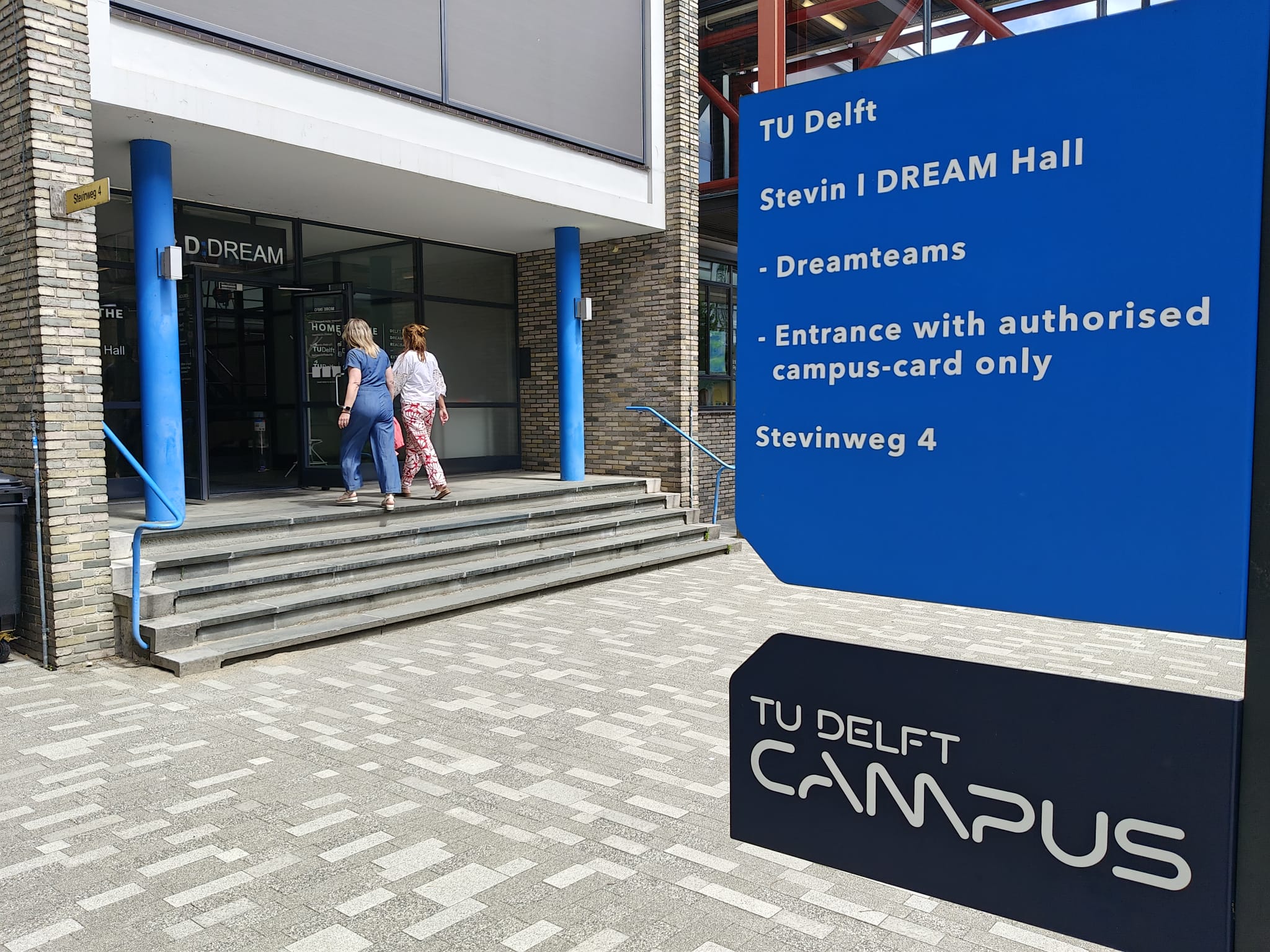
The Dream Hall where many Dream Teams have their workspace. (Photo: Marjolein van der Veldt)
The MARCH, Epoch, Delft Hyperloop, TU Delft Hydro Motion Team, Eco-Runner Team Delft, Space Oasis Delft and Emergence Dream Team projects are jointly calling for change. The students who work full time for these projects hardly follow any courses, but do have to be registered at TU Delft. “You work full time or even more, and do not have the time to study or do part-time work,” the Teams say. “But you still have to pay tuition fees. This is not financially doable for many students.”
Recommended reads

They go on to say that “It makes Dream Teams elitist. For one year, some students then do not have the opportunity to study and develop. This increases inequality. And while many students see the value of a full-time year like this, they cannot do it because the costs are too high.”
The Teams say that this leads to a more and more select field of participants. Students who do not have financial support drop out sooner. To make joining an option for a wider group of people, the Teams argue for a tuition fee waiver. This is a regulation in which students do not have to pay tuition fees for one year, but do still remain registered at TU Delft. They then retain their rights to their public transport card, student grants, student accommodation, and university facilities.
‘TU Delft showpiece’
The Dream Teams reiterate the value they bring to TU Delft. They help in winning prizes, attract sponsors, are in the spotlight internationally, and play a role in the recruitment of new students. They say that “We are the flagship of TU Delft”.
‘If we do not have the time to take our subjects, why should we pay the tuition fees?’
While the Teams are given space (in the Dream Hall), coaching and a limited remuneration, they do not believe that this compensates the costs that the students incur. “The remuneration that you receive from TU Delft amounts to about EUR 700 to EUR 900, while the tuition fees are EUR 1,500. And you work full time for a year. If we do not have the time to take our subjects, why should we pay the tuition fees?”
‘The elitist aspect is not that bad’
The Executive Board is reticent. In a written response to Delta, Vice-Rector Magnificus Hans Hellendoorn says that ‘the efforts of the Dream Teams are highly commendable’, but says that taking part is a personal decision. ‘You also do it for your own development. TU Delft provides support through housing, material and coaching. They use the amenities on campus. We do not feel that full compensation is right.’
To the issue of whether joining in is elitist, he says that ‘Many students take loans for this year. In my experience the elitist aspect is not that bad.’
Low-barrier study programmes
Nevertheless, the current policy does seem to have a dark side. Dream Team members regularly enrol in so-called ‘parking studies’: degree programmes that are easy to enrol in, such as Geomatics or Materials Science & Engineering. They thus retain their registration without following compulsory courses. “But these registrations give a skewed picture of the returns of the degree programmes,” says Step Kruisinga, Chair of the ORAS Student Council party.
Current practice is also causing concern in these programmes. Sid Kumar, Director of Education and Master Coordinator of Materials Science & Engineering, says that some students sign up saying that they will not take any courses because of their board or project year. “Many of them then withdraw their registration or change degree programme,” says the coordinator. “This creates an artificially high rate of drop out and longer duration of studies.”
The figures have a heavy impact on small degree programmes in particular, including on accreditation or internal evaluations. Furthermore, it is often unclear how many students really follow courses, which makes organising things like lab practice difficult. Kumar: “While this may not lead to direct financial damage, the consequences are great. This is especially so because the returns of the degree programme unjustifiably come under pressure.”
Skewed image
A similar sentiment is heard from the Geomatics master’s programme. About half the student inflow every year are ‘ghost students’. “You see these students disappear from our system a year later,” says master coordinator Hugo Ledoux. “When we were not aware of this, we targeted our teaching at too many students. This is not efficient and is expensive.”
About half the student inflow every year are ‘ghost students’
In about July every year, the coordinator now asks the students who have signed up if they are really intending to follow the degree programme. Ledoux: “This gives a reliable picture of the actual inflow, but it does need some shadow administration. It allows us to report more accurate figures internally.”
Ledoux also says that the dropout rates are skewed. “The dropout rate of ghost students gives the impression that the dropout rate in Geomatics is high, while in fact it is actually low among the students who really do take them. This has created an unjustifiably negative image of the degree programme.”
Vice-Rector Magnificus Hans Hellendoorn recognises this. “In interpreting these figures, we take this into account in the internal evaluation of degree programmes and in external accreditation.”
Not very inclusive
The ORAS Student Council party has discussed the issue of ‘tuition fee waiver’ several times with the Executive Board and points out that other universities such as Leiden, Rotterdam, Amsterdam and Utrecht do have tuition fee waivers. Kruisinga: “This makes a board or project year more accessible to a wider group of students.”
They proposed that students who serve at least 1,680 hours a year – the equivalent of a full-time job – on a Dream Team be exempt from tuition fees. Hellendoorn says that he will look at how other universities arrange this, but made no promises.
House of Representatives
In the meantime, the call for action is getting louder across the country. The Intercity Student Consultation (ISO, the umbrella organisation for all representation boards and parties in higher education, Eds.) handed over a manifesto to the House of Representatives on 15 April with the request for a nationwide regulation for tuition fee free service.
The situation at TU Delft will remain unchanged for the time being. The Dream Teams hope that TU Delft will eventually recognise their efforts through greater financial support. “Otherwise a Dream Team year will not be doable for most students.”
Kruisinga adds that “The Executive Board thinks that the elitist aspect is not that bad as students can borrow money or work alongside a full-time Dream Team year. But at the same time, they warn students not to take on too much as the number of burnouts is rising. This contradiction says it all.”
Do you have a question or comment about this article?
m.vanderveldt@tudelft.nl


Comments are closed.