
Residents of the X-Ray student flat are concerned about a new parking policy that will take effect on 1 December. Anyone who wants to park their car will now have to pay an hourly rate or take out a monthly subscription. The cost of such a subscription? Sixty euros per month. ‘Absurdly expensive,’ say the tenants.
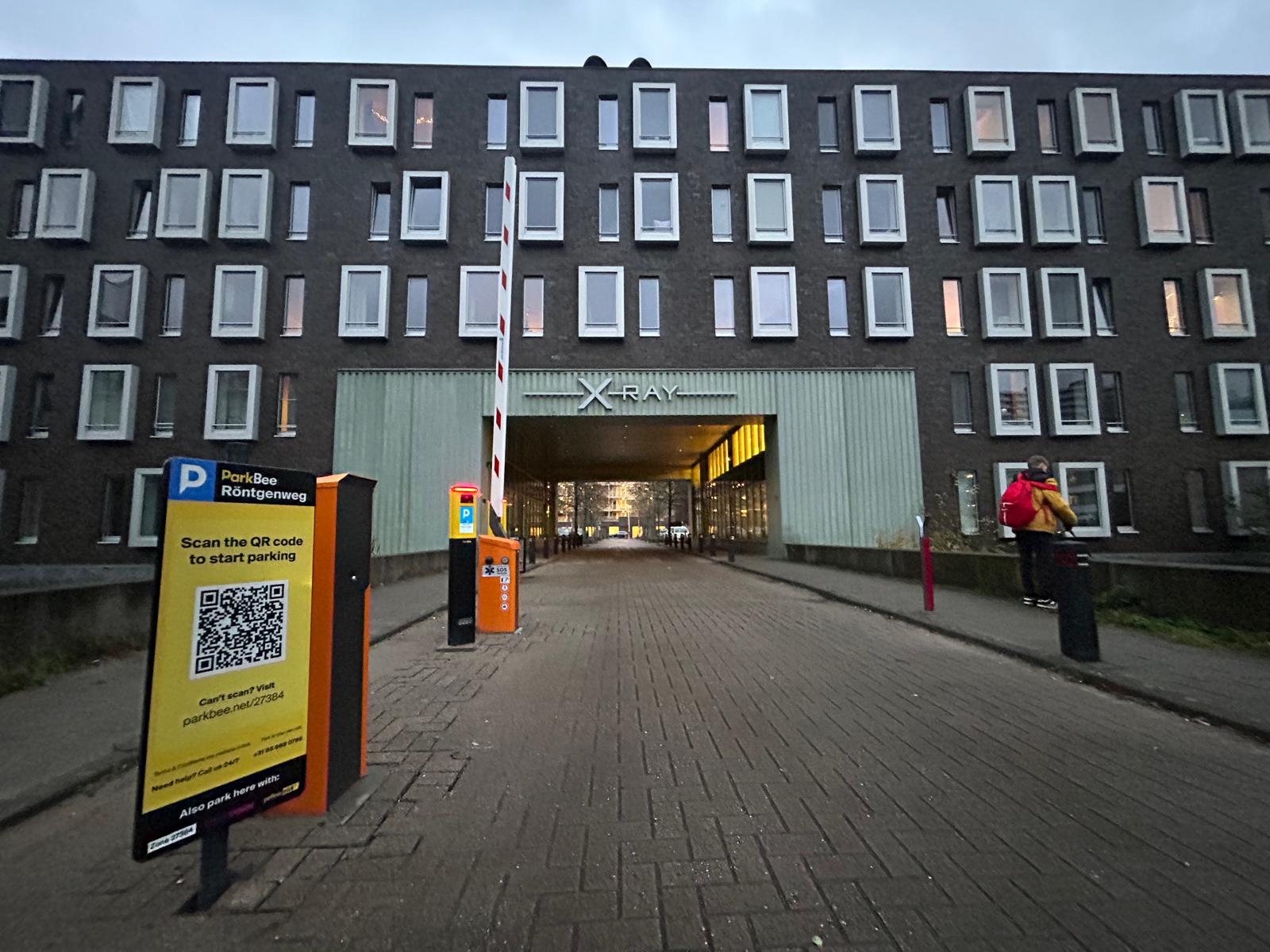
DUWO and ParkBee have partnered up for a total of six car parks. (Photo: Delta)
This article in 1 minute
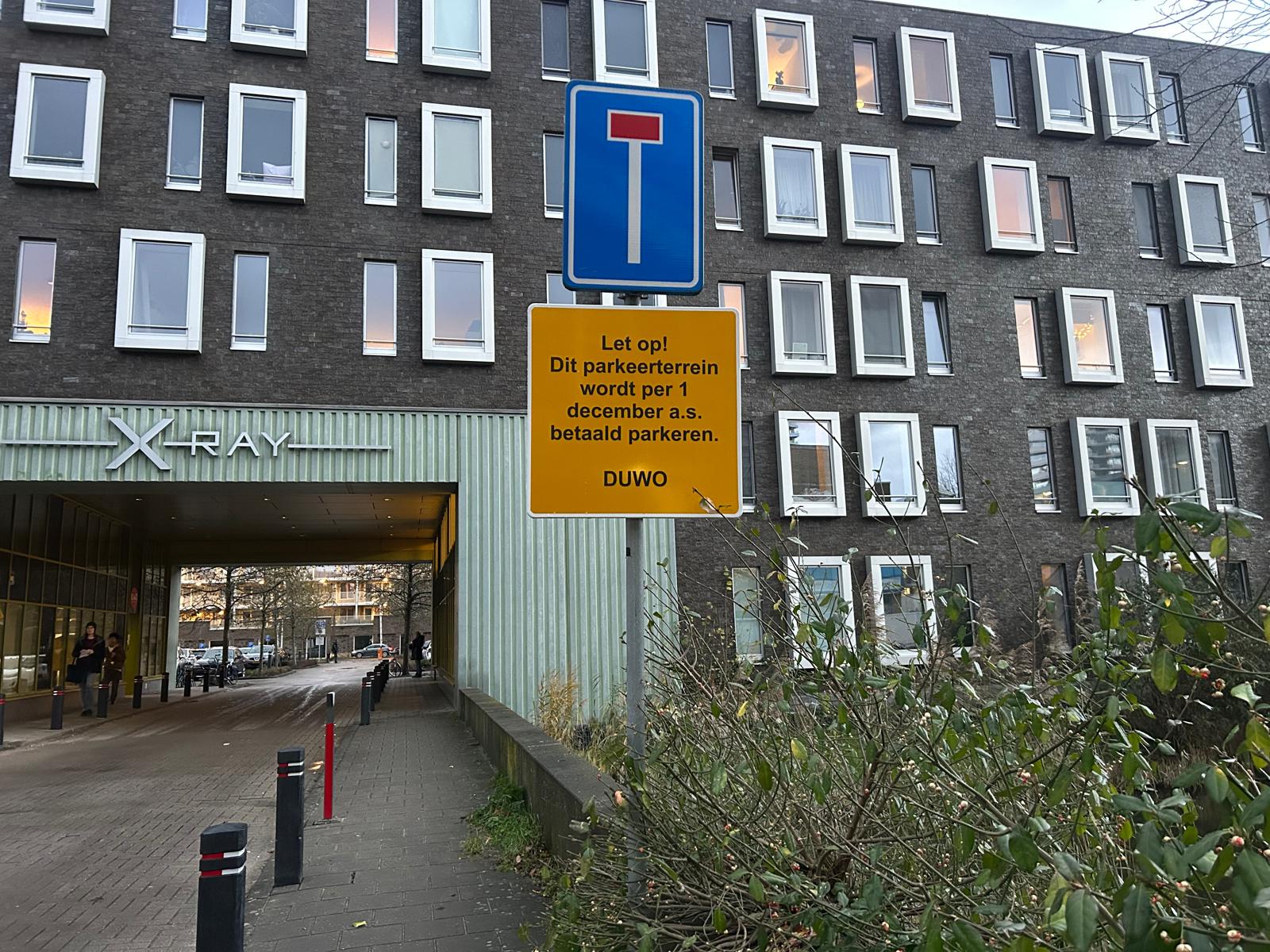
Right in front of the underpass of the DUWO flat X-ray, a red and white barrier stands straight up. For now, the silent guard is unemployed, but soon it will come down for every car that wants to park on the Röntgenweg site. A few metres before the barrier, a bright yellow traffic sign warns in thick black letters: ‘Attention! This car park will be paid parking from 1 December.’
Residents of the 515-room flat currently park there for free. From the beginning of December, they will have to take out a subscription of sixty euros per month or pay an hourly rate at Parkbee, the commercial parking platform with which student housing provider DUWO has a partnership for its car parks.
Experiment for new parking policy
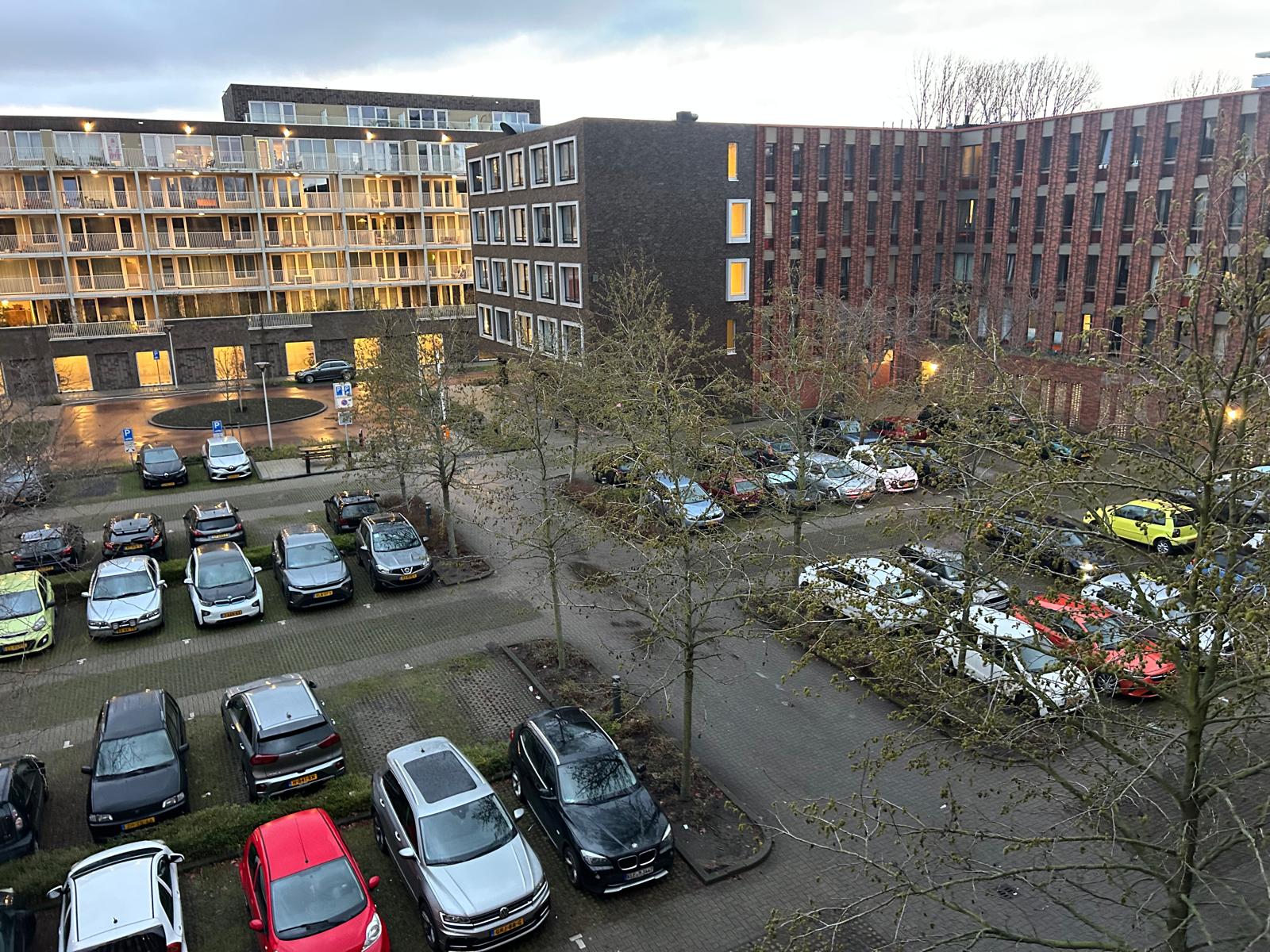
According to DUWO director Jelle van Kempen, the change is part of an experiment that serves as a prelude to a new parking policy. The housing association also hopes that the barrier will help to combat parking congestion. This has been a problem since the municipality of Delft introduced paid parking in the surrounding area. “We receive a lot of complaints from residents. For example, cars belonging to outsiders were parked in front of the entrance to the bicycle shed, which meant it could no longer be opened. Or cars were crammed along the road, preventing refuse collection lorries from turning and therefore collecting rubbish,” explains Van Kempen.
Although residents are pleased that DUWO is taking measures against these “illegal parkers”, they are unhappy with the fee. “Sixty euros a month is absurdly high,” says Jolien, who drives to her parents’ house in Zeeuws-Vlaanderen every week. “My parents already have to help me out, and this will make my financial situation even tighter.” Student Maarten parks several times a month when he borrows a car from his parents or girlfriend: “We were very lucky to have free parking, I understand that. But you can’t suddenly ask students to cough up sixty euros a month. What’s more, I don’t understand where the amount comes from, because a parking permit from the municipality costs 100 euros per year in this area.”
‘We think that student life is perfectly manageable without a car’
Residents without cars also think the amount is too high, as becomes clear on a drizzly afternoon. “Sixty euros? Ouch, that’s steep. Too steep,” says resident Coen as he unlocks his bicycle. Resident Carl is walking towards the entrance of the flat with a black wheeled suitcase. “They can’t be serious about such a high amount, can they?” he responds.
Parking as a commercial product
According to DUWO director Van Kempen, the decision to charge students was carefully considered. “We believe that student life can be lived perfectly well without a car. So if you do choose to have a car, it’s only fair that you bear the social costs.” The monthly fee is not determined by ParkBee, but by DUWO itself. The sixty euro fee was also carefully considered, he says. “Housing is our social product, parking is not. We see that as our commercial product and not as a core task.” That idea formed the basis for the market research that Van Kempen conducted himself. He looked at rental advertisements on Funda and inquired about rates at ParkBee. “That comes to at least 100 euros per month. To be accommodating, we reduced that to 60 euros. With a one-year adjustment period. Until December 2026, current subscribers will pay only 30 euros per month.”
‘DUWO unfairly equates the income of students with that of homeowners’
DUWO leases the land on which the student complex stands from the municipality of Delft. X Ray residents therefore wonder whether the housing association is even allowed to charge for parking. The market research also bothers the students, says resident Jordy. He is a member of the residents’ committee and has been dealing with the parking issue for about three years. “By looking at Funda, you equate the income of students with that of homeowners. That is unfair, because students simply have less to spend.”
ParkBee and DUWO
DUWO signed a framework agreement with ParkBee about five years ago. Currently, six car parks in Delft, Leiden and The Hague are managed by the commercial provider. At the five other locations, residents pay “a symbolic fee of around fifteen euros per month”, says Van Kempen.
DUWO partnered with ParkBee because this company offers hourly parking. The rate is determined by ParkBee. ‘They receive a percentage of the revenue, which allows us to earn money from day visitors, for example.’ According to Van Kempen, DUWO is investing the money in the construction and sustainability of housing.
ParkBee only offers two types of parking: pay-per-hour or pay-per-month. This makes it difficult for students like Maarten, who don’t have their own car but occasionally borrow one. “I’m far from the only one who does this, but we’re now falling between two stools. We don’t use the car enough to take out a monthly subscription, but we use it too often to want to pay an hourly rate. An in-between solution would have been nice.”
Overstimulated in public transport
The student complex also houses students who receive assisted living support from the Jados foundation for people with autism. For them, a car is not a choice but a necessity. Take student Bertjan, for example. Every week, he drives to visit his parents in Zeeuws-Vlaanderen, a journey he cannot make by public transport. “Depending on the departure time, that would take me four to twelve hours, but more importantly, I can’t handle all those stimuli.” The same applies to Jolien, who, like Bertjan, drives to her parents in Zeeuws-Vlaanderen every week. “Taking public transport is extremely difficult for someone with autism. It’s scary, unpredictable and just overwhelming. I was forced to do it once on a Friday, and I was out for the whole of Saturday. That’s how intense it was.” She continues. “What’s more, I sometimes need the car for my studies. I study architecture and I often have to transport large models, such as mini buildings and maquettes. There’s no way I can fit them on my bicycle.” Other residents also consider their cars to be essential. Remco, for example, drives hundreds of kilometres every week for work and exercises in places that are difficult to reach by public transport.
Other solutions?
The students would have preferred DUWO to have opted for other solutions, such as installing its own barrier or collaborating with ParkerenDelft, the organisation that manages parking policy for the municipality. Were these possibilities explored? No, says Van Kempen. But that does not mean, in his opinion, that installing a barrier would have been an option. “That would close off the site to the outside world. We do not consider that desirable. Moreover, installing a barrier would easily cost ten thousand euros, and you would also have to maintain and enforce it. We think that’s too expensive.” Van Kempen is leaving the door open for a collaboration with ParkerenDelft. “If the municipality wants to collaborate, we are of course open to that,” he says. And what about Jolien and Bertjan, for whom a car is a necessity? Van Kempen: “If special arrangements with Jados are necessary from a care perspective, we will of course discuss this with them.”
DUWO tenants may also have to pay or pay more for parking at other locations in the future. The housing association wants to “take the experiences of the experiment at X-Ray to other locations”.
In any case, the policy seems to be effective against illegal parkers. Dennis, who has just arrived in a black Volkswagen Polo, says that he does not live in the student complex. “I park here because it’s free and my own apartment complex has far too few spaces. From 1 December, I will start looking for another solution.”
Do you have a question or comment about this article?
a.m.debruijn@tudelft.nl


Comments are closed.