
In addition to all the developments in Delft, work on Campus Rotterdam is continuing at full speed. The Executive Board has hired an external consultancy firm and the programme team will move into the Groot Handelsgebouw (literally the big trade building) in Rotterdam.
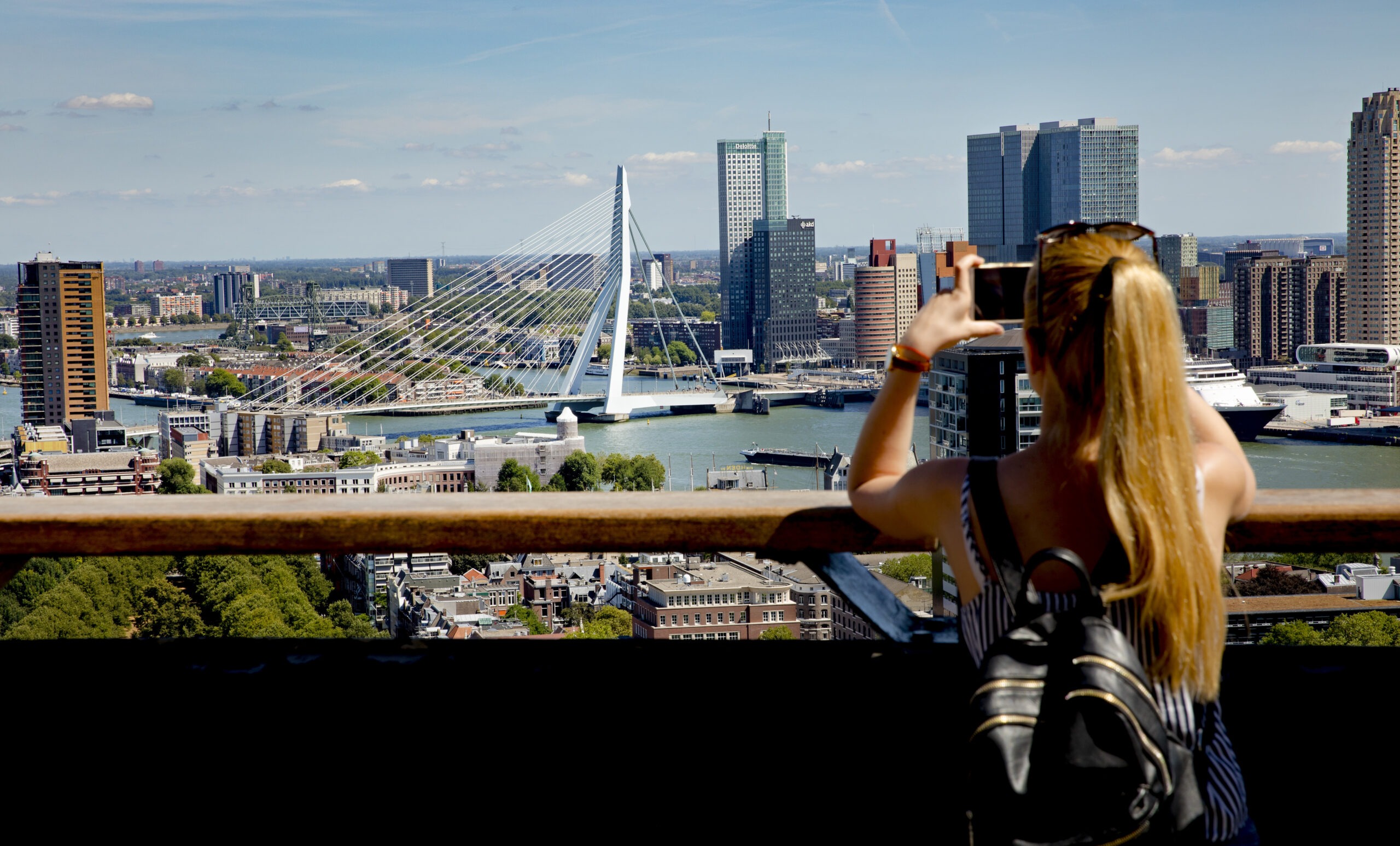
Members of the Campus Rotterdam programme team will soon be able to work from the city of Rotterdam itself. (Photo: Iris van den Broek via Rotterdam Make it Happen)
Some six to fifteen workspaces are currently being prepared in the Groot Handelsgebouw, right next to Rotterdam Central Station. This is a contribution from the municipality of Rotterdam, which rents the space to promote collaboration. TU Delft employees will share the office with staff of the Rotterdam municipality and other organisations with which the university is working on Campus Rotterdam: a new TU Delft location. The aim is for the first Delft students to be able to study in Rotterdam from September 2027. Health and technology, a joint bachelor’s programme offered by Erasmus MC, Erasmus University and TU Delft, is expected to attract around 150 first-year students per year in the long term.
Three new advisors will also be working for the Rotterdam campus. The Executive Board has hired Consilium Sapiens, which has been tasked with giving a presentation and writing a report on ‘what kind of campus or campuses would best meet the needs of stakeholders’ by December. Han Derkx of the Rotterdam Campus programme team announced this in response to questions from Delta.
Hiring Expertise
TU Delft found Consilium Sapiens through the contacts of Executive Board member Nick Bos. He knows the owner, Bert Kip of the Province of Limburg. Bos was a member of the Executive Board of the University of Maastricht, which was one of the three initiators of the Brightlands Chemelot innovation campus that was created under Kip’s management. Apart from Kip, the former CFO and another advisor from Brightlands will be working for Consilium Sapiens.
A survey revealed that many staff and students were concerned about the finances of the Rotterdam campus.
It is not the first time that an external entity will work for the Rotterdam campus. Previously, the consultancy firm Deloitte was hired to advise on the financing of the Rotterdam campus.
All this while TU Delft wants to significantly reduce the hiring of third parties due to budget cuts. Earlier this year a TU Delft survey (in Dutch) revealed that many staff and students were concerned about the finances of the Rotterdam campus. Only 27% of the surveyed people unreservedly thought that creating a campus in Rotterdam was a good idea. The rest of those surveyed either did not see the development as a good idea or only under certain conditions. The costs and financial risks, especially in light of the education budget cuts, were among the biggest obstacles.
Still 3 million euros left
In the meantime, it has become clear what cutbacks TU Delft is facing. All the faculties and services have to spend 10% less by 2028 than their main income stream were in 2024. This will amount to EUR 79 million in total. To the question of whether there will be economising measures on the Rotterdam campus in line with the widescale ‘turn arounds’, Han Derkx’s answer is brief: ‘no’.
TU Delft expects to need EUR 4.8 billion up to 2040
Of the EUR 8 million programme budget that TU Delft made available in 2023, around EUR 3 million is left. Derkx writes that this is enough money to ‘carry out the work in 2026 as well’. However, this is nowhere near enough for the university’s ambitious plans in Rotterdam. TU Delft expects to need EUR 4.8 billion up to 2040. Approximately EUR 2 billion must come from tuition fees and work commissioned by third parties. The remaining amount, around EUR 2.8 billion, must be raised by external partners such as governments and companies.
EUR 1.5 million from the municipality of Rotterdam
This is one of the reasons why TU Delft has created a ‘Strategic Board’ with partner organisations. The Strategic Board is currently compiling a multi-year budget to which each partner has to submit a financial contribution. The amount of TU Delft’s contribution is still pending, writes Derkx. He reports that it ‘partly consists of the allocated EUR 8 million from the programme budget’. Derkx cannot say if more money will be added later. ‘This is a question for the Executive Board.’
The Municipality of Rotterdam has made EUR 1.5 million available in 2025 and 2026 to investigate the feasibility of the Rotterdam campus. A spokesperson from the Municipality says that this money is primarily intended to cover the rent of the office space in the Groot Handelsgebouw, the work of personnel, and study costs. The Municipality will also use this budget to ascertain if a financial contribution is possible in the long term.
- On Monday 10 November and Tuesday 11 November there were two update sessions about the Rotterdam campus for which employees could sign up.



Do you have a question or comment about this article?
[email protected]


Comments are closed.