

Students will see a one percent increase in purchasing power next year. Student organisations consider this insufficient: it does not nearly make up for last year’s decline.
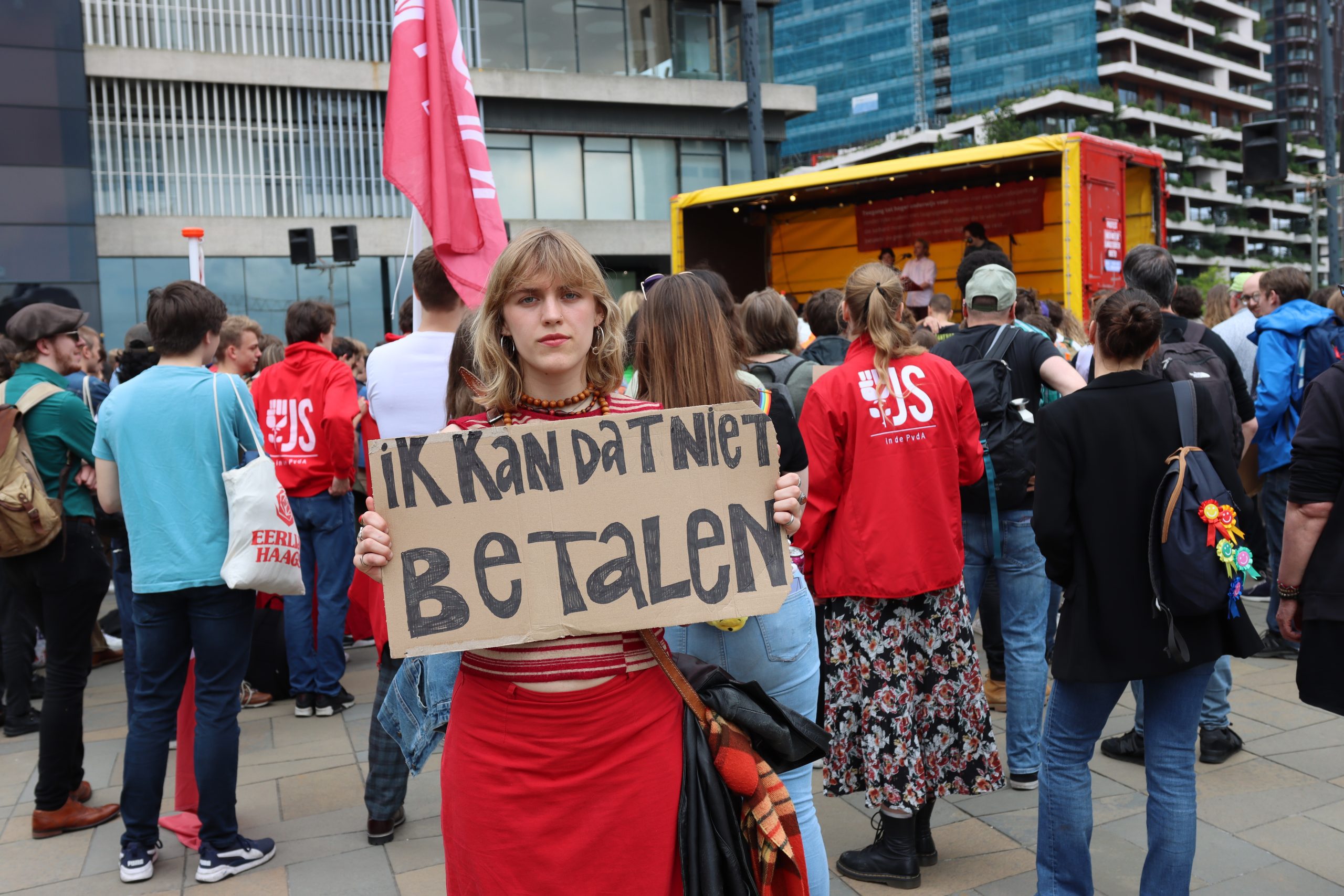
A protester during the protest against the long-term study penalty in Utrecht on 22 June 2024. (Photo: DUB)
Due to sharp wage increases and measures taken earlier, all population groups will have more to spend next year, according to the outgoing cabinet. On average, this represents an increase of 1.3 per cent.
The Dutch Centre for Family Finance Information (Nibud) charts the purchasing power of different households. Since last year, it has also been doing this for students, precisely because the differences proved to be so large: while the average Dutch person saw an improvement in 2025, students had to make considerable sacrifices.
Nibud has published another report this year. ‘We are seeing an improvement in the purchasing power of most households,’ says Jasja Bos of Nibud. This is because ‘wages are expected to rise faster than prices.’
Part-time job
Students will see a one percent increase next year. That is lower than average. ‘For most students, only a limited part of their income comes from a part-time job or paid internship,’ explains Bos. ‘As a result, students’ purchasing power is increasing less. They are dependent on student finance, which is not rising as fast.’
‘Students will see the smallest increase again, even though this group is already struggling so much’
“This one percent increase is not enough to allow students to study without financial worries,” says Sarah Evink, chair of the Interstedelijk Studenten Overleg (Intercity Student Consultation). “Last year, the purchasing power of students declined by 6.6 percent. This means that the situation for students has still not been rectified.”
Helping out
Maaike Krom, chair of the National Student Union, agrees: ‘Students are once again seeing the smallest increase, even though this group is already struggling. They spend about half of their income on rent, so this is really not enough.’
‘Moreover, such a calculation assumes that students will also borrow more and receive money from their parents,’ Krom emphasises. ‘But in fact, this only causes students to incur additional debt. And not everyone has parents who can help out.’
Rent allowance
Incidentally, there is one group of students who will see a significant improvement in 2026: tenants under the age of 21 who live in independent accommodation (such as studios). This is due to new rules regarding rent allowance. Currently, this group can only receive allowance for rents up to 477 euros, but from 2026 onwards, this will also be possible for higher rents. As a result, their purchasing power will increase by 19 per cent. Nibud is unable to say exactly how large this group is.
HOP, Naomi Bergshoeff
- Read more about the cuts to higher education and TU Delft in our dossier.

HOP
Hoger Onderwijs Persbureau
Do you have a question or comment about this article?
redactie@hogeronderwijspersbureau.nl


Comments are closed.