Universities and universities of applied sciences must pay for part of the inflation out of their own pockets. Other than that, there are no new cuts to higher education and research in the 2026 national budget.
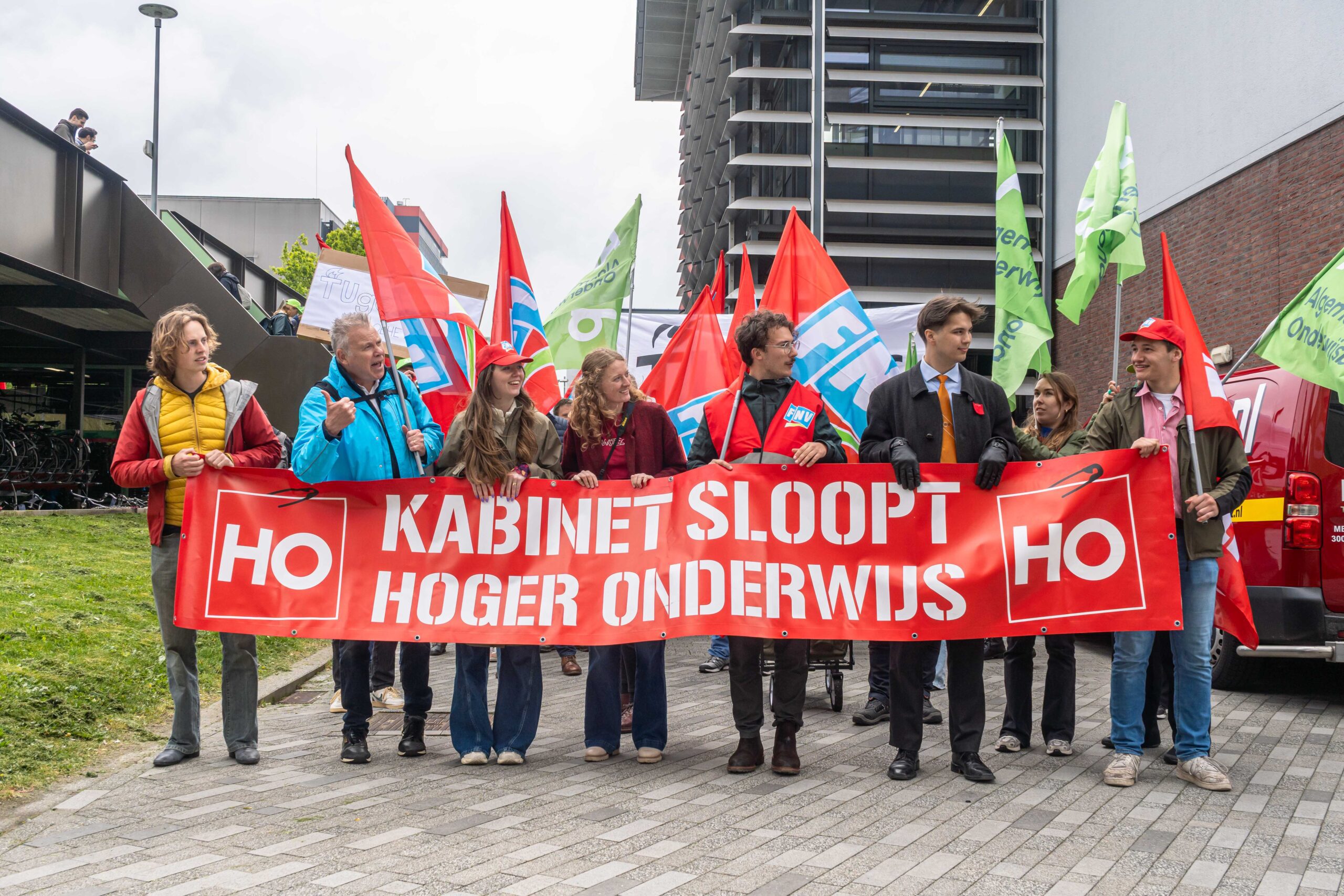
TU Delft employees went on strike on 24 April 2025 to protest against cuts to higher education funding. (Photo: Thijs van Reeuwijk)
Inflation makes everything more expensive and, in principle, government spending increases accordingly. But not next year. The outgoing VVD and BBB cabinet wants to cut spending in general and spend less money on so-called “price adjustments”.
This was announced yesterday by outgoing minister Eelco Heinen (VVD) to the House of Commons when presenting the Budget Memorandum. Today, parliament is debating the new national budget.
Reducing this price adjustment is a common practice. In 2025, half of it was withheld in order to balance the budget. For the Ministry of Education, Culture and Science, this amounted to a total of 171.6 million euros (half of 343.2 million euros).
The amount for 2026 will be revealed in the Spring Memorandum. Withholding the price adjustment will continue to have an impact for years to come: it puts institutions at a financial disadvantage that they will only be able to overcome if politicians decide to increase spending.
Higher education
The Netherlands Association of Universities of Applied Sciences is disappointed with the announced cutbacks via price adjustments. ‘In view of the labour market of today and tomorrow, now is precisely the time to invest in higher professional education,’ says chairman Maurice Limmen.
‘It is incomprehensible that this government continues to cut spending on knowledge and innovation’
The UNL university association also criticises the government’s policy. According to a statement, the additional cuts are expected to amount to 25 million euros for universities, on top of other cuts totalling up to around 300 million euros per year. ‘It is incomprehensible that this government continues to cut spending on knowledge and innovation, when these are precisely what is needed to keep our country safe, resilient and healthy,’ says chairman Caspar van den Berg.
The announced cuts of more than €1 billion in education and research are still in the budget; nothing has changed in that regard. The only exception is the “educational opportunities scheme” in secondary education. As promised (and previously leaked), this will be retained.
Internationals
The cabinet wants to save 168 million euros on the number of international students. But already, fewer students than estimated are coming to the Netherlands. The cutback has already been achieved. In 2026, universities of applied sciences will only have to cut 1.9 million euros and universities 4.1 million euros. That is a total of six million euros.
Incidentally, spending on education will ultimately fall by around three billion euros, so this is only partly due to the savings of roughly one billion. The rest is due to the expected decline in pupil and student numbers.
HOP, Bas Belleman
- Read more about the cuts to higher education and TU Delft in our dossier.

HOP
Hoger Onderwijs Persbureau
Do you have a question or comment about this article?
[email protected]


Comments are closed.