
With cancelled workshops and inaccessible datasets, Trump’s blows to American science are also reverberating in Delft. Climate scientists in Delft are concerned and are calling for a more targeted science policy. “The USA is leaving a gaping hole behind. Those of us in Europe need to fill it up.”
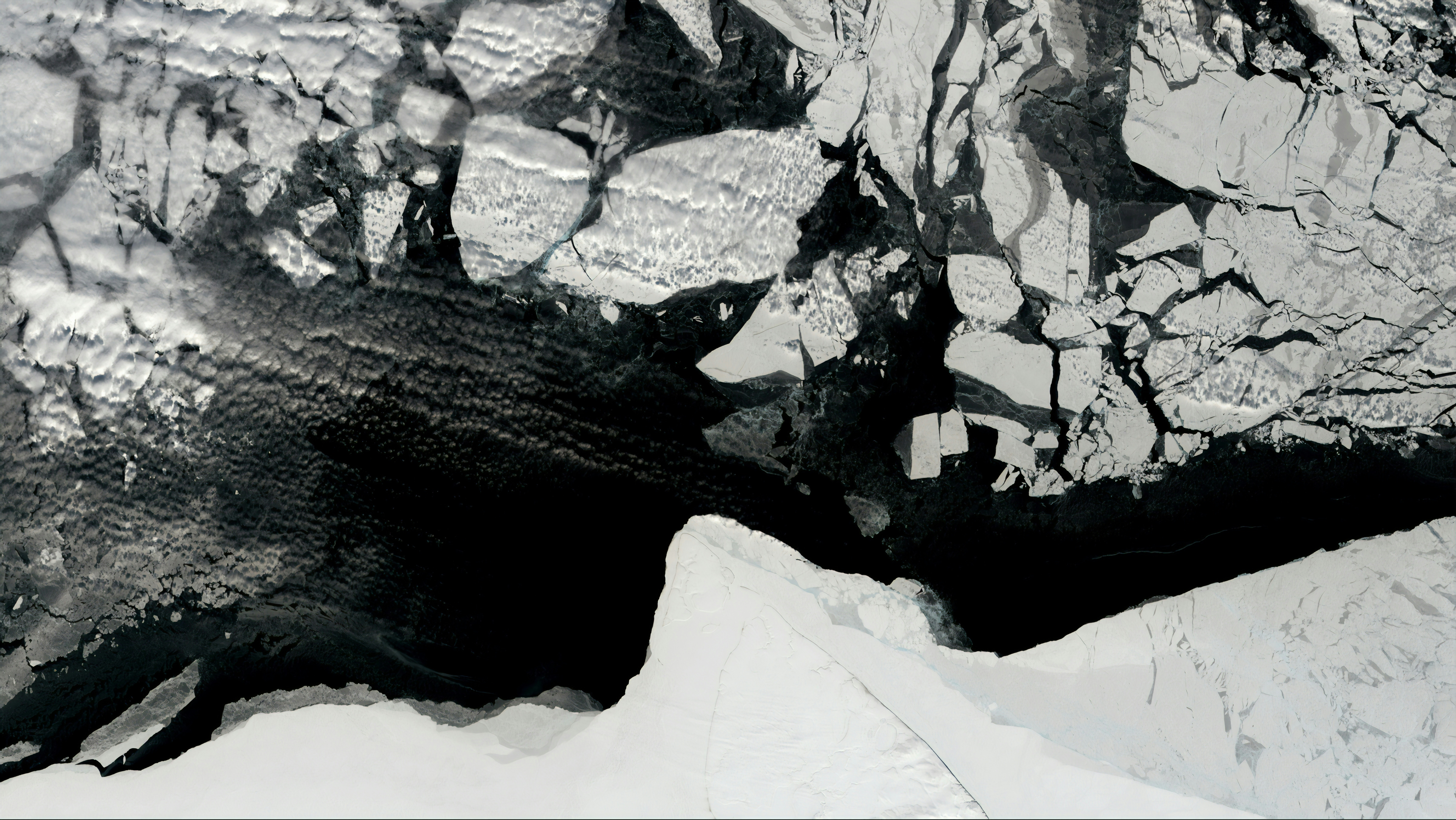
(Photo: USGS via Unsplash)
He is still ‘safe’ this year, but next year scientist Riccardo Riva (Faculty of Civil Engineering and Geosciences, CEG) will have to look for other datasets. He can no longer access the atmospheric data of the American National Center for Atmospheric Research (NCAR) research institute. Riva uses this data for research into the interaction between the dynamic behaviour of the earth and sea level changes.
Apart from NCAR, the American National Oceanic and Atmospheric Administration (NOAA) has also made its data inaccessible. NOAA made around 25 datasets about the climate inaccessible at the beginning of June. These measures are only one of the blows that the scientific world is having to process since Trump took office.
The impact of American science on TU Delft is large. NCAR and NOAA data appear in dozens of TU Delft scientific publications. The United States is even TU Delft’s most important partner. And the American National Science Foundation (NSF) is the seventh most named funder of research in which TU Delft scientists are involved. .
Concerns about ‘enormous threats’
Last week Delta contacted 12 TU Delft scientists about the recent American science policy. Delta had more elaborate conversations with five scientists at the Department of Geoscience and Remote Sensing (CEG). They are all concerned about the developments and consider it important to speak out about this subject in the media. “The threats from the United States of America are enormous,” says Professor Herman Russchenberg of Atmospheric Remote Sensing who studies the creation and behaviour of clouds. “But luckily I am in a position that I can talk about it openly. After all, I am in the Netherlands and have a permanent contract.”
He mostly works with his own data and weather models, but this is not the case for everyone. At the CEG Faculty, Russchenberg shares a corridor with others in the field whose sources include American measurements of Antarctica or big calculation models that operate on American supercomputers at the NCAR research institute. “One of the major threats is that we will no longer have access to this kind of infrastructure,” says Russchenberg in his office. He points to the offices around him. “A lot of colleagues are anxious.”
American measures in climate sciences
- President Donald Trump started his second term of office on 20 January 2025. Decrees and measures in Trump’s first 10 days were already affecting health and climate sciences, and plenty of other areas. For example, the salaries of post-docs which were financed through the National Science Foundation (NSF) were frozen.
- At the beginning of February the National Oceanic and Atmospheric Administration (NOAA) was ordered to identify any subsidy applications containing words like ‘climate science’, ‘climate crisis’, and ‘pollution’.
- At the end of February the Trump Government fired hundreds of the 12,000 NOAA employees.
- In mid-April NOAA published a list of 14 datasets that would ‘no longer be available’ from certain dates such as 16 June.
- At the end of April, NASA ended the rental contract for the Goddard Institute for Space Studies (GISS) that carries out research into worldwide changes, including climate change. While GISS employees are not being fired, it is harder for them to do their work as they suddenly have to work from home from one day to the next.
- At the beginning of May, NOAA announced that six products related to marine and climate science will be closed at the latest at the end of June. Three other products were closed immediately, including a programme for recording climate damage (in Dutch).
Search in Europe
Riccardo Riva is one of the scientists who shares the corridor with Russchenberg and who can no longer access data. NCAR’s atmospheric data served to filter the ‘noise’ from his research. “Wind and air pressure affect the sea level, but they’re not actually what I look at. I research the impact of ocean currents and melting ice caps on sea levels. I used the atmospheric observations as a correction tool in my research.”
Riva could download the data until March, but after that he will have to look for alternative sources. “Luckily its atmospheric models are available in a couple of other places, so there are European versions,” says Riva. “So it may not be extremely bad, but it is difficult. It will affect the reproducibility of my previous research, for example.”
‘These small archiving efforts are a good addition to the efforts of larger organisations’
Scientists who are concerned about the availability of data are not sitting still. For example, the goal of almost European, American and Australian researchers involved in the Safeguarding Research & Culture (SRC) initiative is to save American data that may disappear under Trump as Torrent files.
TU Delft researcher Fredrik Jansson is one of those scientists. He archives datasets and is distributing saved information through Torrent. “It is important,” says Jansson. “These small archiving efforts are a good addition to the efforts of larger organisations. Both are necessary. Collective archiving is faster and is shared more widely, while institutions can put more resources in and could be better organised for certain types of specific data.”
The SRC initiative has about 800 terabytes available and thanks to this storage space, important climate data from NOAA are duplicated. SRC can do a lot with the 100 terabytes, but not everything, its initiator Henrik Schönemann (in Dutch) had told the NRC newspaper previously. “Data from satellites and climate models need even more. You are then talking about petabytes (1,000 terabytes, Eds.),” said Schönemann, who is a historian at Humboldt University in Berlin.
Requests to SURF
One group that does have those petabytes is SURF, the IT education cooperative. Scientists can submit a request for data or infrastructure to be archived through its website. Rajashree (Tri) Datta, an American climate researcher who has worked for TU Delft since October, has submitted such a request. She wants to save 80 terabytes of data on SURF that are crucial for her research on Antarctica. She prefers not to say what kind of data it is.
Along with others in her field, Datta is looking at things like how ice caps influence the atmosphere and thus our climate. To do this, she arranges all sorts of data like a puzzle. This includes satellite information of ice caps, measurements of the ground in Antarctica, and climate models entailing complex calculations on aspects like the speed in which snow turns into ice. “It would only take one piece of the puzzle to fall away for the research to mean that the research cannot be done well. We have to avoid this.”
Postponed workshop
Meteorologist Stephan de Roode uses the Netherlands KNMI data a lot so runs little risk of not being able to access important datasets. But he does see the impact of Trump making its way into his office. De Roode was supposed to go to a scientific climate workshop in Portugal in July. “This has been postponed because a lot of American scientists have had travel restrictions.”
‘You cannot solve a gap in the data easily’
In his everyday work De Roode tries to improve weather forecasting models by looking at effects like turbulence in the atmosphere, cloud behaviour, and the effects of clouds on reflecting the sun’s rays. “The sustainable energy industry uses this improved weather forecasting to be able to take better decisions. If a cloud goes covers the sun, there is less energy from solar panels and you need to access energy from elsewhere. In contrast, you do not want conventional energy power plants to generate more energy only to find out at the end of the day that you could have extracted all that energy from the sun.”
All five scientists do not only foresee great damage in the short term, but also in the long term. “We may be able to get the computational power here, but you cannot solve a gap in the data easily,” says Riva. “Twenty or 30 years of data may sometimes be just enough to make some climate predictions, but if you suddenly have a gap of two years, it means losing 10 years in terms of accuracy.”
De Roode and Russchenberg fear that the influx of scientific talent from the USA will stall. “Young, promising scientists often have temporary contracts. They are now being fired on a massive scale. This is leading to the loss of knowledge for science and for society as these are the people who would do things like issue weather warnings in the future,” says De Roode.
Young talent instead of top scientists
Russchenberg argues that the EUR 25 million promised by outgoing Minister Bruins for academic top talent should be spent on individual young scientists. Russchenberg views Bruins’ emphasis on top academics unwise. “The current top talent in the United States of America for example, has climbed up the ladder to the top in an American system.” This does not mean that they will automatically do well in the Netherlands, says Russchenberg. “If you attract young people, they can grow in our system. Furthermore, top academics are expensive so you can hire more people if you concentrate on up and coming talent.”
‘The United States are leaving a gap in the climate sciences field.’
While the academic hits are done in rapid succession and often seem random, Datta and Russchenberg believe that the academic world needs to act in a more targeted way. Russchenberg: “You see that responses are done arbitrarily through various local and national initiatives. I think that a focused analysis should be made from either the Netherlands or Europe.” Datta says that “The United States are leaving a gap in the climate sciences field. Those of us in Europe need to fill it up.”
Dutch supercomputer
By way of example Datta refers to the Dutch Snellius supercomputer which Europe can use for important infrastructure on the climate. “Snellius can do the calculations for climate models that are now done by NCAR.” She does say though that more is needed for this than just the computer itself. “You also need to be prepared to cover the costs of things like hiring software engineers to keep everything going.” Riva and De Roode are also in favour of a European response. This means that more money again should go to academia. De Roode: “Could the cutbacks at universities be a little less?”
‘I never expected that the scientific collapse would go so fast’
De Roode and Russchenberg are holding their breath about what is to come. Russchenberg points to NCAR where important climate models on computers are run and require much computational power. “NCAR falls under the NSF, the American equivalent of the Dutch Research Council. Its fiscal year runs until September. They are safe until then, but I know a lot of NSF scientists who will then expect strong headwinds from Trump.” De Roode: “I never expected that the scientific collapse would go so fast. So many things have been broken already, and we still have another 3.5 years of Trump to go.”
For Datta, one thing is clear: the scientific world has been changed for good. “Previously scientists could take it for granted that the data with which they work would always be available. That time has passed.”
Do you have a question or comment about this article?
a.m.debruijn@tudelft.nl


Comments are closed.