

Building a snowman? With these tips and facts, you’ll be well prepared.
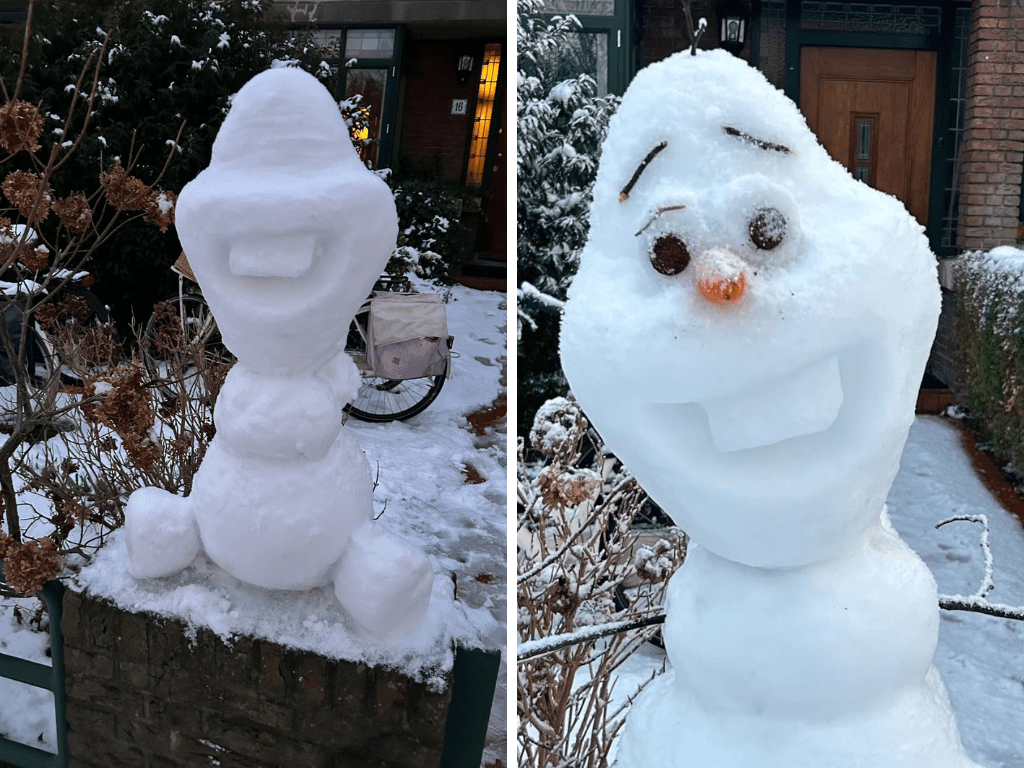
Sisters Charlotte and Suzanne van Leiden, both IDE, created Olaf, the famous character from Disney's Frozen. (Photo: Charlotte van Leiden)
Austrian Nina Maherndl (Geoscience & Remote Sensing) studies snow. She has already been to the Arctic twice, partly to install cameras that measure snowfall and to observe ice crystals in clouds from a research aircraft. Her expertise lies mainly in ice crystals in clouds, i.e. snow that has not yet fallen to the ground. Nevertheless, she does have some tips for true snowman enthusiasts. She has not yet built a snowman this year, but she has thrown a few snowballs at her boyfriend.
5 percent water
Snow consists of snowflakes, air, and a small amount of water. That water acts as a kind of glue that holds the flakes together. The perfect snow for building a snowman contains about 5 percent water.
Fingerprints

Snowflakes can be seen as the fingerprints of the processes that take place in the clouds where they are formed. The shape of the flake shows how they have grown. Little is known about snowflakes. Studying them helps to make better weather forecasts and climate models.
Snowflake shape
The temperature determines the shape of the snowflake. In general, the higher you go in the atmosphere, the colder it is. Dendrites, those beautiful star-shaped branched snow crystals, are formed at around -15 degrees Celsius. If it is zero degrees on the ground and we take an average of 1 degree cooling per 100 meters, you can estimate that the flakes have fallen from an altitude of about 1500 meters.
The temperature throughout the Netherlands is currently perfect for building a snowman
If the flakes look more like needles, they were formed at about 5 degrees below zero and will have originated much closer to the ground.
Temperature

The temperature throughout the Netherlands is currently perfect for building a snowman: between 0 and -5 degrees Celsius. If it is warmer, you will only get slush. If it is colder, the snow is too dry and will not stick together.
If the snow is too cold, you can push harder when rolling the snowballs, causing the flakes to melt a little more and freeze together. A plant sprayer with water could also help. Or look for snow in a place where it is slightly warmer, such as a parking lot instead of a lawn.

Do you have a question or comment about this article?
E.Heinsman@tudelft.nl


Comments are closed.