

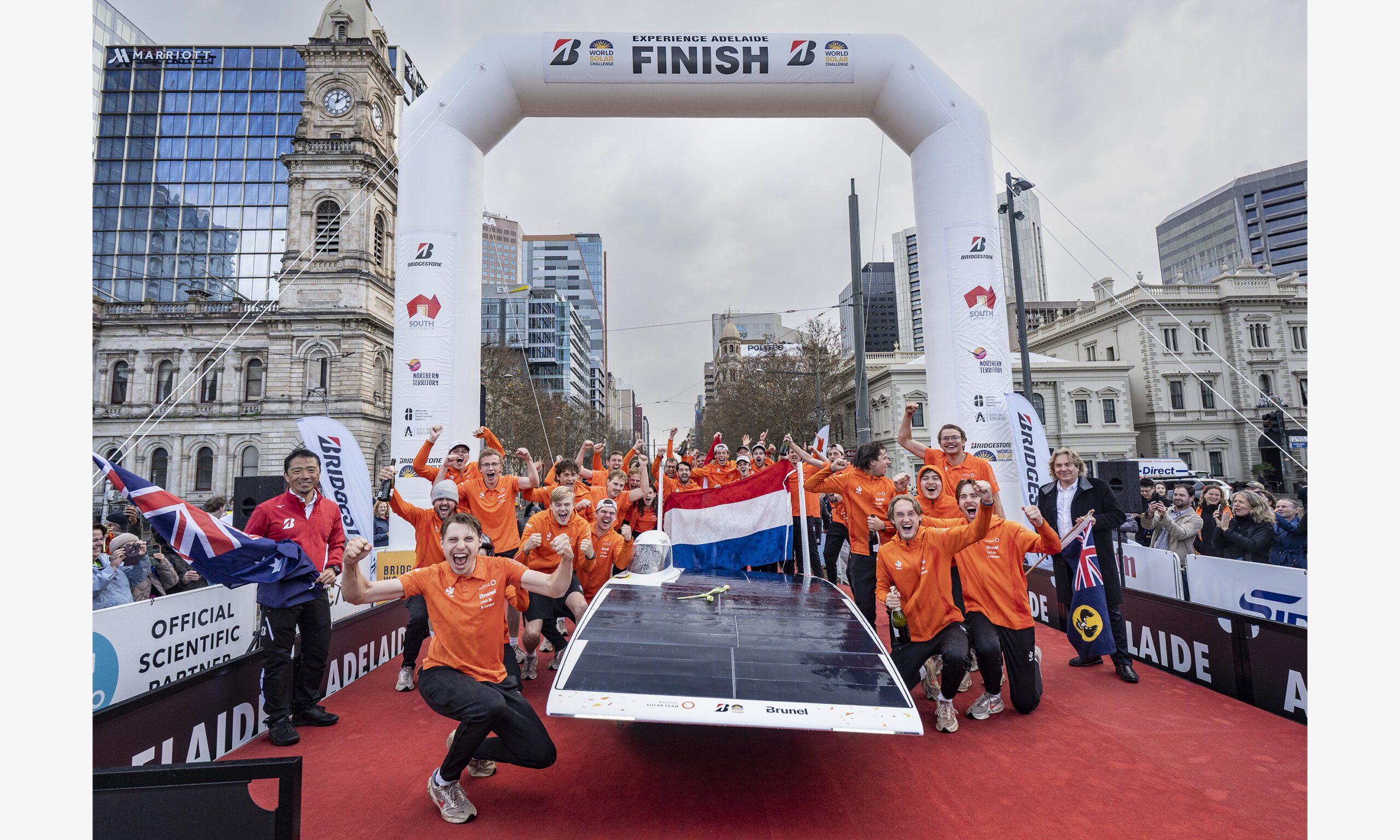
TU Delft’s Brunel Solar Team won the solar racing world championships for the eighth time. TU Delft student Kees Broek, one of the racing drivers, looks back at a close race. “In the end, a combination of various factors paved the way for us to win.”
(Photo: Hans Peter van Velthoven)
After a race of 34 hours, 54 minutes and 21 seconds and a close final sprint, the TU Delft students team crossed the finishing line in their Nuna 13 solar car in Adelaide, Australia, on Thursday 28 August. In doing so, the team won the Bridgestone World Solar Challenge 2025. And this win is in an anniversary year in which the Team turns 25 years old.
Eighth world title
Kees Broek, master’s student of Computer and Embedded Systems Engineering at TU Delft, was one of the four drivers of Nuna 13 and drove the solar car over the timeline. One day after their victory, he still finds it hard to believe that they won the championship. “It’s unbelievable. The final leg was extremely close, but we won. I am so proud of the team.”
The Twente University team in the rearview mirror
On the final day, the Brunel Solar Team faced strong competition from the Solar Team Twente and the Belgian Innoptus Solar Team. The Belgian team left late because of a low battery charge, but the Twente team followed on the heels of the TU Delft team and the difference was only two kilometres. “They kept driving faster and faster,” says Broek. “I saw the flashing lights of their convoy in my rearview mirror. In the end, their battery was drained and the sun was not shining. This is why we were the first to drive across the finishing line in Adelaide. An amazing feeling.”
The finish was uncertain until the very last minute
Yet, their victory when they crossed the finishing line was still not certain. “The time finish, where the race was timed, was on the outskirts of Adelaide. And then you still had to drive to the ceremonial finishing line, 30 kilometres away. If you broke down between the two finishing lines, you lost your position. It started to rain cats and dogs just when we crossed the time finishing line, and there was a lot of traffic. We gave it our all, but it was tense until the very last minute,” said Broek. Martijn Boonen, bachelor’s student of Mechanical Engineering, drove the TU Delft solar car across the final line in Victoria Square in Adelaide.
‘In terms of solar racing, they were not the best conditions’
The circumstances on the final day were not the only test. Earlier in the race, the sun regularly did not shine. Heavy rain showers limited visibility and reduced the energy input. On the fourth day the team also had to replace a flat tyre, cutting down their lead to just a few seconds. “In terms of solar racing, they were not the best conditions, but in terms of thinking strategically, it was interesting,” says Broek. “In the end, a mix of various factors paved the way for our win.”
Apart from strategy, Nuna 13’s aerodynamic innovations played a role. The vehicle is fitted with a manual ‘swordfin’ and a retractable canopy fin. These fins allow the solar car to ‘sail’ on the wind and drive faster without using more energy.
Starting in a good position in Darwin
The race started in Darwin on 24 August, where 26 teams from all over the world turned up at the start. The TU Delft team qualified there for a third starting position, behind the University of Groningen’s Top Dutch Solar Racing team and Aachen University’s Team Sonnewagen. Since winning their last title in 2017, the TU Delft team has had strong competition from Twente and Belgium, who were both again in the running this year. Solar Team Twente came second and the Belgian Innoptus Solar Team third.
Official ceremony in Adelaide
The official award ceremony was held in Adelaide on Sunday evening where the TU Delft team were awarded their eighth world title. This brought an intense week to a close in a festive fashion. The team will fly back to the Netherlands on Monday. Broek is not expecting a ceremony here. “But we will of course celebrate this victory in style with our team and the people who stayed behind in the Netherlands.”
25 years of solar racing and innovation
The Brunel Solar Team was founded in 1999 and builds a new solar car every two years to compete in the World Solar Challenge that drives from Darwin to Adelaide. The team has competed 12 times and has come back with the world championship title eight times. The team combines innovation, sustainability and teamwork, and, through the solar cars, its mission is to be part of a clean mobility future.



Comments are closed.