
According to its own statements, TU Delft has only shared personal data of protesters with the police once in the past two years. This was in February 2024, as recently revealed by Delta. In a message to staff and students, the Executive Board now acknowledges that mistakes were made at the time.
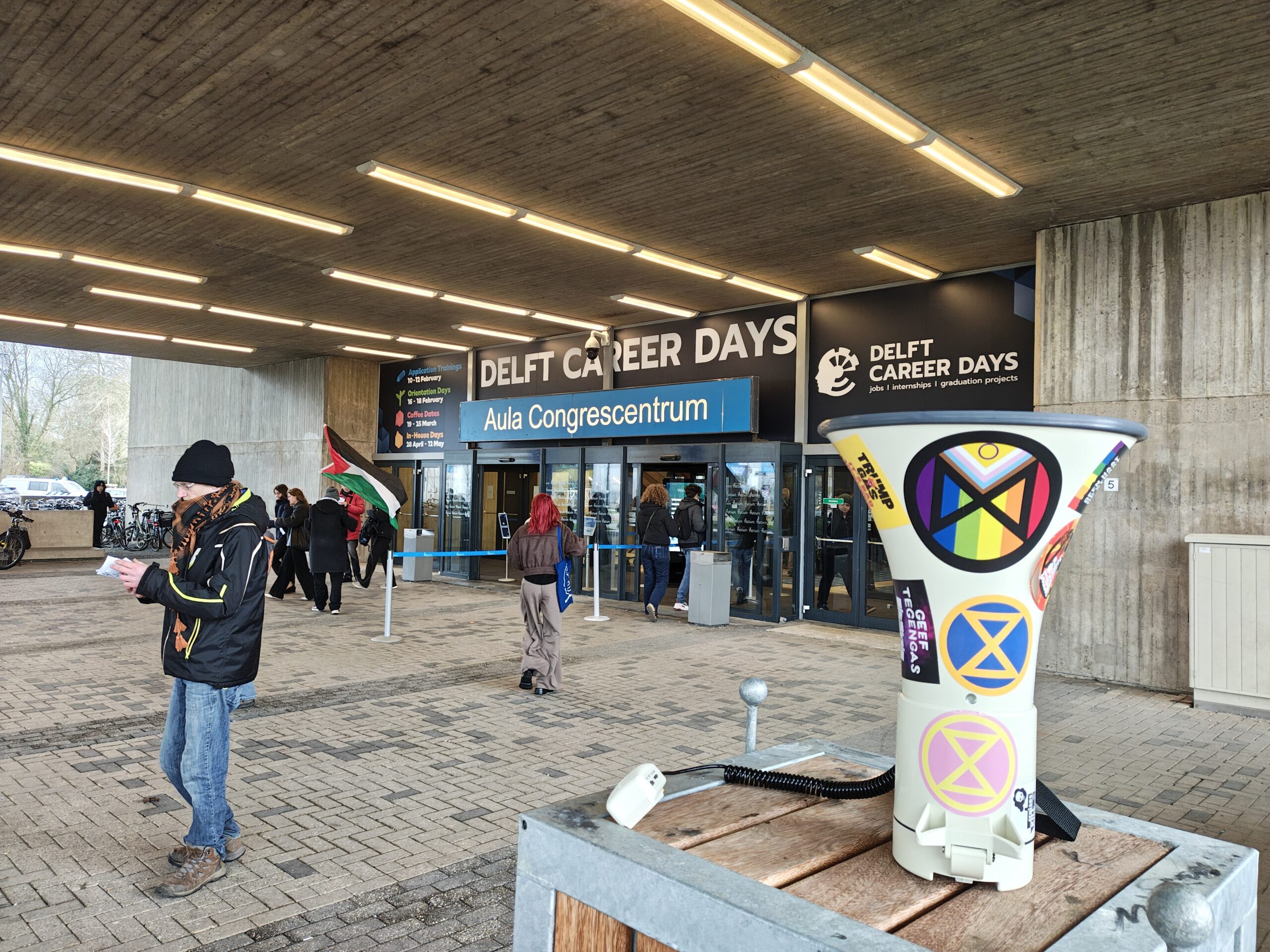
Noise protest in front of the Aula in February 2026. (Photo: Nikita Ham)
Delta recently discovered that, in the run-up to the Delft Career Days in February 2024, TU Delft passed on the names of five activists, at least one employee and students, to the police. The five were members of the climate action group End Fossil, which had announced an occupation. Although the group was in consultation with TU Delft’s Integral Safety department, the latter nevertheless passed on the names at the request of the police.

According to the Executive Board (CvB), this has only happened in this specific instance over the past two years. Sharing personal data during demonstrations is reportedly not standard practice, despite this being laid down in a joint agreement with the police. This agreement has been in place since 2015, as briefly mentioned in the 2015 annual report.
Not properly
TU Delft and the police have not yet disclosed the agreement. It is therefore difficult to verify exactly what the Executive Board means in its explanation, which was published on Monday 2 March on the intranet (for staff) and Brightspace (for students). In it, the Executive Board acknowledges that things went wrong in February 2024. It writes: ‘The provision of personal data must always comply with privacy legislation, such as the GDPR (General Data Protection Regulation, in Dutch Algemene Verordening Gegevensbescherming, or AVG).’
In this case, ‘the registration and information agreements have not been properly implemented, meaning that our working methods are not sufficiently verifiable’ writes TU Delft.
The extent to which external pressure led to these conclusions is unknown. The fact is that the local PvdA and GroenLinks political parties, the Dutch Data Protection Authority and the Mayor of Delft, Alexander Pechtold, have requested clarification.

The university promises to do better. It is having research carried out into ‘how we can improve the implementation of the covenant’. From now on, TU Delft will only share personal data with the police ‘after an explicit decision by the Executive Board’. If this happens, it will also be recorded centrally and checked annually.
Future of the agreement
In addition, TU Delft will enter into discussions with unspecified ‘stakeholders’ about the future of the agreement with the police and ‘the best way to structure it’. The starting point remains ‘that the safety of staff, students and visitors must be guaranteed while respecting privacy, freedom of expression and the right to demonstrate and debate’.
The board writes: ‘Some of our facilities require special safety measures, such as our research reactor and many of our laboratories. Additionally, while most of the site is private property, it is accessible to everyone. This is why safety is always a top priority for us, and we have made agreements with the police regarding this matter.’


Do you have a question or comment about this article?
[email protected]


Comments are closed.