Orientation weeks are under pressure, Bram the wolf disrupts a student hazing, and Harvard University is still negotiating with Trump. What happened in higher education this summer?
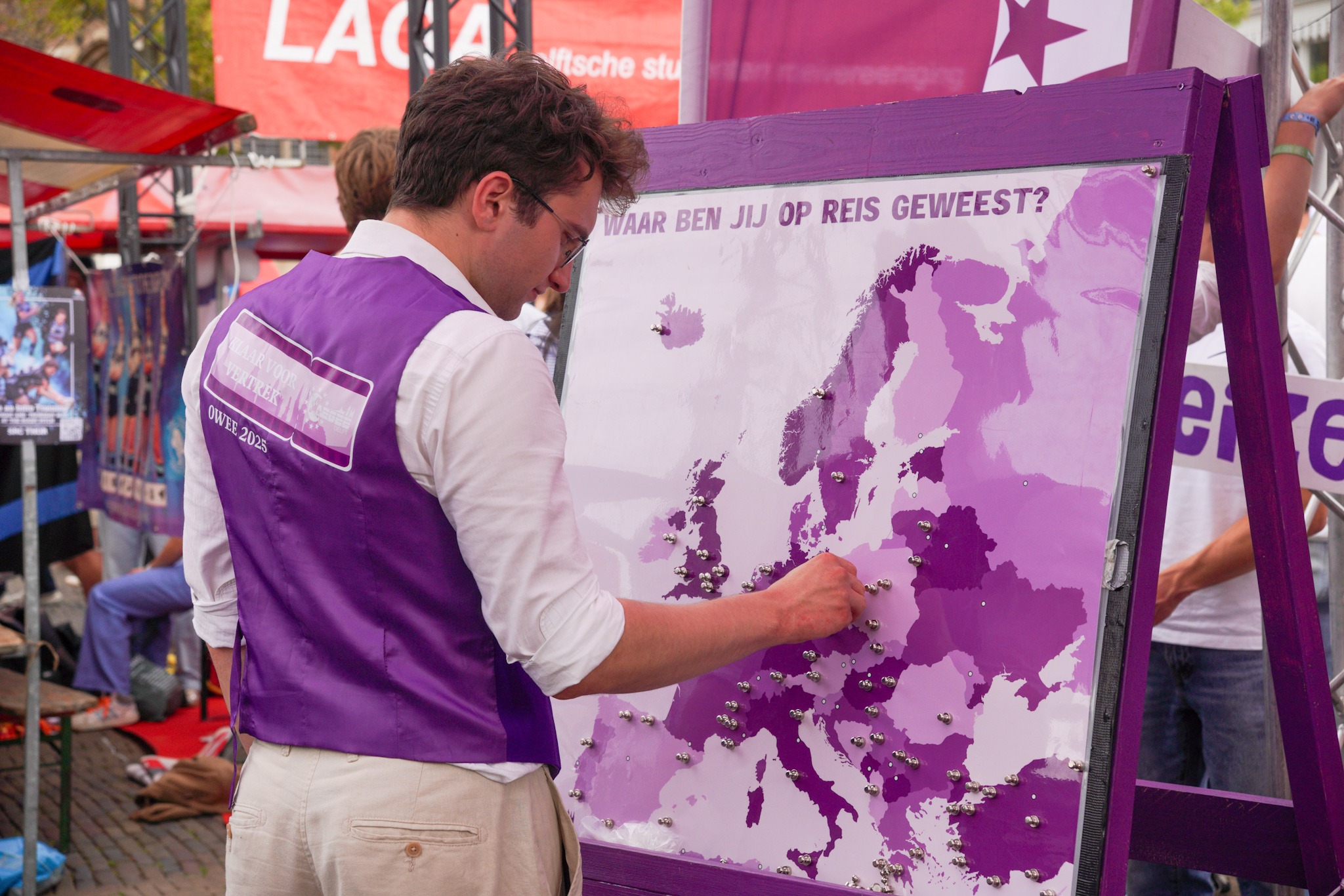
The 2025 information market in Delft. (Photo: Thijs van Reeuwijk)
Far-right student association at Leiden information fair…
Students from the far-right Groot-Nederlandse Studentenvereniging (Great Netherlands Student Association) were at this year’s introduction fair in Leiden to recruit new members. Not everyone appreciated this: an activist emptied a bucket of filth in front of the stand. The association also has a branch in Nijmegen, which led to a brawl at the information fair two years ago.
… one of whose members has been arrested for terrorism
One of the Nijmegen GNSV members was recently arrested on suspicion of preparing a terrorist attack. Weapons and ammunition were found in his possession. The 24-year-old man is also a member of the nationalist Geuzenbond. The association also wanted to recruit new members in Nijmegen this year, but that will not happen.
Introduction weeks under pressure…
During introduction weeks, new first-year students get to know their student city and all the possible associations and clubs they can join. But in some cities, the introduction week is in jeopardy due to a lack of funds. In Den Bosch, the party has already been cancelled.
…because who is going to get involved?
The introduction weeks are also attracting fewer volunteers, say the organisers. Studying is expensive and students have little time outside of their studies and part-time jobs. Lectures, sports tournaments and other activities are also under threat now that associations and clubs are finding it increasingly difficult to find students who are willing to serve on the board for a year. For example, the Batavierenrace from Nijmegen to Enschede was cancelled.
The student organisation ISO has sent a letter to the outgoing Minister of Education (together with a number of other student clubs). They want him to speak out about ‘the current shortage of board members’ and take action.
Four Utrecht fraternity members prosecuted for ‘banga list’…
The Public Prosecution Service is prosecuting four students from the Utrechtsch Studenten Corps for distributing a so-called banga list with photos and personal details of female students (and sexually suggestive comments). Last year, the list sparked yet another wave of outrage about the culture within traditional student associations. After such incidents, the associations usually lose their subsidies, although they often get them back a few years later.
…an Amsterdam fraternity is not allowed to recruit members…
Sometimes the misconduct also provokes resistance within the corps. A fraternity of the Amsterdam student corps (A.S.C./A.V.S.V.) is not allowed to recruit new members this year because of a ‘long history of misconduct and abuses’. It is not clear what was the last straw. The corps like to keep such matters behind closed doors.
… and wolf Bram disrupts hazing
The Amsterdam student fraternity wanted to take prospective members to the Utrechtse Heuvelrug for an introductory camp, or hazing. They had to leave because wolf Bram is roaming that area.
Dutch political arties launch election programmes…
National elections are coming up and various parties unveiled their draft programmes this summer. The VVD was the first and has come up with a short-study bonus, instead of a long-study penalty. The idea: you get a bonus if you graduate quickly. It is not clear who will pay for this.
The SP also has its draft programme ready and wants, for example, more Dutch-language bachelor’s degrees and a higher basic grant. NSC also wants much more Dutch-language higher education and wants to retain the basic grant in any case. So no major changes of course. Other parties are still coming up with their programmes and the calculations of the Dutch Central Planning Bureau (CPB) are also coming soon.
… and civil servants put possible cuts in a menu
With an eye on the elections and the subsequent negotiations on a new government, the outgoing Minister of Finance has already put his annual “reallocation list” online. This is a list of all kinds of possible cuts in all departments, without any judgement on their desirability.
In higher education, for example, you could double tuition fees, cut back on basic grants or make the student public transport card valid only on trains. That would save the treasury hundreds of millions of euros. And what if you stopped giving universities and colleges money for their master’s students? That would save more than a billion, officials estimate.
Trump still in dispute with Harvard…
The American government is still negotiating with Harvard University on a deal to end all lawsuits. President Trump says the university is not doing enough to combat anti-Semitism on campus.
Despite calls from thousands of students and staff not to cooperate with Trump’s attempt at “blackmail”, the New York Times believes that Harvard does indeed intend to pay the government 500 million dollars. In return for that money, Harvard will retain its autonomy and receive billions in research funding. Brown University has already made such a deal and is paying “only” 50 million, while Columbia did so a week earlier for 200 million.
… but censorship is already kicking in
A Harvard publisher blocked a special edition of an education magazine because it was about Gaza. Apparently, any protest against Israel’s violence and even any comment in an academic journal is a sensitive issue for the White House.
Dutch MP Schoof is welcome in Twente…
Outgoing Prime Minister (and Twente native) Dick Schoof will open the academic year at the University of Twente on 1 September, but not everyone is happy about it. Students and staff have called on the university board in an open letter to find someone else. After all, Schoof is partly responsible for the “biggest attack on higher education this century”. The board of directors has promised to respond to the letter after the holidays.
… and Israel remains welcome in EU research
Just before the summer, European government leaders discussed the possibility of excluding Israel from Horizon, the EU fund for research and innovation. But at the end of July, the European Commission came up with a more limited proposal: it only wants to (temporarily) exclude innovative Israeli companies that conduct research that could lead to military applications. So universities and research institutions are off the hook for now. The proposal still has to be voted on.
HOP, Bas Belleman and Olmo Linthorst

HOP
Hoger Onderwijs Persbureau
Do you have a question or comment about this article?
[email protected]


Comments are closed.