

Three Chinese astronauts are stuck in their space station after a possible crash with space debris. What can be done about space debris? Jeannette Heiligers (Astrodynamics & Space Missions) is working on a solution. “Space debris is one of the biggest challenges in aerospace.”
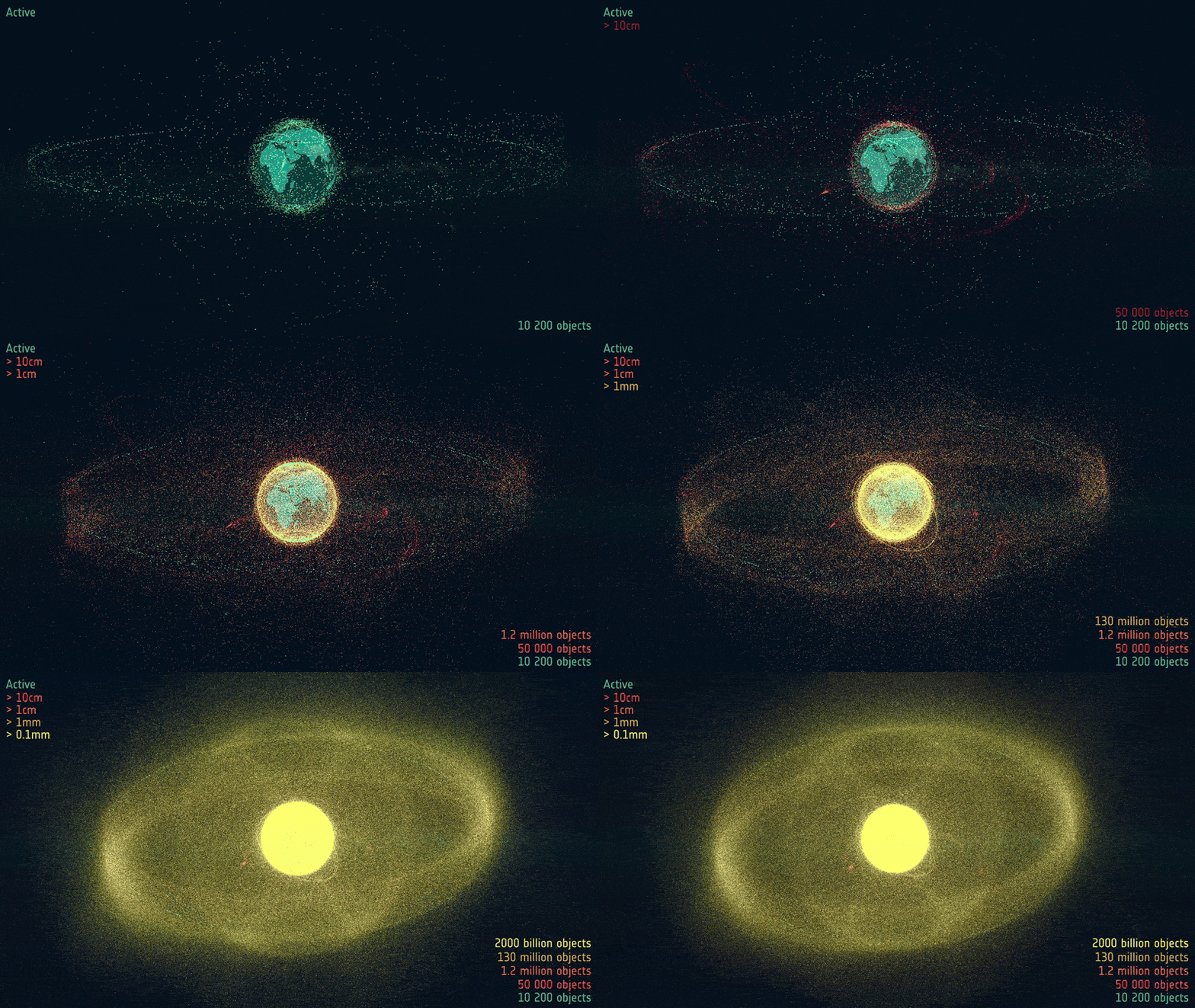
Space debris. (Number of objects in orbit: Active satellites: 10 200 objects (blue), > 10cm: 50 000 objects (red), > 1 cm: 1.2 million (orange), > 1 mm: 130 million objects (yellow orange), > 0.1 mm: 2000 billion objects (yellow)). Credit: ESA
What is space debris?
“Space debris is a collective term for all the human related rubbish that is floating around in space. It ranges from old satellite parts to whole satellites that no longer work to tiny broken fragments. All that rubbish, which is not under control anymore, is called space debris.”
How big is the problem?
“Space debris is one of the biggest challenges in aerospace. There are areas where satellites regularly have to maneuver to avoid a collision. For example, ISS, the international space station, has to move out of the way of space debris about twice a year.”
There are now Chinese astronauts stuck on the Tiangong space station, probably because of space debris. Astronauts in the ISS also have to preventively get into capsules to return to earth more often. Is space debris a growing problem?
“Yes, the problem is growing. This is partly because of enormous constellations like Starlink which launch thousands of satellites into space every year. So the space around the earth is getting more crowded and we are thus creating more space debris. It is a snowball effect. At a certain point, there may be so many crashes that certain areas around the earth will simply not be usable anymore. And these are places that we badly need. Not only for crewed spaceflight, but also for all sorts of satellite applications that we use in our daily lives for safety, communications, weather forecasting and so on.”
What can be done?
“At the very least, avoid creating new space debris. For example, ESA has a rule that when you launch a mission, you must prove that you will remove the satellite from orbit within five years. In other words, you bring the satellite to a place where it will never present problems. These are called ‘graveyards’ which move towards earth so that the satellite eventually incinerates in the atmosphere. There are also initiatives to clear up space debris: active debris removal. For example ClearSpace1 which is a mission that will remove one piece of space debris (the Proba1 satellite was launched in 2001, Eds.). It is a good initiative, but given the amount of space debris it is neither sustainable nor cost-effective to launch a satellite and use it to clear up just one piece of debris. I was awarded a NWO (Dutch Research Council) Vidi scholarship to deal with space debris in a more sustainable way, using a new way of satellite propulsion: a solar sail. This is a sort of very big, very thin sail that you attach to a satellite. The sunlight that hits it generates power which the satellite uses to move endlessly in space. With this technique you can use one satellite to not remove just one, but perhaps five or 10 pieces of space debris.”
When will this solar driven clean-up team start work?
“SWEEP (Space Waste Elimination around Earth by Photon Propulsion), the project I’m working on, has two-and-a-half years to go, so I want to understand and examine everything by 2028 so I can write a proposal for a test mission. It could actually fly three to five years later. If everything goes as well as I think and hope, a mission would take another five years before it starts. This may not be a solution that will be in operation tomorrow, but I am definitely positive about the chances of success.”

Science editor
Edda Heinsman
Do you have a question or comment about this article?
[email protected]


Comments are closed.