
On Monday morning 9 February, trains between The Hague and Delft were cancelled and traffic lights were not working due to a power outage. Is this an isolated incident or a sign of an increasingly vulnerable electricity grid? Power grid professor Peter Palensky: “Overall, the infrastructure is improving.”
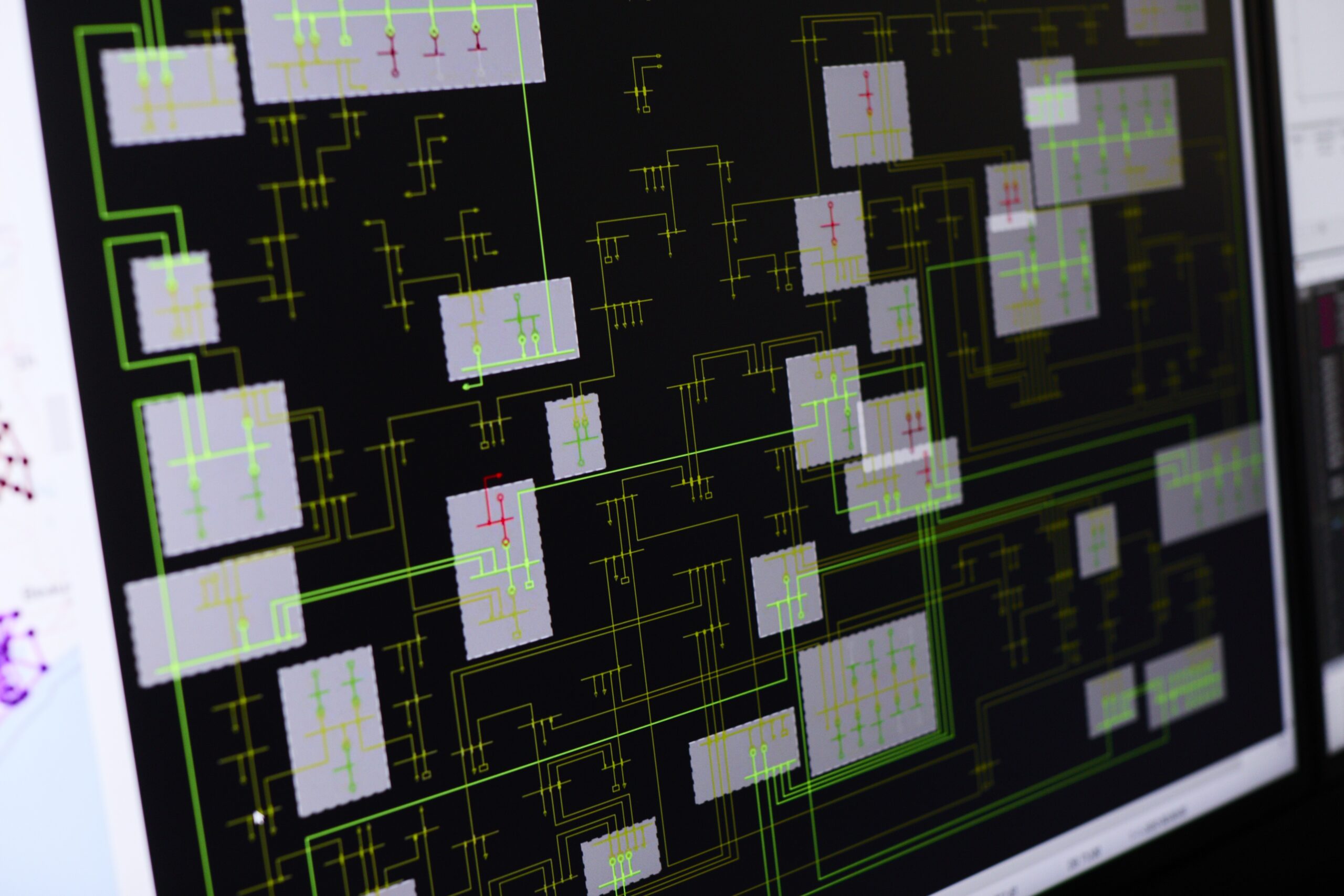
A powergrid. (Foto: Willem de Kam)
He himself had no problem getting to work due to the power outage on Monday morning 9 February, because power grid researcher Peter Palensky (Faculty of Electrical Engineering, Mathematics and Computer Science) lives around the corner from the campus. But several of his colleagues were delayed by the train.
What caused the power outage? “At the TenneT substation in Wateringen, there was a switch from one transformer to another. This caused a voltage drop lasting a few seconds, with all the consequences that entailed.” Palensky follows these kinds of incidents with interest. “Our research group consists of two hundred people. They work on self-healing systems, for example. So that if something breaks down, there is no complete blackout. So I think it is important to know what happened here, so that I can get inspiration on how to improve things.”
Structured in a very hierarchical way
Self-healing systems? “The electricity grid is currently structured in a very hierarchical way. That makes it efficient and easy to operate. But we now have a completely different ecosystem. Electricity is generated in a more distributed way, for example by people with their own solar panels on their roofs. And there is also a greater need for resilience in light of geopolitical challenges, which calls for a new design for the electricity grid. Electricity that can flow through multiple routes, with more backup systems, and a little more intelligence. This could lead to a more robust energy system.”
‘The total number of hours of power outages is not increasing’
Should we expect more power outages in the future? “Overall, the infrastructure is improving. The total number of hours of power outages is not increasing if you look at the figures. It is a reliable, high-quality network. What could happen, however, is sabotage. Think of Berlin, for example. But that is a political and social problem, not a fault in the infrastructure. Although a self-healing grid could help there too.”
There is a lot going on around the power grid. What are the biggest challenges? “We are electrifying every corner of our society – industry, transport, heating – away from gas, for good reason. But the network was never built for that. We never thought that cars or boilers would become electric. The grid operators now have careful plans in place, but they face many challenges. There is a demand for workers, from the planning department to people who dig trenches. And there are problems with the supply chain. For example, if you order a transformer now, you won’t get it in three months, but in three years, if you’re lucky.”
Post-mortem analysis
Palensky and his colleagues are working on the UTOPYS programme, for which they recently secured a large NWO grant. The aim is to create models, also known as digital twins, of an energy network. “You can then fast-forward to the future to make decisions about expansion, for cyber security analyses, or to perform a post-mortem analysis of a fault like the one we had today.”
Creating these kinds of models takes years. Why does it take so long? “It’s not something you can buy in a shop; we really have to invent it. We need all the parameters from the companies and all their models and all their networks, and we have to update them daily. It’s not easy.”
Science editor
Edda Heinsman
Do you have a question or comment about this article?
[email protected]


Comments are closed.