The new Dutch cabinet has been sworn in. What do the plans outlined in the coalition agreement mean for scientific research in the Netherlands? The economists at the Netherlands Bureau for Economic Policy Analysis took a closer look.
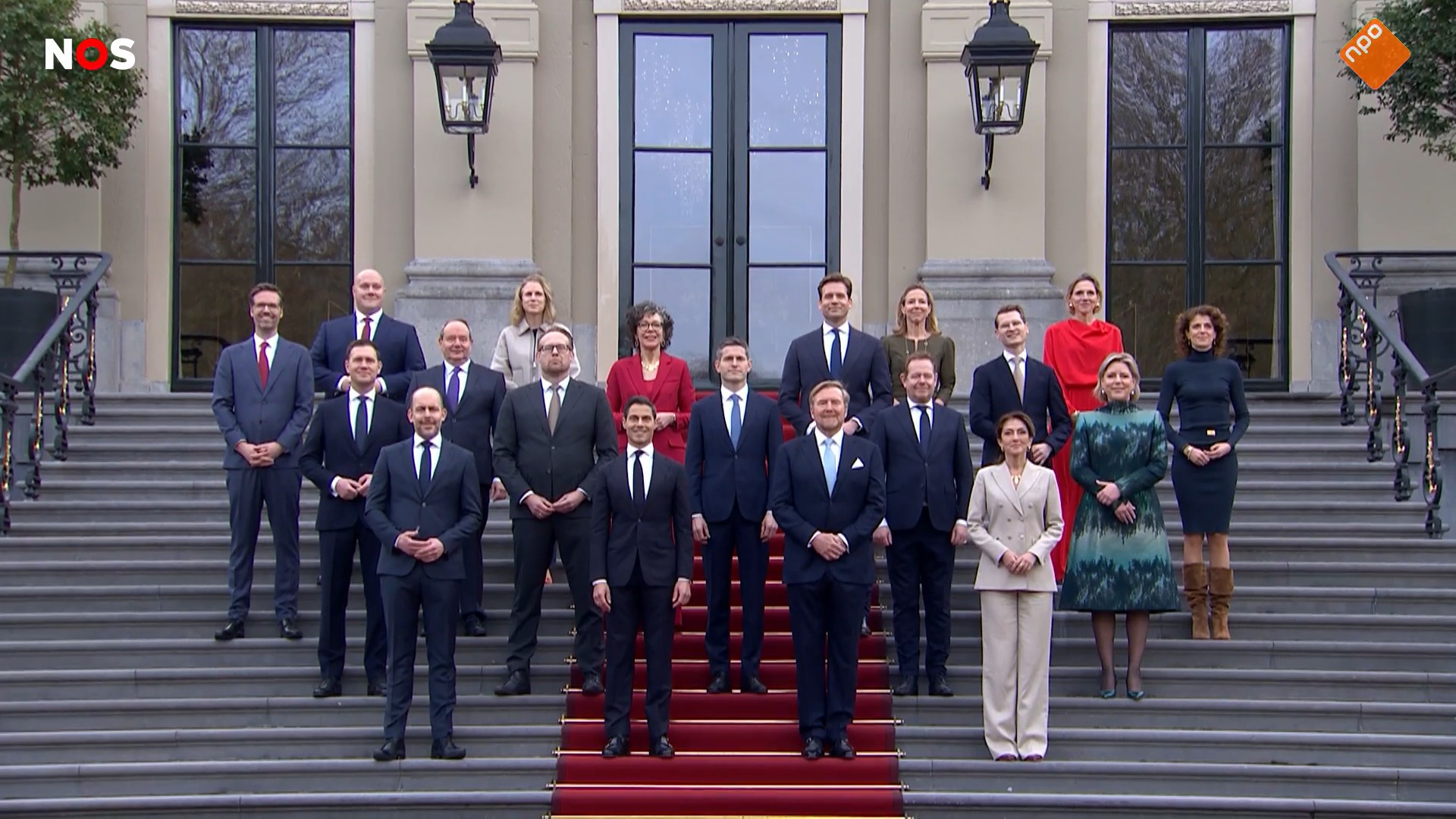
The Jetten cabinet on the palace steps. (Screenshot: NOS)
The CPB has analysed the new minority government’s coalition agreement. Its report, published last Friday, also covers education and research.
The three parties aim to increase spending on education and research by 1.5 billion euros. As the incoming cabinet prepares to take office, more details are starting to emerge about how this additional funding will be distributed.
There are plans, for example, to spend 100 million euros on school fruit – a significant portion of the budget. Most of the other budget changes, such as the proposed increase of the basic grant for students living away from home, are still uncertain.
According to the CPB, funding for higher education institutions is set to increase, and the Research and Science Fund for universities will be reinstated. The costs of these plans remain unclear.
Extra spending on science
Nevertheless, the CPB’s analysts have already drawn one clear conclusion. “The coalition agreement encourages scientific research to a limited extent.”
This is because the extra spending on science is partly offset by cuts in other areas, such as funding for teaching hospitals, which may have to scale back their research and training activities.
In addition, the incoming government is earmarking funds for a National Disruptive Innovation Agency, whose mission will be to foster technological breakthroughs. “However, this will only provide a temporary boost to innovation”, warns the CPB.
Defence resources
The coalition also has other plans when it comes to knowledge and innovation. Private sector R&D, for instance, is expected to benefit from a recently announced technology strategy. Promising news, but the CPB remains cautious.
While the purse strings are being loosened for the defence budget, it remains to be seen how this money will be spent. Some of the additional defence resources will be allocated to education and innovation, but here too no exact figures are known yet.
Improve quality of education
And what about the education budget? The CPB predicts that the increased expenditure will improve the quality of education, “thereby increasing the likelihood that pupils and students will obtain a basic qualification or a higher professional education or university degree”.
From an economic perspective, however, some of the budget plans are less effective. Take free fruit in schools, for example. Currently, most parents pay for their children’s lunchtime fruit snacks themselves. The same principle applies to the basic student grant: in the absence of government support, students will look elsewhere for sources of income.
The CPB sees a similar problem with regard to ‘lifelong learning’, or continuing education and training. There is a chance that the government will end up paying for educational activities that people would have pursued regardless.
English-language programmes
The CPB makes no mention of the course change on English-language instruction, which will be subject to fewer restrictions under the new government. The previous government wanted to introduce stricter rules for English-language programmes, which meant that some programmes would have to switch back to Dutch, but these plans have been scrapped.
As a result, higher education institutions will find it easier to recruit foreign students again. Some of these students choose to stay in the Netherlands after graduating, which should help to ease labour market shortages.
The new government will be officially sworn in on Monday. Riannne Letschert will be appointed as education minister, after having overseen the coalition negotiations between the party leaders.
HOP, Bas Belleman/Translation: Taalcentrum-VU
How do you predict the return on knowledge?
Regarding the government’s plan to invest an additional 1.5 billion euros in education and research, the CPB can only say that this will increase “human capital”. The forecasting agency believes this will be good for the economy, but without a model, it does not know exactly how good.
At the request of the Ministry of Education, SEO Economic Research has now mapped out how much scientific knowledge already exists about the return on education and research. Outgoing Minister Moes sent the results to the Dutch Parliament last Tuesday. SEO believes it will be possible to build preliminary model within two years.
Side note
SEO does make one side note. Education not only generates economic growth, but also has other social benefits. The Dutch Education Council has already listed these benefits. Some examples include healthier behaviour, a lower risk of illness, fewer teenage pregnancies and less crime.
SEO therefore believes that predicting economic growth should be a stepping stone to a broader model. There also needs to be more insight into the value of education and research for what is referred to as ‘broad prosperity’. (HOP, Olmo Linthorst)
HOP
Hoger Onderwijs Persbureau
Do you have a question or comment about this article?
[email protected]


Comments are closed.