Support open science where possible, do not publish in fraudulent journals and be cautious with AI. The Royal Netherlands Academy of Arts and Sciences (KNAW) is presenting a draft version of the new integrity code. Everyone can now respond to it.
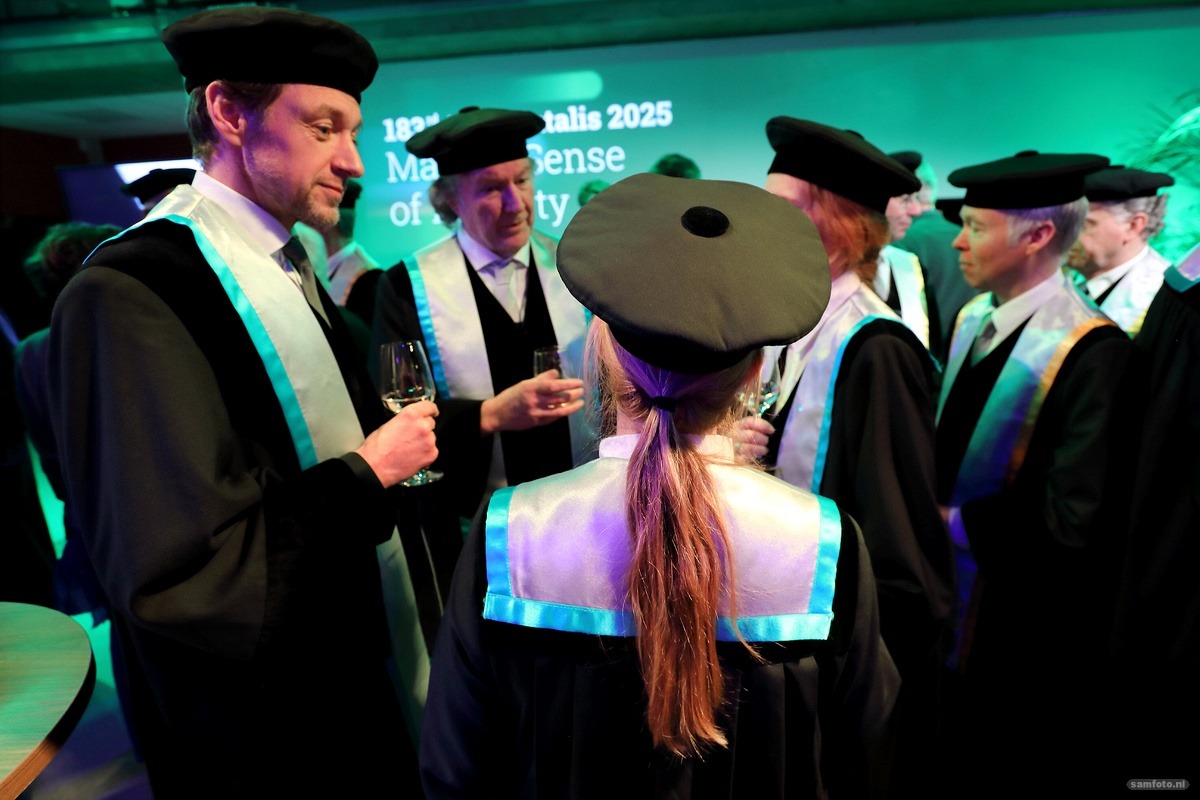
The Dies Natalis 2025. (Photo: Sam Rentmeester)
The current code of conduct for scientific integrity is only seven years old. Nevertheless, a committee of the Royal Netherlands Academy of Arts and Sciences (KNAW) decided last year that it was already in need of an update.
The committee felt that the code should be better aligned with the practice-oriented research conducted by universities of applied sciences. Other than that, the use of artificial intelligence has exploded, and due to all the international tensions, knowledge security is also much higher on the agenda.
Politics
And then there was COVID-19. The draft code (in Dutch) published by the KNAW states that ‘political involvement’ in scientific research has increased in recent years. One might think of the lockdowns, which raised the question for many: are scientists or politicians deciding that schools should close?
Scientists must be clear when they engage in politics. And politicians should not interfere with the fact-finders. ‘In order to properly fulfil their respective social roles, all parties must respect each other’s individuality and autonomy,’ according to the advice in the new code. Moreover, scientists not only provide facts, but also ‘methodological doubt’.
Malicious journals
The enormous growth in malicious ‘scientific’ journals has also led to a new addition: do not cooperate with them. Only publish in journals that apply serious quality controls.
The KNAW is asking everyone to contribute to the draft text. This can be done until 20 October
Based on the integrity code, anyone who has doubts about the integrity of scientific research can file a complaint with the university. Appeals can be lodged with the Netherlands Board on Research Integrity (LOWI).
The KNAW asks everyone to contribute to the draft text. Comments are welcome until 20 October. Is the language correct? Is anything missing? Have the consequences of a rule been properly considered?
Open science and AI
Some new additions sound cautious. For example, the principle of open science has been included in the code. Data and publications must be freely accessible ‘where possible and desirable’.
The new code of conduct for generative artificial intelligence has also been deliberately formulated in broad terms, the authors explain in an accompanying note. Developments are happening fast, and the new rules must also be compatible with technology that does not yet exist.
One rule: ‘Only use technologies whose functionality is known and scientifically validated.’ That will not be easy. AI programmes such as ChatGPT, Perplexity and Mistral generate texts and images themselves based on statistics and data. It is difficult to say what the sources were or how the data was processed.
Another rule: ‘Do not use technologies that hinder compliance with the principles and standards in this code.’ The drafting committee calls on employers to help their employees with this and to develop guidelines.
The new code of conduct applies to both universities and university of applied sciences. Higher professional education is not mentioned explicitly, except when it comes to the funding of chairs and lectureships, for example. This must be transparent, it says.
The new version of the Dutch Code of Conduct for Scientific Integrity should come into effect at the beginning of next year.
HOP, Olmo Linthorst
HOP
Hoger Onderwijs Persbureau
Do you have a question or comment about this article?
redactie@hogeronderwijspersbureau.nl


Comments are closed.