

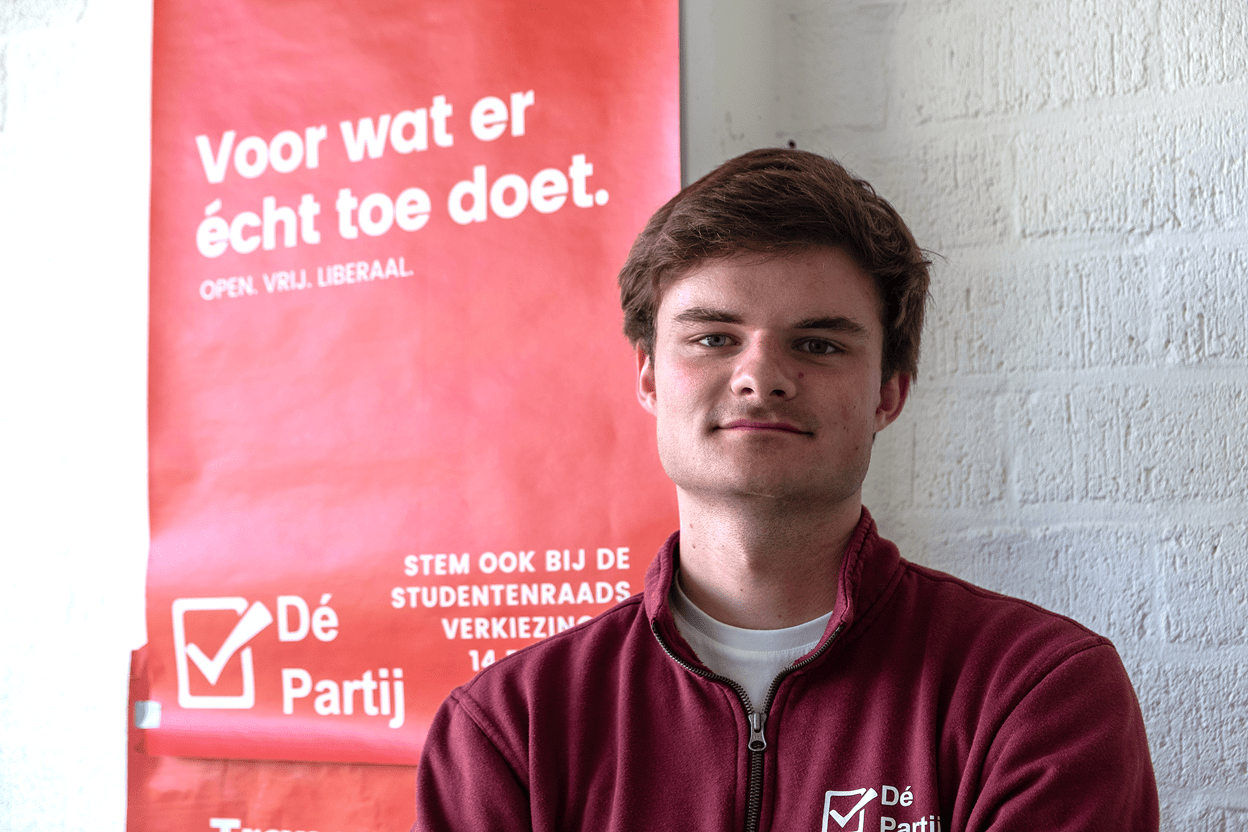
For three years, Koos Meesters was a Student Council member representing Dé Partij. Now that he has obtained his bachelor’s degree, he is calling it a day. He will not be running in the elections in early June. Nevertheless, developments at TU continue to concern him. “The Executive Board makes policy, but each Dean is a sort of king of their own little kingdom, interpreting that policy in their own way.”
(Photo: Sinan Keleştemur)
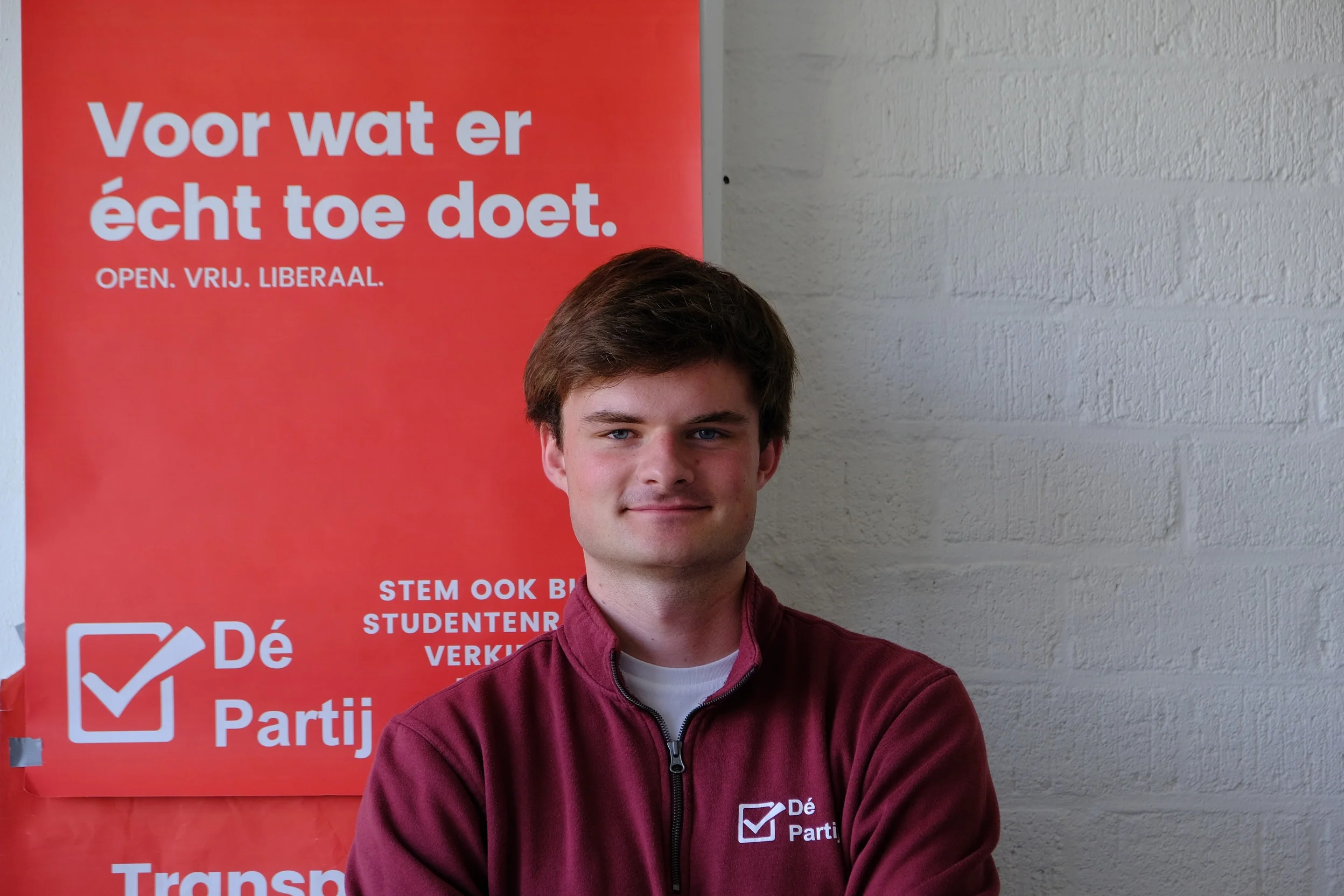
There are clear signs of life having been lived in Dé Partij’s faction room. A half-hung party flag dangles by the window, and on one of the three desks lies a partly completed puzzle. Opposite it sits Koos Meesters, Dé Partij’s one-man representative on the Student Council. “My two housemates, who support me, are not here very often anymore. And I’m not here nearly every day either.”
‘Here’ is building 26b, an office block located between the Science Centre and The Green Village. On the ground floor is an old exam hall; under fluorescent lights and suspended ceilings on the second floor sits the entire Student Council, alongside Meesters the factions of ORAS and Lijst Bèta.
Soon, the latter two will once again have the place to themselves. After three elections – each time Dé Partij won one seat, and each time Meesters occupied it – the faction leader is stepping down: he will not be running in the elections on 2, 3 and 4 June. And so Dé Partij will also cease to exist, for Meesters has no successor. In the cosy, student-like office, the one-man faction and council veteran reflects on his time as a student council member.
Why have you decided to stop?
“I’ve just finished my bachelor’s at Technology, Policy and Management, and I want to do a master’s abroad. Besides, after three years I’ve seen enough.”
Members of Lijst Bèta and ORAS only stay for one year. So, you’ve been there by far the longest.
“Yes, but that also has its advantages. Almost all boards in Delft are new in September, and the handover is always somewhat difficult. So, the standard tactic of TU Delft is to take all the difficult decisions at the beginning of September, so they can more or less steamroller those new boards. The fact that I’ve been around longer really helps.”
‘Why are there different parties if they cannot criticise each other?’
Why did you decide to found Dé Partij three years ago?
“Because I felt that Lijst Bèta and ORAS did not express their opinions. They had views but did not voice them. They had no election programmes. Moreover, they censored themselves, for example with a ban on negative statements about other parties, so everything would remain pleasant. But why have different parties if they cannot criticise each other? We rewrote those rules when I entered the council. And by now both ORAS and Lijst Bèta also have election programmes.”
That sounds like a serious motivation. Yet your first campaign seemed quite light-hearted to me, with the main point being to bring back the meatball sandwich. Why choose that?
Meesters smiles. “We needed 900 votes, so we had to come up with something. The meatball sandwich symbolised the restriction of freedom of choice in various areas. But above all, we had something people could talk about. ‘Dé Partij, that’s the one with the meatball sandwich, right?’ is better than ‘Dé Partij, who are they?’”
Did the meatball sandwich come back?
“It is now rotated through the menu.” Laughing: “But I can’t say I was directly the driving force behind that. The soccer associations had a bit more say in that.”
‘A better idea is to make a 0.0 beer cheaper than a normal one’
And what about the alcohol policy, that other key point of Dé Partij?
“That has remained unchanged. Reducing alcohol consumption is a logical goal, because alcohol is bad for your health. But the current policy – no alcohol on campus before 5 PM – makes it harder to bind people to the community. If you don’t live in Delft, you’re already on the train home when the faculty bar opens. A better idea is to make a 0.0 beer cheaper than a normal one.”
Is social cohesion among students in Delft under pressure?
“Yes. Among people who live in Delft, student culture is quite stable. But more and more TU students cannot find housing. That makes it harder for study associations, for example, to fill first-year committees. And TU Delft says: not our problem, that’s the responsibility of the municipality.”
Back to the Student Council. How does it function?
“It is supposed to adjust the Executive Board’s policy where necessary. In a soft way – through discussions, lobbying and persuasion – which does not always yield much. Or in a hard way – by making demands and taking action. That is also difficult, because the Executive Board is only legally required to meet us twice a year. All other contact we have with staff is essentially a favour. So, if we really push hard, they can close the door. A member of the Executive Board once literally said that to me.”
Which board member said that?
“It was a confidential conversation, so I’d rather not say. It’s more about the prevailing culture than one person’s opinion. At one point we were talking about activism and legal action. And then that person said: ‘you are not supposed to start lawsuits’. If you’re afraid of that, it says a lot about your own organisation. It felt a bit like a discouragement strategy. The message was: don’t be an activist and don’t start lawsuits. Without even asking me whether I intended to do so.”
‘Council members have become more willing to show their teeth’
Are you allowed to start legal proceedings as a council member?
“We are the only body within TU Delft with the right to initiate a dispute, first with a disputes committee and then, if necessary, in court. But it doesn’t make you popular. It is our most powerful instrument.”
Has it ever been used?
“No. Together with the other council members, we have threatened to use it twice. That was enough to bring the other party to their senses. You shouldn’t do it too often, because then it becomes an empty threat.”
What was the dynamic between the council and the Executive Board before you joined?
“At that time, boundaries were not tested, out of fear of damaging the good relationship. Negative advice was hardly ever given, even when the council had many reservations about a policy document. From the beginning I said to the others: ‘we can also give negative advice’. That made council members – also those from ORAS and Lijst Bèta – more willing to show their teeth.”
So, you’re a bit of a thorn in the side. How do you approach that in practice?
“When I can, I invoke the law. The statute book and parliamentary intent statements give the Student Council the right to participation, and we must use that. It’s a good pressure tool, because it frightens people, since many things here do not go by the rules.”
‘They twist themselves into all sorts of shapes to avoid giving that information’
Which rules do you mean?
“Firstly, internal rules. The Executive Board makes policy, but each Dean is a sort of king of their own little kingdom, interpreting that policy in their own way. There is no department that checks whether policy is implemented uniformly and enforces it. As a result, one faculty may have all kinds of entry requirements for courses, and another none at all.
But also the Higher Education Act, which prescribes that the Executive Board must provide the Student Council with information, is not always followed. For example, last year we received a list of budget cuts, but without stating how much money each measure would yield. When you ask for figures, the answer is: we don’t know ourselves. So, either they make policy without financial information, or they systematically do not write things down to sideline the Student Council. Both possibilities are worrying.”
Do you have another example?
“Yes. Take the accounts of the sports and culture complex. We have often asked for them, also officially. But the response was alwats very evasive. First I asked for the financial annual report, then they sais I need to ask specific questions. So, I sent a list of 120 questions, based on which I could reconstruct the report. Then they said that was not a serious request.
So, they twist themselves into all sorts of shapes to avoid giving that information, while it would have saved so much time and effort if they had simply shared the report three years ago. Moreover, they have a legal obligation to provide us with that information.”
How do you explain that lack of transparency?
“I don’t know. I don’t understand what they are afraid of. There is also structurally little transparency about collaborations with Israeli universities, which only creates more distrust. It may be that they simply do not have the information. But they don’t say that, because it would seem incompetent. Sometimes there is very little sense of humanity. Also, in the initial responses to the report on social safety, and to the agreement with the police. Those are defensive and formal.”
‘I hope the new administrators can bring change’
Are you afraid that this legal oversight will disappear when you leave?
“I think that more assertive style of discussion will remain. But that also depends on the new council members. If no one feels like playing hardball, it won’t happen. I hope the new administrators can bring change: they are younger, two of them are women, and one does not have an academic background. That is a good thing, because it brings an outside view.”
Suppose your master abroad does not work out and you stay in Delft. Would you stand for election again?
“Maybe I’ll be back here in a year, haha. I always say to anyone who wants to change something at TU Delft: get ten signatures and you can stand for election. If you have a good story, you can easily get onto the council. Apparently, even with a meatball sandwich.”
Response from the Executive Board member
The identity of the former Executive Board member whom Meesters says he spoke to is known to the editors. When asked, this person responded by email to Meesters’ anecdote. The administrator remembers the conversation but does not recognise the portrayal described.
The former board member did speak with all new factions about possible styles, ‘ranging from cooperative to more trade-union-like to activist’. The administrator emphasises that their ‘preferred style is cooperation’, but that Student Council members are free to choose how they operate.
According to the administrator, they did not try to discourage Koos from being activist or from starting legal proceedings but did outline that ‘choices (on both sides) will lead to certain behaviour on the other side’.
Starting legal proceedings is everyone’s right, the former board member stresses, and crucial for the functioning of the rule of law. The administrator says they ‘never considered speaking less frequently with the Student Council, even when we fundamentally disagreed’, and emphasises that ‘the university benefits when participation bodies are taken seriously’.
Do you have a question or comment about this article?
nathan@hgsmk.nl


Comments are closed.